


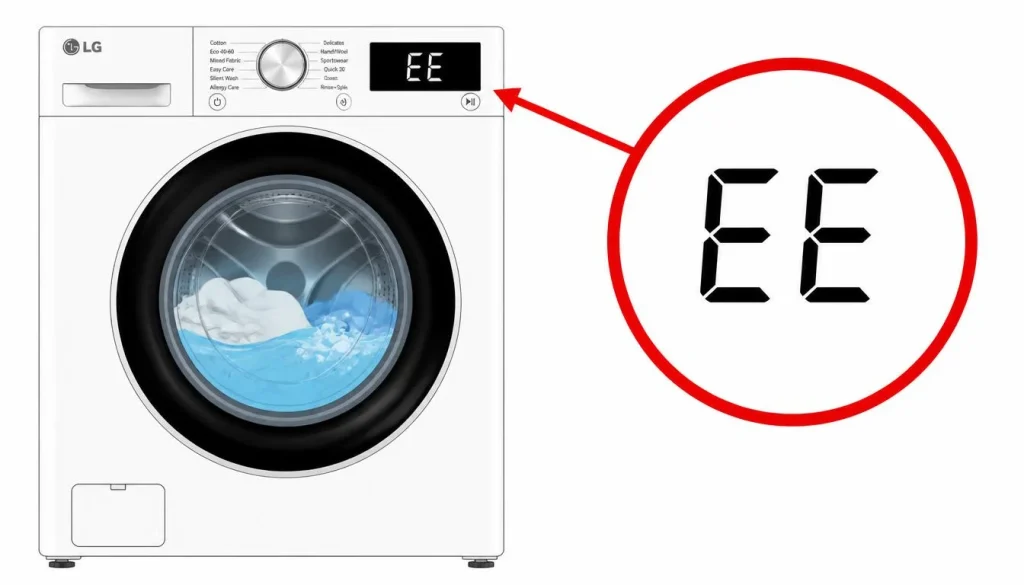
LG Washer EE Error: EEPROM Fault Causes and Fixes
When “EE” appears on the display of an LG washer, the machine is reporting a memory fault on its main control board. The LG washer EE error indicates that the EEPROM—the small memory chip that stores the washer’s program data and settings—is not working properly. The machine has detected that the memory it relies on to run cycles correctly is unstable or unreadable, and it stops operation rather than running a cycle with corrupted data.
This definition matters because it separates the LG washer EE error from water, drainage, door, and motor codes. The EE code is a board-level electronic fault. It is not caused by a kinked hose, an unbalanced load, or a clogged filter. The component involved is the EEPROM on the electronic control board, and the condition is that this memory has become unstable or damaged.
This article explains what the LG washer EE error means, why the EEPROM matters, the causes that lead to the fault, the reset procedure that should be attempted first, the repair options when the reset fails, how EE differs from other electrical and board codes, and the circumstances in which the control board must be replaced.
?What Does the LG Washer EE Error Mean
The LG washer EE error means that the EEPROM is not working properly. HomeServe’s LG error code guide defines EE directly: the EEPROM, described as a sort of microchip, isn’t working properly. Vietnamese repair guidance describes the same condition: the EE error appears when the EEPROM memory—an electronic memory used to store program data—becomes unstable or damaged, and this component is important because it ensures the washer operates correctly and stores the necessary settings.
The EEPROM is a small non-volatile memory chip on the main control board (PCB). It holds the washer’s program code, model-specific parameters, and user settings. Unlike temporary memory, it retains its contents when power is removed. When this chip becomes unstable or loses its data, the control board cannot reliably execute cycles, and the LG washer EE error is displayed as a protective response.
This is why the code is classified as an electronic fault rather than a mechanical one. The washer’s motor, pump, valves, and sensors may all be functional, but the board that coordinates them cannot trust its own memory. The machine stops because continuing to run with corrupted program data could produce unpredictable behavior.
Why the EEPROM Fails
The EEPROM is a solid-state component, but it is not immune to failure. Repair guidance identifies several conditions that lead to the LG washer EE error.
Moisture and corrosion are common contributors. Humidity in the control board area, condensation, or a leak that reaches the electronics can degrade the chip’s connections and internal storage. A washing machine operates in a wet environment, and the control board is protected but not sealed against every moisture scenario.
Power surges and unstable supply can damage the EEPROM. Voltage spikes, brownouts, or repeated power interruptions can corrupt the chip’s data or damage its write circuitry. Repair guidance lists unstable power supply as a cause of the EE error.
Component failure over time is another path. Electronic components have finite lifespans, and the EEPROM’s memory cells can wear out after many write cycles. A board that has served for years may develop a memory fault without any external trigger.
Manufacturing defects or solder joint failure can also produce the condition. A weak solder joint on the EEPROM’s pins can create an intermittent connection, and the board may read the memory as unstable even though the chip itself is intact.
The LG washer EE error therefore points to the EEPROM and its connection to the board, but the underlying reason can be environmental, electrical, or simply age-related.
The Reset Procedure: What to Try First
Before concluding that the control board has failed, the LG washer EE error should be addressed with a power reset. This is the standard first step in repair guidance, and it is the only user-level action that can resolve the code without parts.
Unplug the washer from the power outlet and wait 5 to 10 minutes. This allows the control board’s capacitors to discharge completely and forces the EEPROM to be re-read from a clean power state. If the memory instability was caused by a transient electrical condition, the reset may allow the board to initialize correctly.
After the waiting period, plug the washer back in and start a short cycle. If the LG washer EE error does not return, the fault was temporary and the machine can be used normally. If the code reappears immediately or during the first cycle, the EEPROM or its connection has a persistent fault, and the reset has done its diagnostic job by ruling out a transient glitch.
Repair guidance also recommends checking the power supply as part of this step. Ensuring that the outlet voltage is stable and that the washer is not sharing a circuit with high-draw appliances helps rule out an external electrical cause.
What to Do If the Reset Does Not Clear EE
If the LG washer EE error returns after the reset, the remaining causes are component-level. The EEPROM is on the main control board, and the board is not a user-serviceable part in LG’s documentation.
Repair guidance identifies two repair paths. The first is to repair or reprogram the EEPROM if the chip itself is intact but its data has been corrupted. This requires specialized equipment and is typically performed by a board-level repair service rather than a general appliance technician. The second is to replace the main control board, which is the standard solution when the EEPROM or its supporting circuitry has failed.
The LG washer EE error does not have a user-level component fix. Unlike a drain filter that can be cleaned or a hose that can be straightened, the EEPROM is soldered to the control board and requires electronics expertise to service. Attempting to remove or replace the chip without the correct tools and procedure risks further damage to the board.
EE vs. Other Electrical and Board Codes
LG’s error library contains several codes that relate to electrical and electronic conditions, and distinguishing them helps confirm the diagnosis.
The PF code indicates a power failure: the washer lost power during a cycle, and the code appears when power returns. PF is about the power supply, not the memory.
The Ed5 code is described as a PCB communication failure: the PCB does not work due to poor communication. Ed5 is about communication between boards, while EE is about the EEPROM’s own operation.
The nE and nF codes relate to Wi-Fi connectivity, not to the main control memory. The LE code relates to motor harness connectors, not to the EEPROM. And the tE code relates to the thermistor, a temperature sensor, not to memory.
This distinction matters because the LG washer EE error is specific to the EEPROM. Cleaning a drain filter, checking a door latch, or resetting a Wi-Fi module does not address EE. The relevant component is the memory chip on the control board.
Quick Reference Table
| Symptom or Situation | What It Means | What To Do |
|---|---|---|
| EE appears on the display | EEPROM on the control board is not working properly | Unplug the washer for 5–10 minutes and restart |
| EE clears after the reset | Transient memory or power condition | Monitor for recurrence |
| EE returns after the reset | Persistent EEPROM or board fault | Board repair or replacement is required |
| PF appears instead | Power failure during a cycle | Restart the cycle; check the power supply |
| Ed5 appears instead | PCB communication failure | Service diagnosis of board communication |
| Power supply is unstable | Possible cause of EEPROM corruption | Stabilize the supply or use a surge protector |
| Moisture is present near the control board | Possible corrosion of the EEPROM circuit | Dry the area and have the board inspected |
| EE reappears after board replacement | Replacement board may have a programming issue | Service must verify the board configuration |
Frequently Asked Questions
?What does the LG washer EE error mean
The EE error indicates that the EEPROM—the memory chip on the main control board that stores program data and settings—is not working properly. The machine detects that its memory is unstable or unreadable.
?Is the LG washer EE error a water or drainage problem
No. EE is an electronic memory fault. It is not caused by a kinked hose, a clogged filter, or an unbalanced load, and the troubleshooting for those conditions does not apply to EE.
?Can I fix the LG washer EE error myself
The only user-level step is a power reset: unplug the washer for 5–10 minutes and restart it. If the code returns, the EEPROM or its connection on the control board has a persistent fault, and the board requires repair or replacement.
?Why does the reset need to be 5–10 minutes
The waiting period allows the control board’s capacitors to discharge completely, forcing the EEPROM to be re-read from a clean power state. This rules out a transient electrical condition before concluding that the chip has failed.
?What causes the EEPROM to fail
Moisture and corrosion, power surges and unstable supply, normal component aging, and solder joint failure are the common causes. The LG washer EE error can also appear after a power interruption that corrupts the chip’s data.
?Is EE the same as PF
No. PF indicates a power failure during a cycle, and the code appears when power returns. EE indicates that the EEPROM itself is not working properly. PF is about the power supply; EE is about the memory.
?What is the difference between EE and Ed5
Ed5 indicates that the PCB does not work due to poor communication between boards. EE indicates a fault in the EEPROM’s own operation. Ed5 is a communication issue; EE is a memory issue.
?When should I call a technician for the LG washer EE error
Call a technician if the EE code returns after the 5–10 minute power reset. The EEPROM is soldered to the control board, and repairing or replacing it requires board-level expertise. A persistent EE code is a service matter, not a user-repair matter.
When the LG Washer EE Error Requires Service
The LG washer EE error requires service when the power reset does not clear the code. At that point, the fault is in the EEPROM or its connection on the main control board, and the repair options are board-level.
Service is the appropriate next step because the EEPROM is not an accessible component. It is mounted on the control board inside the washer’s cabinet, and repairing or replacing it requires opening the machine, accessing the board, and in most cases replacing the board itself. This work is beyond the scope of user maintenance, and attempting it without the correct procedure risks damage to the board and to the washer’s other electronic systems.
Repair guidance describes the two service paths. If the EEPROM’s data is corrupted but the chip is intact, a board-level repair service may be able to reprogram it. If the chip or its supporting circuitry has failed, the main control board must be replaced. A qualified technician can determine which path applies after testing the board.
It is important not to continue running cycles repeatedly when the LG washer EE error persists. The code indicates that the board cannot trust its own memory, and continued operation with corrupted program data can produce unpredictable cycle behavior. Addressing the fault promptly protects the washer and the laundry.
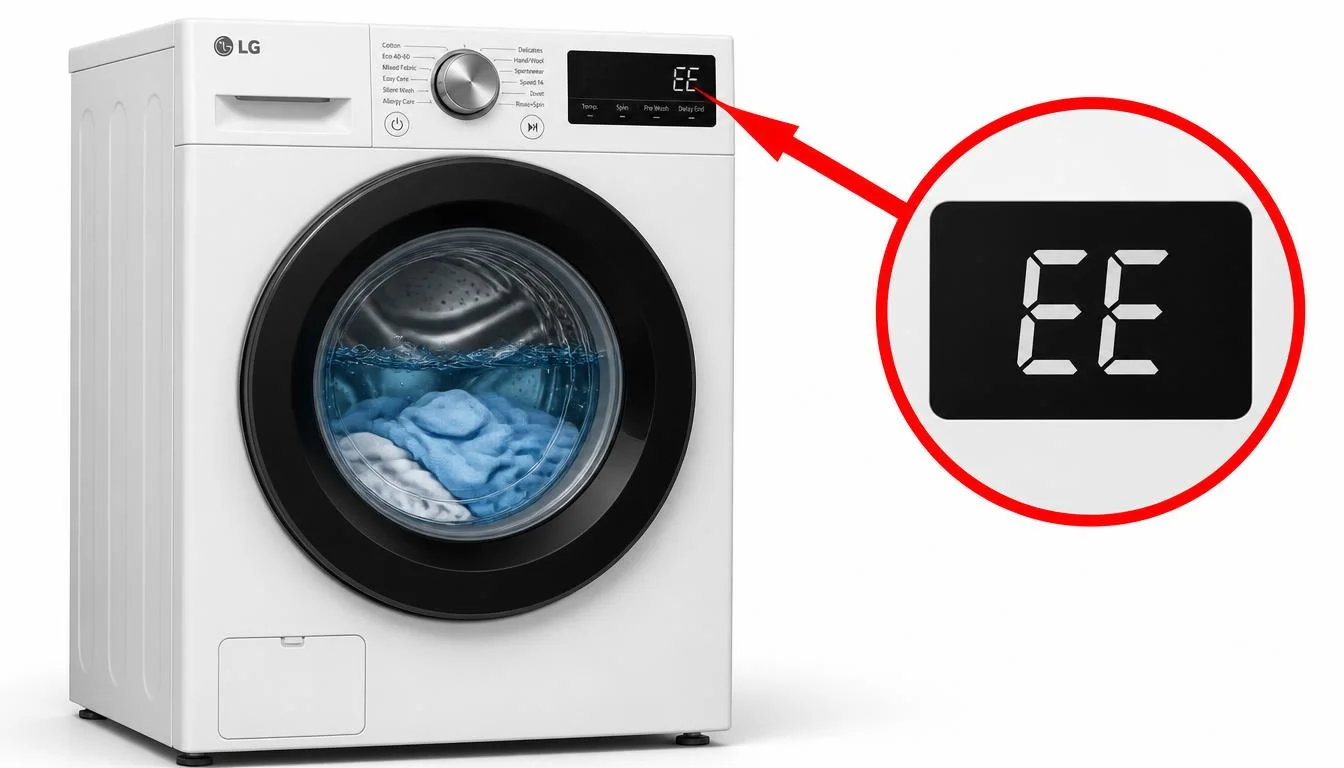
Preventing the LG Washer EE Error
The LG washer EE error cannot always be prevented, because EEPROM failure can be age-related. However, the causes that repair guidance identifies point to practical protective measures.
Stabilizing the power supply is the most direct preventive step. Using a surge protector or a voltage regulator for the washer’s circuit reduces the risk of power surges and brownouts damaging the EEPROM or corrupting its data. Repair guidance lists unstable power supply as a cause of the EE error, and protecting the board from voltage spikes addresses that cause.
Keeping moisture away from the control board is another measure. Fixing leaks promptly, avoiding excessive humidity around the washer, and ensuring that the machine is not exposed to standing water reduce the corrosion risk that can degrade the EEPROM’s connections. If the washer is in a damp area, improving ventilation helps.
Avoiding repeated power interruptions during a cycle also supports board longevity. Interrupting a wash mid-cycle does not directly damage the EEPROM, but repeated unclean shutdowns can contribute to data corruption over time.
