


LG Refrigerator FF Error: Freezer Fan Ice Fix
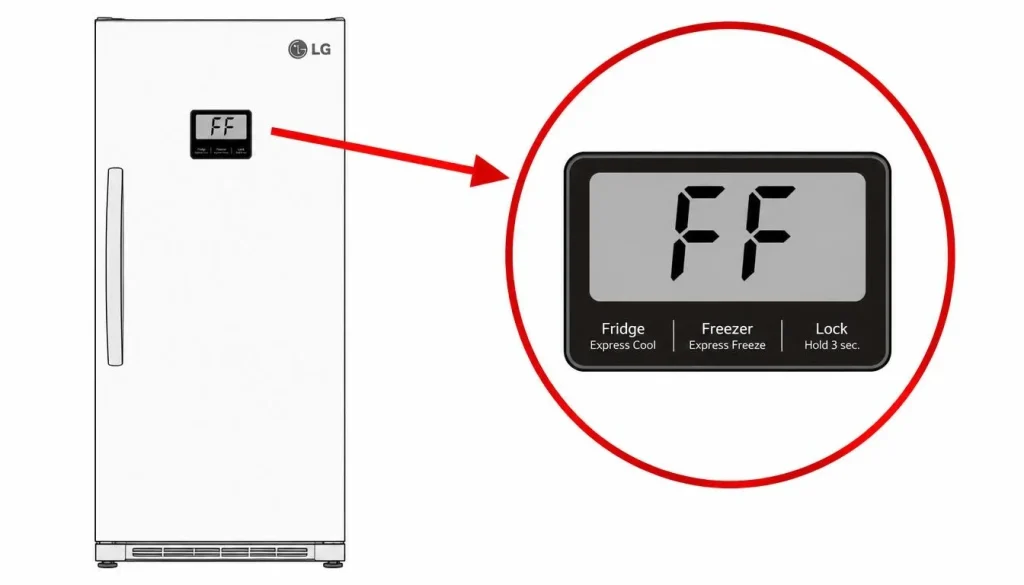
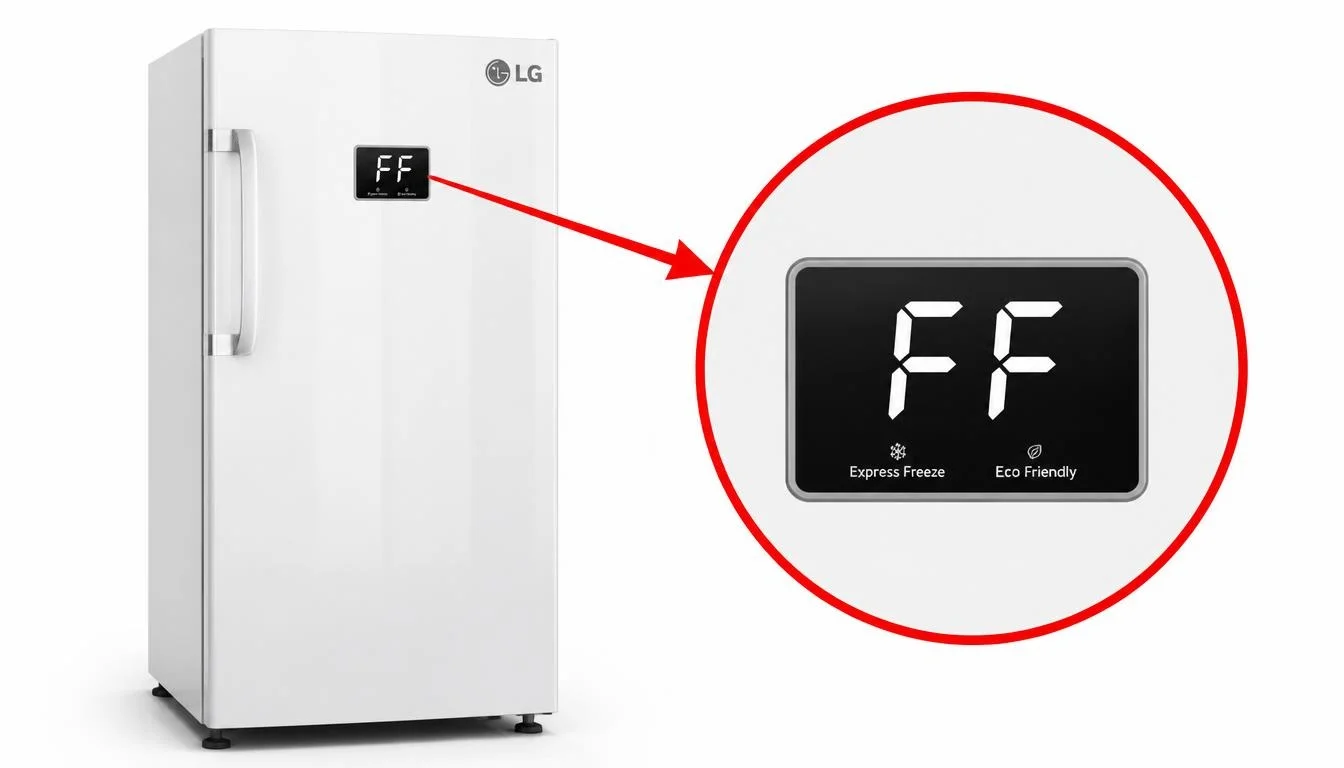
When “FF,” “Er FF,” or “E FF” appears on an LG refrigerator display, the machine is reporting that its freezer fan motor is no longer operating properly. LG’s official troubleshooting documentation states that an ER(E) FF/rF appearing on the LED lamp display window is an error code for an abnormality in the freezer/refrigerator compartment fan motor, and that a product inspection is necessary. The newer LG guidance describes the condition in practical terms: an Er FF, E FF, or F error code appears when ice or frost buildup prevents the freezer fan motor from turning.
The LG refrigerator FF error is therefore an airflow and temperature-management fault, not a sensor fault like FS or rS, and not a defrost-heater fault like dH. The freezer fan is the component that circulates cold air through the compartment and the evaporator. When ice or frost locks the fan blades, the air stops moving, the freezer cannot hold a consistent temperature, and the control board posts FF rather than continuing to run a fan that is physically stuck.
This distinction matters because the response to the LG refrigerator FF error is a specific user-level thawing procedure that LG documents in detail. Unlike some sensor codes that route the user directly to service, FF has a documented home remedy: unplug the unit, leave both doors fully open, and allow the ice to melt naturally for at least 24 hours. If the ice melts and the fan turns freely, the code clears. If the code returns after a complete thaw, the fan motor or its circuit is the likely fault, and LG directs the user to service.
This article explains what the LG refrigerator FF error means, how it differs from the rF code, the causes LG identifies, the complete six-step thawing procedure in LG’s documented order, the safety warnings that accompany it, the conditions in which the code requires service, the food-safety considerations that apply during a multi-day thaw, and the practical habits that reduce the chance of ice locking the fan again.
?What Does the LG Refrigerator FF Error Mean
The LG refrigerator FF error means that the freezer fan motor is not operating normally. LG’s older documentation states this directly: the ER(E) FF error occurs when the freezer fan motor does not operate normally. The newer documentation confirms the same definition and adds the mechanism: an Er FF, E FF, or F error code appears on the refrigerator display when ice or frost buildup prevents the freezer fan motor from turning.
The code is specific to the freezer fan. LG distinguishes it from the rF code, which occurs when the refrigerator compartment fan motor does not operate normally. This means the LG refrigerator FF error points to the freezer side of the cooling system, while rF points to the fresh-food side. The two codes share the same family and the same general troubleshooting approach, but the component they identify is different.
The fan motor itself is the component that moves air across the evaporator coils and through the freezer compartment. When the fan turns, cold air circulates and the compartment reaches its set temperature. When ice or frost locks the blades, the air stops, and the temperature regulation fails. The LG refrigerator FF error is the control board’s notification that the airflow it expects is not occurring.
FF vs. rF: What the Difference Tells You
The LG refrigerator FF error is not the only fan-related code in LG’s refrigerator error library. The rF code is its counterpart on the fresh-food side, and distinguishing the two helps confirm which compartment is affected.
The FF code points to the freezer fan motor. The ice or frost that blocks the freezer fan typically forms around the evaporator in the freezer compartment, and the fan that moves air across that evaporator is the one that locks.
The rF code points to the refrigerator compartment fan motor. In dual-evaporator models, the fresh-food section has its own evaporator and its own fan, and the rF code indicates that the fresh-food fan is not operating normally.
The practical implication is that a user who sees FF should focus the thawing procedure on the freezer compartment, while a user who sees rF should focus on the fresh-food compartment. LG’s thawing procedure instructs the user to open both doors wide, which addresses both compartments simultaneously, but the code itself tells the user which fan is the primary suspect.
Causes of the LG Refrigerator FF Error
LG’s documentation identifies the causes of the LG refrigerator FF error in practical terms, and the causes fall into two categories: ice blockage and fan motor failure.
Ice or Frost Buildup Around the Fan Motor
The primary cause is ice or frost buildup around the fan motor. LG states that the error can occur when the fan motor is locked due to ice (frost) around the fan motor. The newer documentation explains why this happens: ice or frost buildup around the motor usually prevents the fan from turning, and this often happens when the freezer contains too much food or the door is not fully closed, allowing outside air to enter.
The mechanism is straightforward. Moisture from the air inside the freezer condenses on the cold evaporator coils and freezes. Over time, the frost layer grows until it reaches the fan blades. If the fan is running when the frost reaches the blades, the ice can lock the fan in place, and the motor cannot turn. The control board detects that the fan is not rotating and posts the LG refrigerator FF error.
Too Much Food in the Freezer
LG identifies overloading the freezer as a contributing condition. When the freezer contains too much food, air cannot circulate freely, and the evaporator can become iced over more quickly. The restricted airflow also means the fan has to work harder, and the ice that forms is more likely to reach the blades.
A Door That Is Not Fully Closed
A door that is not fully closed is the second contributing condition. When the door remains slightly open, outside air enters the freezer, bringing moisture that condenses and freezes. A door seal that is worn or a door that is blocked by an item can produce the same effect. The frost that forms from the incoming moisture is the material that eventually locks the fan.
A Failed Fan Motor
The fourth cause is a failed fan motor. If the fan motor itself has failed—whether through an open winding, a seized bearing, or a control-board output fault—the fan will not turn even after the ice has been removed. This is the cause that remains when the thawing procedure does not clear the code, and it is the point at which LG directs the user to service.
The Six-Step Thawing Procedure for the FF Error
LG’s newer documentation provides a detailed six-step procedure for resolving the LG refrigerator FF error when the cause is ice blockage. The steps are sequential, and each one prepares for the next.
Step 1: Move the Food
The first step is to move the food. LG instructs the user to move the food to another refrigerator or an insulated cooler to keep it from spoiling. This step is necessary because the refrigerator will be unplugged for at least 24 hours, and the food cannot remain in a warming compartment during that time.
Step 2: Place Towels on the Floor
The second step is to place dry towels on the floor around the refrigerator to catch any water as the ice melts. The thawing ice will produce water, and the towels protect the flooring from damage.
Step 3: Unplug and Defrost the Refrigerator
The third step is to unplug the refrigerator and leave the freezer and refrigerator doors fully open for at least 24 hours to allow the ice or frost to melt naturally. LG adds a seasonal qualification: defrosting may take approximately one day in summer and up to three days in winter, depending on the amount of ice. The older documentation specifies the same durations: one day during summer and three days during winter to melt the ice around the fan motor.
The duration matters. A partial thaw that leaves ice deeper in the fan housing can allow the LG refrigerator FF error to return as soon as the refrigerator is restarted. LG’s instruction is to leave the doors open for the full period, not until the visible ice disappears.
Step 4: Dry the Interior
The fourth step is to dry the interior. Once the ice has completely melted, LG instructs the user to wipe away any remaining moisture inside the refrigerator with a dry towel. Removing the residual moisture prevents it from refreezing around the fan when the refrigerator is restarted.
Step 5: Plug the Refrigerator Back In
The fifth step is to plug the refrigerator back in. LG states that the user should plug the refrigerator back in and allow 24 to 48 hours for the compartments to reach their normal operating temperatures. The refrigerator does not cool instantly after a long thaw; the compressor and fans need time to bring the compartments back to their set points.
Step 6: Still Need Help
The sixth step is the service escalation. If the issue persists after following the steps above, LG states that the user can get further support through the LG Chatbot on the website or by requesting a technician visit. This is the point at which the LG refrigerator FF error is no longer an ice-blockage problem, and the remaining cause is the fan motor or its circuit.
The Five-Minute Reset as a First Diagnostic Step
Before the full thawing procedure, LG’s older documentation describes a shorter reset step for the LG refrigerator FF error. The instruction is to unplug the power cord of the product or trip the exclusive circuit breaker to reset the power, and then reuse it after about 5 minutes.
The purpose of the 5-minute reset is to allow the control board to discharge and re-initialize. If the FF code was caused by a transient electronic glitch rather than a physically locked fan, the reset may clear the code and the fan may resume normal operation.
The reset is diagnostic as well as corrective. If the LG refrigerator FF error clears after the reset and does not return, the cause was transient. If the code returns immediately, the fan is likely still locked by ice, and the full thawing procedure is the appropriate next step. The reset does not replace the thaw when ice is present; it only rules out a control glitch before the user commits to a multi-day defrost.
Safety Warnings LG Attaches to the Thawing Procedure
The LG refrigerator FF error thawing procedure involves water, electricity, and a refrigerator that will be open for days. LG attaches specific warnings to the procedure, and the most important one concerns how the ice is melted.
LG’s FAQ addresses the question directly: “Can I use a hair dryer to melt the ice faster?” The answer is explicit: do not use a hair dryer. The heat could warp plastic parts inside the refrigerator or create a fire hazard. The instruction is to leave the doors open and allow the ice to melt naturally.
This warning is not boilerplate. A hair dryer concentrates heat in a small area, and the plastic interior components of a refrigerator are not designed for that temperature. The plastic can deform, and the electrical components near the fan and evaporator can be damaged. The natural thaw is slower, but it is the method LG specifies because it is safe for the appliance.
The other practical safety consideration is the water. The melting ice will produce a significant volume of water, and LG’s instruction to place towels on the floor is the minimum preparation. If the refrigerator has a drain pan or a defrost drain, the user should check that it is clear and positioned to catch the water.
When the FF Error Requires Service
The LG refrigerator FF error requires service under the condition LG states clearly: the code persists after the thawing procedure has been completed. LG’s older documentation states that if the same symptom and the same inspection code are repeated, it is necessary to have the product checked by an LG service technician for an accurate diagnosis. The newer documentation states that if the issue persists after the steps, the user should request a technician visit.
Service is the appropriate next step because the remaining cause is the fan motor itself or its control circuit. The fan motor is an internal component, and diagnosing whether the motor has failed, whether its wiring has an open or short circuit, or whether the main board is not supplying power requires access to the freezer evaporator area and electrical testing. LG’s public documentation does not describe a user-level procedure for these checks, and it routes the persistent code to service.
The food-safety dimension also influences the service decision. LG’s older documentation states that if the user is concerned about the food stored inside, it is recommended to have the product checked by a service technician by requesting service. This means the user does not have to complete the full thaw if the food risk is unacceptable; a service request is appropriate at that point.
Food Safety During the Thaw
The LG refrigerator FF error thawing procedure requires the refrigerator to be unplugged for at least 24 hours, and in winter for up to three days. LG’s first preparation step addresses this: move the food to another refrigerator or an insulated cooler to keep it from spoiling.
If a backup refrigerator or cooler is not available, the food safety concern becomes the deciding factor. LG’s older documentation provides the alternative: request service for an accurate diagnosis if the food cannot be protected during the thaw. A service visit may be able to address the ice blockage or the fan motor without the multi-day power-off, depending on the diagnosis.
After the thaw and the restart, LG states that the compartments need 24 to 48 hours to reach their normal operating temperatures. During that recovery period, the food should not be returned to the refrigerator until it has reached a safe temperature. The LG refrigerator FF error affects the appliance and the food, and the thawing procedure is not a no-risk operation for the contents.
Preventing Ice From Locking the Fan Again
LG’s documentation identifies the conditions that lead to the LG refrigerator FF error, and each condition suggests a preventive habit.
Keeping the freezer from becoming overfilled is the most direct measure. LG states that ice buildup often happens when the freezer contains too much food. Leaving space for air to circulate allows the evaporator to operate at a consistent temperature and reduces the frost that forms.
Ensuring that the freezer door closes fully is the second measure. LG identifies a door that is not fully closed as a cause of outside air entering and moisture freezing. Checking that nothing blocks the door, that the gasket is clean and sealing, and that the door closes firmly prevents the moisture intrusion that feeds the frost.
Completing the full thaw duration when the code first appears is the third measure. LG specifies at least 24 hours and up to three days in winter. A shortened thaw can leave ice in the fan housing, and the LG refrigerator FF error can return as soon as the fan tries to start. Following the full duration is the difference between a one-time code and a recurring one.
Quick Reference Table
| Situation or Observation | What It Means | LG’s Documented Action |
|---|---|---|
| FF appears on the display | Freezer fan motor is not operating normally | Unplug for 5 minutes to reset, then observe |
| FF returns after the 5-minute reset | Ice may be locking the fan | Proceed to the full thawing procedure |
| Ice or frost is visible around the fan area | Fan is physically blocked | Unplug, open both doors, and thaw for at least 24 hours |
| Thawing in summer | Ice melts more quickly | Allow approximately one day |
| Thawing in winter | Ice melts more slowly | Allow up to three days |
| Code clears after the thaw and does not return | Ice blockage was the cause | Dry the interior, restart, and allow 24–48 hours for cooling |
| Code returns after a full thaw | Fan motor or circuit fault is likely | Request service through LG Chatbot or a technician visit |
| rF appears instead of FF | Refrigerator compartment fan fault | Follow the same thawing approach for the fresh-food side |
| Food cannot be moved for the thaw | Thawing may risk the food | Request service instead of unplugging for days |
| User considers using a hair dryer | Accelerated melting method | Do not use a hair dryer; allow natural thawing |
Frequently Asked Questions
?What does the LG refrigerator FF error mean
LG states that the ER(E) FF error occurs when the freezer fan motor does not operate normally, and that the code is an error for an abnormality in the freezer/refrigerator compartment fan motor. The newer guidance adds that ice or frost buildup around the motor usually prevents the fan from turning.
?Is FF the same as rF
No. FF points to the freezer fan motor, and rF points to the refrigerator compartment fan motor. They share the same error family and the same general troubleshooting approach, but they identify different fans.
?What causes the LG refrigerator FF error
LG identifies ice or frost buildup around the fan motor as the primary cause, and notes that this often happens when the freezer contains too much food or the door is not fully closed, allowing outside air to enter. A failed fan motor is the cause that remains when the thaw does not clear the code.
?Can I fix the LG refrigerator FF error myself
In many cases, yes. LG documents a complete six-step thawing procedure: move the food, place towels on the floor, unplug the refrigerator and open both doors for at least 24 hours, dry the interior, plug it back in, and allow 24–48 hours for cooling. If the code returns after a full thaw, LG directs the user to service.
?How long does the thaw take for the FF error
LG specifies at least 24 hours, with approximately one day in summer and up to three days in winter depending on the amount of ice.
?Can I use a hair dryer to melt the ice faster
No. LG’s FAQ states that a hair dryer should not be used because the heat could warp plastic parts inside the refrigerator or create a fire hazard. The instruction is to leave the doors open and allow the ice to melt naturally.
?What should I do with my food during the thaw
LG instructs the user to move the food to another refrigerator or an insulated cooler to keep it from spoiling. If the food cannot be moved, LG’s older guidance offers the alternative of requesting service for an accurate diagnosis.
?What should I do after the ice melts
Wipe away any remaining moisture inside the refrigerator with a dry towel, plug the refrigerator back in, and allow 24 to 48 hours for the compartments to reach their normal operating temperatures.
?Why does FF return after a thaw
A returning FF code indicates that the fan motor or its circuit has a fault that is not caused by ice blockage. LG states that if the same symptom and the same inspection code are repeated, the product should be checked by an LG service technician.
?What causes the ice to build up in the first place
LG states that ice buildup often happens when the freezer contains too much food or the door is not fully closed, allowing outside air to enter. Keeping the freezer from becoming overfilled and ensuring the door seals properly reduce the likelihood of recurrence.
?Does FF affect the refrigerator compartment
The FF code is specific to the freezer fan. The rF code covers the refrigerator compartment fan. LG’s thawing procedure opens both doors, but the code identifies the freezer side as the primary suspect.
?When should I call a technician for the FF error
Call for service if the FF code persists after a complete thaw of at least 24 hours (or up to three days in winter), or if the food cannot be protected during the thaw. LG’s guidance is to request service through the LG Chatbot or a technician visit.
