


LG Dishwasher AE Code: Leak Detection and Fixes
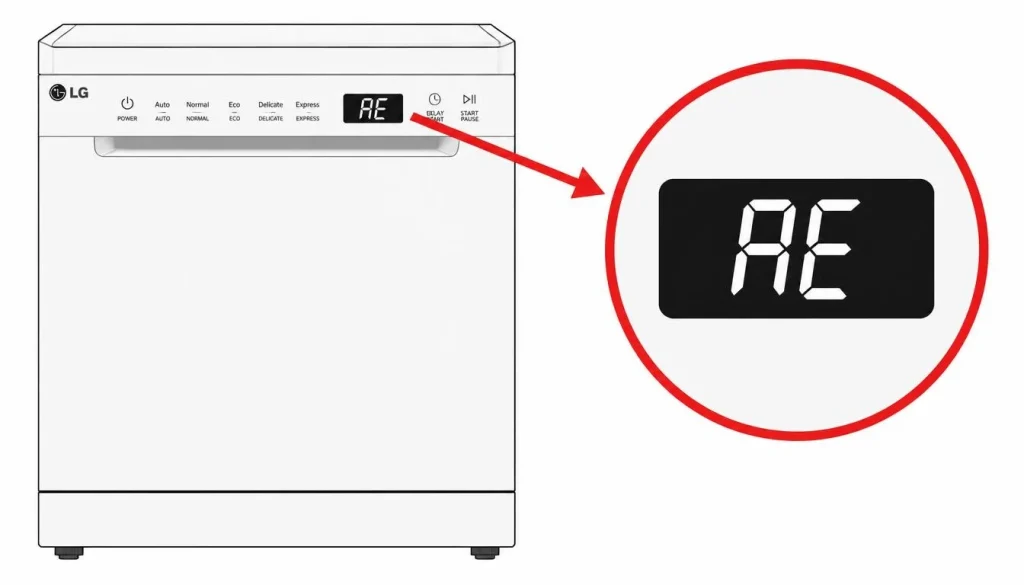
When the LG dishwasher AE code appears on the display, the machine is reporting that water has reached a place inside the appliance where it should not be. LG’s official documentation states that an AE or E1 error code means there is a leak inside the dishwasher activating the float switch, and that before the dishwasher can be used again, the underlying cause of the leak must be found and fixed . The code is a leak-detection alert, and LG treats it as a stop-and-check condition rather than a routine maintenance prompt.
The LG dishwasher AE code is not a drainage error, a water supply error, or a motor error. It is the machine’s response to its base-pan float being lifted by water. LG’s Spanish-language error guide describes AE/F54 as an “Error de fuga de agua” — a water leak error — and states that water leaks occur inside the equipment . The regional error guides list the same code under the overflow and leak category, and note that when an AE error occurs, the dishwasher will continue draining to protect the appliance and the floor from potential leaks .
This definition matters because the response to the LG dishwasher AE code is different from the response to a suds code or a fill code. The machine is not asking for a detergent change or a water valve check. It is reporting that its leak protection has been triggered, and the correct response is to determine whether there is a real leak, a false trigger from a stuck float, or an overflow condition that pushed water into the base.
This article explains what the LG dishwasher AE code means, how the float-switch leak detection works, the causes LG identifies, the official step-by-step checks for leveling, the door gasket, the spray arms, and detergent use, the drain-pan drying procedure, the reset methods, the additional leak sources that repair guidance identifies, the repair cost context, and the circumstances in which professional service is required.
?What Does the LG Dishwasher AE Code Mean
The LG dishwasher AE code means that the leak-detection float in the base pan has been activated. LG’s US support page states this directly: an AE or E1 error code means there is a leak inside the dishwasher activating the float switch . LG’s regional error guides describe the same condition as a water leak inside the appliance .
The float is a mechanical sensor, not an electronic moisture detector. Repair guidance explains that LG dishwashers use a styrofoam float in the base pan, and that if the float gets stuck in the raised position from detergent residue buildup, the AE code will trigger even without an actual leak . This is an important distinction. The code reports that the float has risen, not that a sensor has detected moisture electrically. A real leak and a stuck float produce the same display.
LG’s documentation also notes that when the error occurs, the dishwasher will continue draining to protect the appliance and the floor from potential leaks . This means the machine may run its drain pump intermittently even while the code is displayed. The draining is a protective behavior, not a sign that the cycle is continuing normally.
How the Float-Switch Leak Detection Works
The leak-detection system is built around the base pan — the shallow tray at the very bottom of the dishwasher, beneath the tub and the pump. Water that escapes the tub, the hoses, the pump seals, or the door gasket eventually collects in this pan.
The styrofoam float sits in the pan on a guide channel. When the pan is dry, the float rests at the bottom, and the switch is open. When water enters the pan, the float rises. At a certain level, the rising float closes the switch and signals the control board. The board then displays the LG dishwasher AE code and activates the drain pump to limit further water accumulation.
Repair guidance emphasizes that the float remains triggered as long as any moisture remains in the drip pan — even a thin film of water will keep the error active . This is why simply unplugging the dishwasher does not always clear the code. The float must drop, and it cannot drop until the pan is dry.
The same guidance notes that the float can stick in the raised position because of detergent residue buildup . In that case, there may be no water in the pan at all, but the float remains elevated and the code persists. Rinsing the float and the guide channel with warm water is the remedy for this false trigger .
Causes of the LG Dishwasher AE Code
LG’s official documentation identifies a set of causes for the LG dishwasher AE code, and repair guidance adds the specific leak points that technicians find in practice.
An Unlevel Dishwasher
LG lists an unlevel unit as a cause. The Spanish and Korean error guides state that the error can occur if the unit is not leveled or if the door is misaligned . When the dishwasher tilts, water can pool toward one side of the tub and spill into the base pan, or the door seal can fail to seat evenly. LG’s US page provides a leveling test: open the dishwasher, place a level against the top, sides, and bottom, remove the bottom rack, pour about a gallon of water into the bottom, and see whether the water pools to one side .
A Dirty or Damaged Door Gasket
LG identifies the door gasket as a leak source. The US page instructs the user to check the door gasket for buildup or damage, look for food or grease buildup on the gasket or the area of the tub where the gasket would seal, and clean it away because buildup can cause leaking since the door cannot seal properly . If the door seal is damaged or torn, LG states that service is required .
Clogged or Damaged Spray Arms
LG lists the spray arms as a cause. The US page instructs the user to inspect the spray arms for buildup or blockages, remove them if present, clean them with a soft brush and warm soapy water, and reinstall them . If the spray arm is damaged, LG states that service is required . A damaged or loose spray arm can direct water outside the tub area rather than onto the dishes.
Excessive Suds From the Wrong Detergent or an Overdose
LG identifies detergent-related overflow as a cause. The regional error guides state that the error can be due to excess foam from the use of dishwashing liquid . The US page explains the mechanism in detail: dishwasher pods or tablets generally contain the correct amount of detergent, but using more than one pod or tablet can lead to excessive suds and cause water to overflow . For liquid or powder detergent, the dispenser has two marked levels, and filling the entire dispenser beyond the marked levels will lead to excessive suds and cause water to overflow . Dishwashing liquid is specifically warned against: it is super concentrated compared to dishwasher detergent and will create too many bubbles and cause the water level inside the unit to overflow .
Water Poured Into the Heat Dry Blower
LG identifies a specific user-error cause that is easy to overlook. The regional guides state that pouring water into the Heat Dry blower causes this error . The guides warn that the water softening system cap and the Heat Dry air filter cap are different in size and shape, and that confusing them can lead to water being poured into the blower, which can produce leaks . The instruction is to verify the caps and add water only to the water softening system side .
Internal Leak Points Identified by Repair Guidance
Repair guidance expands the cause list with the specific components that fail and drip into the base pan. The door seal is described as a common cause, with tears, gaps, or hardening from age and detergent exposure . The spray arm seals and the pump connections are listed as points to inspect for drips . The tub-to-sump junction is identified as a location where the main wash pump gasket can fail and need replacement . A loose hose or clamp, a seeping inlet valve, a worn door gasket or bottom seal, and a sump or pump seal drip are all listed as common culprits . A cracked spray arm can allow water to spray outside the tub area, and excessive suds can push water out of the tub during the wash cycle .
The Official Step-by-Step Checks
LG’s US support page provides a sequence of checks for the LG dishwasher AE code. The sequence begins with leveling and then moves through the door gasket, the spray arms, and detergent use. Each check is followed by the drain-pan drying step that clears the code if the underlying cause has been addressed.
Step 1: Ensure the Unit Is Level
Open the dishwasher and place a level inside against the top, sides, and bottom of the unit . Remove the bottom rack, pour about a gallon of water into the bottom of the dishwasher, and see whether the water pools to one side or another . If the water level is off to either side of the tub, the unit is not leveled correctly . LG’s leveling video describes the adjustment: remove the toe kick panel, locate the two front screws that control the back legs, turn them in the direction of the arrow to raise the back or opposite to lower it, and adjust the front legs with an adjustable wrench until the unit is completely level . The gap between the door and the tub should be equal, and the tub should be equal on both the left and right sides .
Step 2: Check the Door Gasket
Look for food or grease buildup on the gasket or the area of the tub where the gasket would seal . If buildup is present, clean it away, because it can cause leaking since the door cannot seal properly . Once the gasket is cleaned, proceed to drying the drain pan . If the door seal is damaged or torn, LG states that service is required .
Step 3: Check the Spray Arms
Inspect the spray arms for buildup or blockages . If present, remove the spray arms, clean them with a soft brush and warm soapy water, and reinstall them . Then proceed to drying the drain pan . If the spray arm is damaged, LG states that service is required .
Step 4: Check the Detergent
For pods or tablets, use only one. Using more than one pod or tablet can lead to excessive suds and cause water to overflow . If only one pod or tablet is used and the LG dishwasher AE code still appears, LG states that the unit will need to be examined by a technician .
For liquid or powder detergent, fill only to the marked levels: the 15 line for lightly soiled loads or soft water conditions, and the 25 line for heavily soiled loads or hard water conditions . Filling the entire dispenser beyond the marked levels will lead to excessive suds and overflow . Do not use dishwashing liquid; it is super concentrated and will create too many bubbles, causing the water level to overflow . Switch to dishwasher pods or detergent, which are specifically formulated to work with the amount of water used during the cycle .
Step 5: Dry the Drain Pan
LG’s sequence repeatedly refers to drying the drain pan as the step that assists in clearing the error code . Repair guidance describes the practical procedure: turn off the dishwasher, remove the lower kickplate panel, use towels to soak up any water in the base pan, and identify the leak source . The float drops once the pan is dry, and the code clears when the float is no longer raised.
Resetting the LG Dishwasher AE Code
The reset methods for the LG dishwasher AE code vary in effectiveness depending on whether the float is still raised. LG’s Spanish error guide states that for AE/F54, the user should unplug the equipment, wait 60 seconds, and try again, and if the error persists, close the water inlet tap and request repair .
Repair guidance clarifies what the reset can and cannot do. One source states that the AE error will not reset by unplugging the unit alone, because the float switch remains triggered as long as any moisture remains in the drip pan — even a thin film of water will keep the error active . This is consistent with LG’s instruction to dry the drain pan before expecting the code to clear.
A quick reset attempt described in repair guidance is to unplug the unit for 5 to 10 minutes and see whether the code returns . Another source notes that on most LG models, holding down the Start/Pause button for around 3 to 5 seconds will cancel the current cycle and clear a stuck fault code in the same way unplugging does . These methods address a temporary or stuck condition; they do not address an active leak, which will re-trigger the float as soon as water reaches the pan again.
The practical rule is that the reset should follow the physical checks, not replace them. If the pan is dry and the float moves freely, a reset may clear the code. If the pan holds water, the reset will not hold until the leak source is found and the pan is dried.
Additional Leak Sources and Repair Cost Context
Repair guidance identifies leak points that go beyond LG’s user-level checks. The door gasket, the spray arm seals, the pump connections, the tub-to-sump junction, the water inlet valve, and the sump or pump seal are all listed as components a technician may inspect or replace .
The cost context from repair guidance is that a typical professional repair for the LG dishwasher AE code runs from $150 to $320, with difficulty rated as hard and usually a technician job . The parts a technician may check or replace include the door gasket, the water inlet valve, and the pump gasket kit . This range is repair-guidance data, not LG’s official pricing, and it should be treated as an indication of scale rather than a quotation.
Repair guidance also includes a safety note about water damage: leaks from dishwashers can damage hardwood floors and subflooring before becoming visible, and if AE codes are recurring, the subfloor under the unit should be inspected for soft spots or mold . This is a practical reason not to dismiss a repeating LG dishwasher AE code as a nuisance.
AE vs. Other LG Dishwasher Codes
The LG dishwasher AE code belongs to the leak and overflow category, and distinguishing it from related codes helps confirm the diagnosis.
The FE code is an overflow error caused by excess water supply or excess foam. LG’s regional guides group FE with AE(RE) and state that FE/AE(RE) can occur if the water supply exceeds the standard amount or if excess foam from dishwashing liquid causes a leak . The LG dishwasher AE code is the leak-detection variant, while FE is the overfill variant.
The IE code is a water inlet error. LG’s regional guides describe IE as appearing when a specific amount of water is not supplied to the tub, with causes including a water outage, a bent supply hose, or a closed inlet valve . The LG dishwasher AE code is not a fill problem; it is a leak or float problem.
The OE code is a drainage error, most often resulting from food clogs or an installation issue . The LG dishwasher AE code is not a drain error, although the machine may run its drain pump while the code is displayed as a protective measure .
The CL code is the Child Lock indicator, which LG states is not actually an error code . The LG dishwasher AE code is a genuine condition alert, while CL is a control-panel lock.
Quick Reference Table
| Situation or Observation | What It Means | What To Do |
|---|---|---|
| AE appears on the display | Float switch has been activated by water in the base pan | Check for a leak and dry the drain pan |
| Water is pooling under the dishwasher | A real leak is reaching the base pan | Find and fix the leak source |
| Pan is dry but AE persists | Float may be stuck from detergent residue | Rinse the float and guide channel with warm water |
| Dishwasher is not level | Water can pool and spill into the base | Level the unit using the front and rear leg adjustments |
| Door gasket has food or grease buildup | The door cannot seal properly | Clean the gasket; replace it if torn or damaged |
| Spray arms are clogged or damaged | Water can spray outside the tub | Clean the spray arms; service if damaged |
| Multiple detergent pods were used | Excessive suds can push water into the base | Use one pod only |
| Dishwashing liquid was used | Concentrated soap foams heavily and overflows | Switch to dishwasher pods or detergent |
| Water was poured into the Heat Dry blower | A user-error leak path | Request service; do not pull out a built-in unit |
| AE returns after unplugging | Moisture remains in the pan or a leak is active | Dry the pan completely and inspect for leaks |
| AE persists after all checks | Internal seal, pump, or valve leak | Request service through LG support |
Frequently Asked Questions
?What does the LG dishwasher AE code mean
It means there is a leak inside the dishwasher that has activated the float switch . LG’s Spanish guide describes it as a water leak error inside the equipment .
?Is the AE code an error or a warning
It is a condition alert, not a routine notification. LG treats it as a leak that must be found and fixed before the dishwasher is used again .
?Can I clear the AE code by unplugging the dishwasher
Unplugging for 60 seconds is LG’s documented reset step, but repair guidance states that the AE error will not reset by unplugging alone if any moisture remains in the drip pan . The pan must be dry for the float to drop.
?Why does the AE code keep coming back
It keeps coming back because the float is still raised. Either water is still reaching the base pan from an active leak, or the float is stuck from detergent residue .
?What is the float switch and where is it
The float is a styrofoam float in the base pan at the bottom of the dishwasher, on a guide channel . It rises when water enters the pan and triggers the switch.
?Can a dirty door gasket cause the AE code
Yes. LG states that food or grease buildup on the gasket can cause leaking because the door cannot seal properly . If the gasket is torn or damaged, service is required.
?Can too much detergent cause the AE code
Yes. LG states that using more than one pod or tablet, filling the dispenser beyond the marked levels, or using dishwashing liquid can create excessive suds and cause water to overflow . The overflow can reach the base pan and trigger the float.
?What should I do if the dishwasher is not level
LG provides a leveling procedure using the front and rear leg adjustments behind the toe kick panel . If the unit is not level and you are not comfortable adjusting it, LG’s regional guides direct the user to request service .
?What if water was poured into the Heat Dry blower
LG’s regional guides warn that pouring water through the Heat Dry blower can cause leaks . For a built-in unit, the guidance is not to pull the dishwasher out, because of the risk of floor damage, and to request service .
?When should I call for service for the LG dishwasher AE code
Call for service if the door seal or spray arm is damaged, if the error persists after using the correct detergent and one pod or tablet, if the error persists after the unit is leveled, or if the pan is dry and the float moves freely but the code returns . LG’s Spanish guide also directs the user to close the water inlet tap and request repair if the error persists after the reset .

When the LG Dishwasher AE Code Requires Service
The LG dishwasher AE code requires service under several conditions that LG states explicitly. If the door seal is damaged or torn, service is required . If the spray arm is damaged, service is required . If only one pod or tablet is used and the error code is displayed, LG states that the unit will need to be examined by a technician . If the error persists while using the correct detergent recommendations, LG directs the user to request a repair . And if the unit is not leveled, or the error persists even though the unit is leveled, LG’s regional guides direct the user to request service .
Repair guidance adds the conditions that a technician is best equipped to handle: a leak at the tub-to-sump junction, a failed pump gasket, a seeping inlet valve, a sump or pump seal drip, or a loose hose or clamp . These are internal components that require access to the base and the pump area, and the repair is rated as hard and usually a technician job .
It is important not to continue running cycles repeatedly while the LG dishwasher AE code is active and water is present in the base pan. The float protection exists to limit water damage, and each cycle can add more water to the pan. Addressing the leak source promptly protects the cabinets, the flooring, and the subfloor, which repair guidance notes can be damaged before the leak becomes visible .
Preventing the LG Dishwasher AE Code
Prevention for the LG dishwasher AE code follows directly from its causes. Using the correct detergent and the correct amount is the most controllable preventive measure. LG specifies one pod or tablet, or liquid or powder filled only to the 15 or 25 line depending on soil level and water hardness . Dishwashing liquid should never be used inside the dishwasher .
Keeping the door gasket clean prevents the buildup that interferes with sealing . Cleaning the spray arms periodically prevents the blockages that can redirect water outside the tub . Verifying that the unit is level, and rechecking it if the dishwasher is moved, prevents the tilt that allows water to pool and spill . And when adding water to the water softening system, confirming that the correct cap is being used prevents the user-error leak through the Heat Dry blower .
