


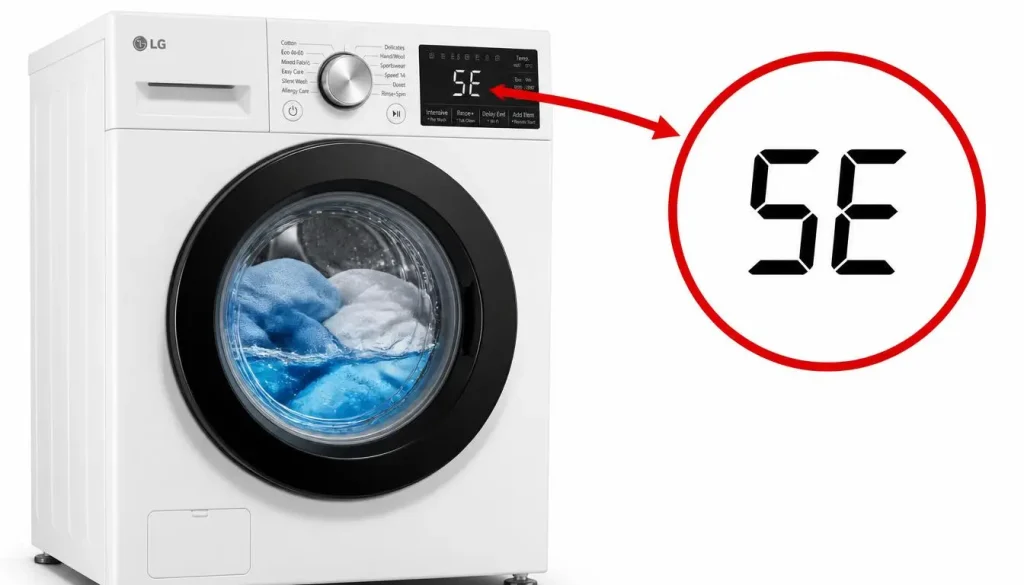
LG Washer SE Error: Causes, Reset and Fixes
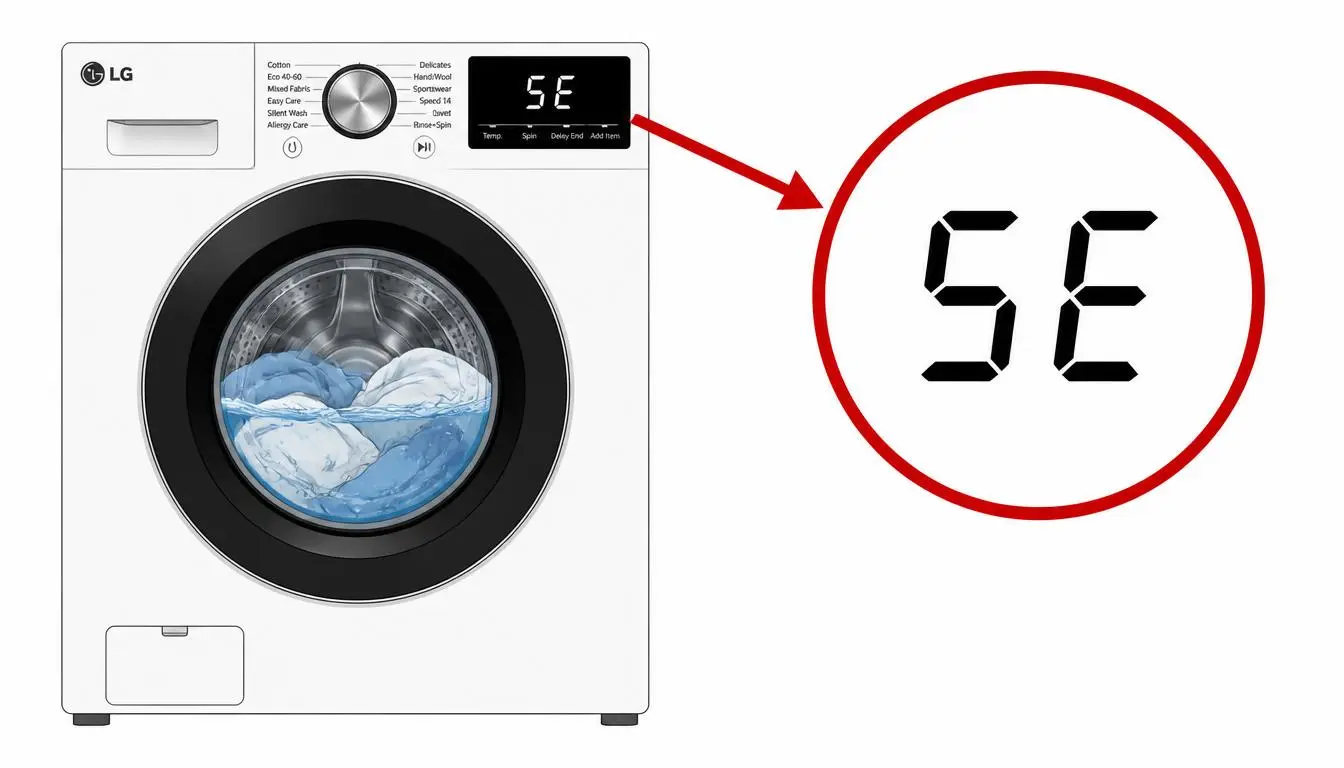
When an LG washer SE error appears on the display, the washing machine is reporting a fault in its self-diagnostic system. The SE code is an internal signal issued by the appliance’s electronic control unit to indicate that a sensor reading or operation has deviated from its expected parameters. More specifically, the SE error is tied to the monitoring of the motor or rotational speed sensors that relay data back to the control board.
The LG washer SE error is not a general failure code. It is a targeted alert that the communication loop between a sensor and the control module is not delivering the accurate or expected signals. This distinction matters for diagnosis: the problem may lie in the sensor itself, in the wiring that carries its signal, or in the control board that processes it. This article explains what the LG washer SE error means, the causes identified by official and repair sources, the reset procedure, the step-by-step diagnostic sequence, and the circumstances in which professional service is required.
?What Does the LG Washer SE Error Mean
The LG washer SE error indicates an anomaly related to sensor operations within the washing machine’s drive mechanisms. LG’s own troubleshooting materials group SE with the motor, drum, and rotation error codes, describing the shared meaning as the drum or motor facing resistance, overload, or imbalance. Other LG support documentation describes SE as a sensor error code.
Repair guidance provides a more precise technical definition: the SE code is tied to the monitoring of motor or rotational speed sensors that relay data back to the control board. When the sensor readings do not conform to pre-established norms, the system flags a fault to prevent potential operational issues or damage. The error reflects a failure in the communication loop between the sensor and the control module, indicating that the unit is not receiving the accurate or expected signals.
The LG washer SE error is generated by the machine’s diagnostics rather than by immediate external factors. It serves as a protective measure, ensuring that the washing process is halted or adjusted to avoid further complications. Some repair references describe SE simply as a motor error and recommend calling a technician, which reflects the fact that the fault can originate in the motor speed sensing circuit rather than in the load or the water system.
Common Causes of the LG Washer SE Error
Repair guidance identifies four categories of causes for the LG washer SE error. Each category affects the signal path between a sensor and the control board in a different way.
Internal Component Failures
The electronic control board can experience circuitry or component failures due to prolonged use or power surges, which may lead to intermittent or consistent SE error code occurrences. Components such as relays or microprocessors within the board might degrade over time, causing improper signal processing that triggers the error. Internal solder joints or connectors might become loose or corroded, leading to erratic sensor data readings associated with the error.
Wiring or Connection Issues
Damaged or frayed wiring harnesses inside the washing machine may create false signal paths or intermittent contact, potentially triggering the SE error code. Poor or loose connections between sensors and the control board can prevent proper communication, which might be misinterpreted by the system as a malfunction. Faults in the connector plugs or terminal blocks may develop from vibration or wear, leading to inconsistent electrical performance.
Environmental and Moisture-Related Issues
Exposure to excess moisture, whether from leaks or condensation, can deteriorate both the control board and sensor components, causing unexpected error codes. Water or humidity intrusion into critical areas might result in short circuits or corrosion on sensitive circuitry, thereby triggering the error code. Inadequate protection of internal electronics against environmental factors can increase susceptibility to errors over time.
Other External Influences
Fluctuations in power supply or inconsistent electrical currents from the household circuit may stress the electronic systems and lead to errors. Improper installation, such as an unlevel machine or misaligned components, can contribute to abnormal operation of sensors and electronics. Accumulated residue or debris in electronic compartments might interfere with sensor contacts or cooling, resulting in the machine detecting faults.
How to Reset the LG Washer SE Error
LG’s official troubleshooting guidance for the SE error begins with a reset. The procedure is simple and should be performed before any component inspection.
LG’s front-load error code documentation states that the user should turn off the power and unplug the washing machine from the outlet, let the appliance rest for 10 seconds, restore power, turn the machine back on, and restart the wash cycle. LG adds that if the error code continues after this reset, the appliance will need service from a professional technician.
A more thorough hard reset is also described in repair guidance: press and hold the Start/Pause button for 5 seconds to dissipate residual power, then plug the machine back in and run a Rinse + Spin cycle. This longer procedure allows the control board and sensor circuit to fully discharge before the machine rechecks the sensor readings.
The reset is diagnostic as well as corrective. If the LG washer SE error clears after the reset, the fault was likely a temporary glitch or a power fluctuation. If the error returns immediately or after a short run, a component in the sensor circuit is genuinely faulty.
Step-by-Step Troubleshooting for the LG Washer SE Error
The following sequence combines the checks identified by LG and repair sources. The washer should be unplugged before any panel is removed or any internal component is touched.
Step 1: Reduce and Redistribute the Load
LG groups SE with the motor, drum, and rotation codes, and its recommended action for this group is to open the drum, remove tangled or heavy clothes, spread the load evenly in the drum, and restart the cycle. An overloaded or unbalanced drum forces the motor to work harder and can produce abnormal rotational speed readings. LG also warns against forcefully spinning the drum by hand. If the error clears after the load is adjusted, the cause was mechanical loading rather than a failed sensor.
Step 2: Perform the Reset
If adjusting the load does not clear the code, perform the reset described above: unplug the washer, wait 10 seconds (or use the 5-second Start/Pause hold for a fuller discharge), restore power, and restart the cycle. This step clears temporary faults and allows the machine to recheck the sensor circuit.
Step 3: Inspect the Wiring and Connectors
With the washer unplugged and the appropriate panel removed, inspect the wiring harness between the motor speed sensor and the control board. Repair guidance identifies damaged or frayed harnesses, loose connections between sensors and the board, and faults in connector plugs or terminal blocks as direct causes of the LG washer SE error. Look for chafed insulation, burn marks, and loose pins, and reseat each connector firmly. This check costs nothing and sometimes resolves a fault that appeared to be a sensor failure.
Step 4: Test the Hall Sensor
The Hall sensor is the component that reports the motor’s rotational speed and position to the control board. Repair guidance identifies the Hall sensor as the most likely fix for the LG washer SE error, describing it as an inexpensive part that resolves the majority of cases, with part numbers often beginning with 6501KW. The sensor is tested with a multimeter set to ohms, measuring between the sensor’s pins; readings far outside the expected range point to a failed sensor. On some LG direct-drive models the sensor is integrated into the stator, so the parts diagram for the specific model should be checked before ordering a replacement.
Step 5: Check for Moisture and Debris
Repair guidance lists moisture intrusion and accumulated residue as contributors to the SE error. With the machine unplugged, inspect the control board area and sensor connectors for signs of water, condensation, or corrosion. Check electronic compartments for debris that might interfere with sensor contacts or cooling. Drying the area and cleaning the contacts can resolve faults caused by environmental factors.
Step 6: Test a Cycle
After the load, wiring, sensor, and moisture checks, plug the washer back in and run a short cycle. If the LG washer SE error returns, the remaining suspects are the control board and the motor circuit itself, which require professional diagnosis.
Quick Reference Table
| Symptom or Check | What It Means | What To Do |
|---|---|---|
| SE appears on the display | Sensor or motor speed signal fault | Reduce the load and perform a reset |
| SE clears after reset | Temporary glitch or power fluctuation | Monitor for recurrence |
| SE returns on an empty drum | Sensor circuit or board fault | Inspect wiring and test the Hall sensor |
| Load was heavy or unbalanced | Motor strain produced abnormal readings | Redistribute the load and restart |
| Wiring is frayed or connectors are loose | Signal path is disrupted | Reseat or repair the harness |
| Hall sensor readings are out of range | Speed sensor has failed | Replace the Hall sensor |
| Moisture or corrosion near the board | Environmental damage to electronics | Dry and clean the affected area |
| SE persists after all checks | Control board or motor circuit fault | Professional service is required |
Frequently Asked Questions
?What does the LG washer SE error mean
SE is a sensor error code generated by the machine’s self-diagnostic system. It indicates that a sensor reading, specifically from the motor or rotational speed sensors, has deviated from its expected parameters, and the communication loop between the sensor and the control module is not delivering accurate signals.
?Is the LG washer SE error a motor failure
Not necessarily. Some references describe SE as a motor error, but the code itself is tied to the motor speed sensor and its signal path. The motor may be functioning while the sensor that reports its speed has failed.
?Can I fix the LG washer SE error myself
In some cases, yes. Reducing the load, performing a reset, inspecting the wiring, and testing the Hall sensor are all within DIY range. Replacing the Hall sensor is described as an inexpensive fix that resolves the majority of cases. Control board faults require professional service.
?How do I reset the LG washer after an SE error
LG’s guidance is to unplug the washer, wait 10 seconds, restore power, turn the machine on, and restart the wash cycle. A fuller reset involves holding Start/Pause for 5 seconds while unplugged, then running a Rinse + Spin cycle.
?What is the most likely fix for the LG washer SE error
Repair guidance identifies replacing the Hall sensor as the most likely fix, describing it as an inexpensive part that resolves the majority of SE error cases.
?What causes the LG washer SE error
The causes fall into four groups: internal component failures on the control board, wiring and connection issues between the sensor and the board, environmental and moisture-related damage, and external influences such as power fluctuations or improper installation.
?Why does the SE error appear after a heavy load
LG groups SE with motor and rotation errors, which can be triggered by resistance, overload, or imbalance. An overloaded drum forces the motor to work harder and can produce abnormal rotational speed readings that the sensor reports as a fault.
?When should I call a technician for the LG washer SE error
LG states that if the SE error continues after the 10-second reset, the appliance needs service from a professional technician. Service is also warranted if the error returns after the wiring and Hall sensor checks, since the remaining cause is a control board or motor circuit fault.
When the LG Washer SE Error Requires Service
LG’s official documentation draws a clear line: if the SE error continues after the reset procedure, the appliance will need service from a professional technician. This is the simplest and most authoritative criterion for calling a technician.
Repair guidance adds context for why the SE error often requires professional attention. The fault can originate in the control board’s circuitry, its relays or microprocessors, or its internal solder joints and connectors. Diagnosing which of these has failed requires board-level testing and, in some cases, replacement of the board. The motor circuit itself is another potential source that lies beyond the reach of basic troubleshooting.
Service is also the appropriate choice when the error returns on an empty drum after the load has been adjusted and the reset performed, when the wiring harness shows damage that cannot be safely reseated, or when the Hall sensor has been replaced and the LG washer SE error still appears. At that point, the control board’s ability to process the sensor signal, or the motor circuit that the sensor monitors, becomes the relevant diagnostic target.
It is important not to continue running cycles repeatedly when the SE error persists. The code is a protective measure, and continued operation with a faulty sensor signal can stress the motor and the control board, potentially turning a small repair into a larger one.
Preventing the LG Washer SE Error
The causes of the LG washer SE error point to practical preventive habits. Avoiding overloaded or unbalanced loads reduces the strain on the motor and the rotational speed sensing system, which is why LG’s own guidance for this error group begins with load management. Never forcefully spinning the drum by hand is another LG recommendation that protects the drive mechanism.
Protecting the washer’s electronics from moisture and power fluctuations addresses two of the documented cause categories. Using a surge protector helps safeguard the control board from the voltage fluctuations that repair guidance identifies as a contributor. Keeping the area around the control board dry and free of condensation reduces the risk of corrosion on sensitive circuitry. Avoiding improper installation, such as an unlevel machine, supports normal operation of sensors and electronics. Periodically checking connectors for looseness and keeping electronic compartments free of accumulated debris address the wiring and residue causes before they produce a recurring LG washer SE error.
