


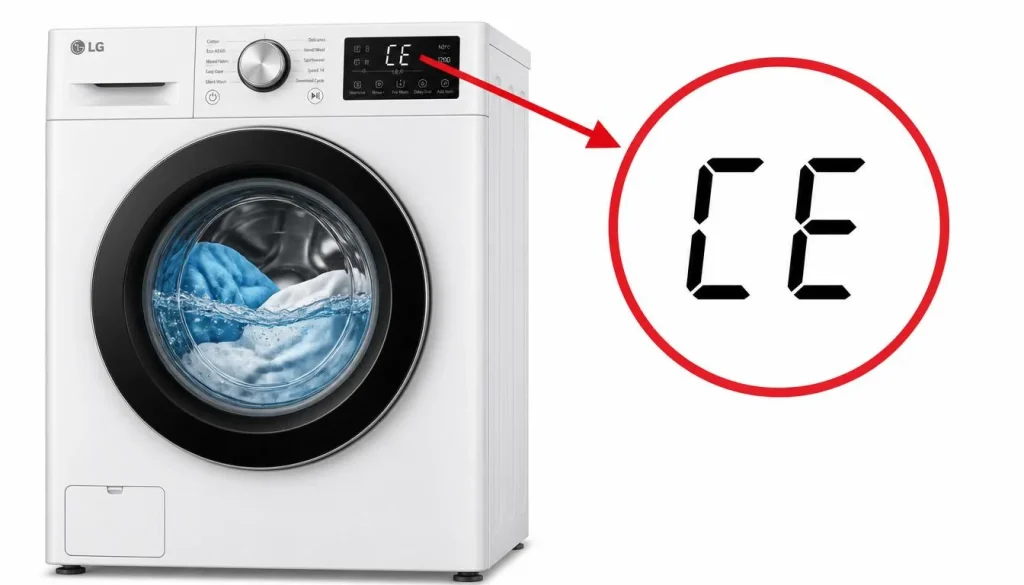
LG Washer CE Error: Causes, Meaning and Fixes
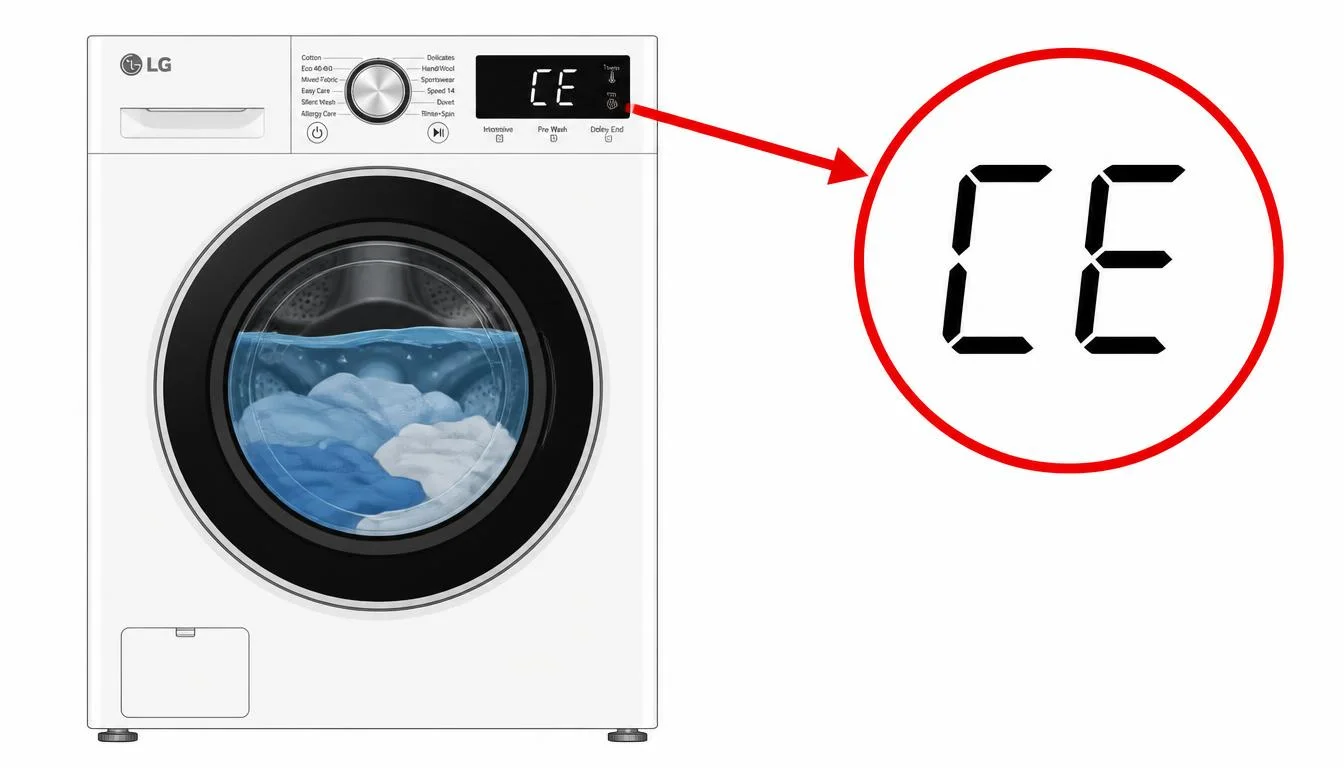
When the letters “CE” appear on the display of an LG washer, the machine is reporting a fault that stops the cycle and prevents normal operation. The LG washer CE error is unusual among LG error codes because the two repair sources used for this guide describe it in fundamentally different ways. One source treats CE as an electrical current fault in the motor drive circuit. The other treats it as a communication fault between the washer’s electronic control modules. Both descriptions agree on one point: the washer has detected an abnormal condition, has stopped the cycle, and will not resume normal operation until the fault is addressed.
This article presents both interpretations side by side, because the correct repair path depends on which fault is actually present in your machine. It explains what each source says the LG washer CE error means, lists the causes each source identifies, sets out the troubleshooting steps in the order each source recommends, and identifies the circumstances in which professional service is required. All information is drawn from the two cited repair sources, and where they disagree, the disagreement is stated rather than resolved.
?What Does the LG Washer CE Error Mean
The LG washer CE error has two documented meanings, and the difference matters for diagnosis.
The Motor Current Interpretation
According to TruePro Home Services, the LG washer CE error means the main control board is detecting excessive or abnormal electrical current flowing to the drive motor . The board shuts down motor operation immediately to prevent damage . This is described as a protective response: something in the motor circuit is drawing more current than the board expects . The washer will not spin or agitate until the problem is resolved .
Under this interpretation, the LG washer CE error is not a general electronics fault. It is a specific current-limit event in the motor power circuit. The control board has measured current outside its expected range and has intervened to protect the motor and the board itself.
The Communication Interpretation
According to Hoffmann Brothers, the LG washer CE error is a display of an internal communication issue between the various electronic control modules within the appliance . In simple terms, it signifies that one part of the machine’s system is not properly exchanging data with another . The code is an alert from the machine’s monitoring software indicating that the expected signals between component boards—such as the main control board and the display or sensor modules—are either missing or not within the required parameters .
Hoffmann Brothers states that this message is not related to issues like water supply, balance, or mechanical malfunctions, but instead highlights a disruption in the digital control network that coordinates the washer’s operations . The error can be triggered by intermittent glitches, faulty wiring connections, or internal degradation of the electronic modules . It often serves as an early warning to prevent further complications in the wash cycle by temporarily stopping normal operations .
Why the Two Interpretations Must Both Be Considered
The two sources do not merely use different words for the same fault. They point to different systems: the motor power circuit in one case, and the control communication network in the other. A technician or a confident DIY repairer should therefore treat the LG washer CE error as a symptom that can arise from either path. The reset step is common to both paths. After the reset, the diagnostic sequence should branch according to what the machine does: if the drum will not spin or agitate, the motor-current path is the relevant one; if the machine shows intermittent electronic behavior, sensor-related symptoms, or communication-related symptoms, the communication path is the relevant one.
Causes Under the Motor Current Interpretation
TruePro Home Services identifies five causes of the LG washer CE error under the motor current interpretation. Each cause produces the same result: current draw exceeds the board’s threshold, and the board shuts down the motor.
Shorted Stator Winding
An insulation breakdown in the stator coil creates a short circuit . The motor draws excessive current, and the board detects it instantly . This is the most direct electrical cause of the LG washer CE error under this interpretation, and it is the reason the stator winding resistance test is included in the troubleshooting sequence.
Overloaded Drum
An extremely heavy load forces the motor to work harder . The current draw exceeds the board’s threshold, triggering the CE code . This is the simplest and least invasive cause, which is why load reduction is the first troubleshooting step.
Failed Main Control Board
The motor driver circuit on the control board has a blown IGBT (transistor) or power relay . It sends uncontrolled current to the motor or misreads current sensor data . In this case, the fault is on the board itself rather than in the motor or wiring.
Damaged Motor Wiring
Chafed or pinched wires between the control board and the stator short against the washer frame or each other, creating abnormal current paths . This cause is mechanical in origin but electrical in effect: vibration or poor routing has damaged the insulation, and the resulting short produces the abnormal current that the board detects.
Seized Bearings
Worn tub bearings create excessive friction . The motor draws more current to turn the drum, exceeding the current limit . This cause links a mechanical wear problem to an electrical error code, which is why the hand-spin test is included in the diagnostic sequence.
Causes Under the Communication Interpretation
Hoffmann Brothers identifies a different set of causes for the LG washer CE error under the communication interpretation. These causes affect the signals exchanged between sensors, the control board, and other electronic modules.
Faulty Water Level Sensor or Pressure Sensor Malfunction
The CE error code may be triggered when the sensor that monitors water levels is receiving false readings . A dirty, worn, or failed sensor might send inaccurate data back to the control board, causing the machine to interpret that there is an abnormal condition . Internal buildup or small particles in the sensor tube can obstruct normal pressure transmission, leading to irregular sensor behavior . Electrical issues within the sensor module itself—since it relies on delicate components—might result in intermittent or continual erroneous signals .
Wiring and Connection Issues
Loose connectors or corroded wiring between the sensor and the electronic control board can disrupt communication . Even minor disconnections may cause the system to register a fault and display the CE code . Physical damage or insulation wear on wiring harnesses might allow interference or signal loss, misleading the control logic regarding water levels or sensor status . Environmental factors such as moisture exposure in the wiring compartment can accelerate degradation, prompting erratic readings .
Communication Breakdowns on the Control Board
The main control board orchestrates the operation of various sensors across the washing machine . If there is a disruption in the board’s ability to process incoming sensor data, an error like CE might be displayed . Firmware inconsistencies or minor electronic glitches within the control board might result in short-term miscommunication that could trigger the error code . Intermittent software bugs caused by power fluctuations might also momentarily confuse the system, showing the error even if the sensors are functioning normally .
Inlet System Abnormalities and Water Flow Irregularities
An issue with water intake—such as low water pressure or partially closed valves—can cause the sensor to register an imbalance in water levels, and this abnormality might drive the control board to flag an error . Blockages in the water inlet filter or tubing could result in water flow being different from the machine’s requirements, confusing the sensor’s calibration . Inconsistent water supply conditions might also introduce pressure variances that the sensor could misinterpret as a failure in the system’s ability to manage water levels effectively .
Debris and Build-Up Affecting Sensor Readings
Accumulated debris on or around the sensor can disturb the normal air pressure readings needed for accurate water level detection . Mineral deposits from hard water may also form on sensor surfaces or in connecting tubes, compromising sensor accuracy . This build-up can create a persistent error condition, even though the sensor might otherwise be in proper working order if clean .
Step-by-Step Troubleshooting for the LG Washer CE Error
The following sequence combines both sources. It begins with the steps that are common to both interpretations, then branches into the motor-current checks and the communication checks. The washer should be unplugged before any panel is removed or any internal component is touched.
Step 1: Reduce the Load Size
TruePro recommends turning off the washer, removing about half the laundry, and restarting the cycle . An overloaded drum is the simplest cause of the CE error . If the code clears after the load is reduced, the cause was mechanical loading rather than a failed component.
Step 2: Reset the Washer
TruePro recommends unplugging the washer for 5 minutes to reset the control board and clear temporary faults, then plugging it back in and running an empty cycle . TruePro adds an important diagnostic note: if the CE code appears with no load in the drum, the problem is mechanical or electrical . Hoffmann Brothers recommends disconnecting the washing machine from the power outlet for at least one minute to allow the electronics to reset, then reconnecting the machine and checking whether the error clears before proceeding with further steps . The two sources give different waiting times—5 minutes versus at least 1 minute—but both treat the reset as the first electronic step.
Step 3: Spin the Drum by Hand
TruePro recommends opening the door and spinning the empty drum by hand . It should rotate smoothly with even resistance . Grinding, scraping, or inability to turn indicates seized bearings or a jammed object . Seized bearings force the motor to overcurrent, which links this mechanical check directly to the motor-current interpretation .
Step 4: Test the Stator Winding Resistance
TruePro recommends unplugging the washer and accessing the stator—on the rear panel for front-load models and on the bottom for top-load models . Disconnect the stator wire harness . Using a multimeter set to ohms, measure the resistance between each pair of the three stator leads . All three readings should be within 1–2 ohms of each other and typically between 5 and 15 ohms . A significantly lower reading on any pair indicates a shorted winding .
Step 5: Inspect Motor Wiring for Shorts
TruePro recommends tracing the motor wiring from the stator connector to the control board . Look for chafed insulation, melted wire coatings, or wires touching the metal frame . Any wire touching ground causes abnormal current . Repair with heat-shrink tubing and reroute the harness away from sharp edges .
Step 6: Inspect the Control Board and Connections
Hoffmann Brothers recommends removing the front or back panel following the manufacturer’s instructions to access the control board . Check all wiring connectors, ensuring that cables and plug-ins are secure and not damaged . If any connectors appear loose or corroded, gently clean them or reseat them to improve contact .
Step 7: Examine the Pressure Sensor and Its Components
Hoffmann Brothers recommends locating the water pressure sensor, which monitors the water level in the drum . Inspect the pressure sensor’s tube or hose for blockages, kinks, or disconnections, and clear any obstructions carefully . Ensure the sensor itself is securely mounted and the electrical connector is firmly attached .
Step 8: Check the Inlet Valve and Water Supply Lines
Hoffmann Brothers recommends verifying that the inlet water valves and associated filters are clean and free of debris . Ensure that the water supply hoses are not kinked or damaged, allowing proper water flow to the machine . Confirm that water fills the drum normally during the cycle without any abnormal resistance .
Step 9: Verify Sensor Calibration and Replace If Needed
Hoffmann Brothers recommends testing the sensor with a multimeter to check for expected resistance or voltage values, referring to the service manual for specifications . Consult the wiring diagram to compare sensor readings; if calibration seems out of range, consider having the sensor recalibrated or replaced .
Step 10: Reassemble and Perform a Test Run
Hoffmann Brothers recommends reassembling the washing machine panels securely after completing inspections and any necessary adjustments . Run a test cycle with minimal load to confirm that the error has been resolved . If the error reappears, repeat the inspection steps or consider professional service assistance .
Quick Reference Table
| Symptom or Check | Source Interpretation | What to Do |
|---|---|---|
| CE appears and washer will not spin or agitate | Motor current fault | Start with load reduction and reset |
| CE appears with no load in the drum | Mechanical or electrical problem | Proceed to hand-spin and stator tests |
| Drum grinds, scrapes, or will not turn by hand | Seized bearings or jammed object | Stop and inspect bearings or obstruction |
| Stator readings differ by more than 1–2 ohms | Shorted stator winding possible | Test all three pairs; replace stator if shorted |
| Chafed, melted, or grounded motor wires | Abnormal current path | Repair insulation and reroute harness |
| Loose or corroded connectors on control board | Communication disruption | Clean or reseat connectors |
| Pressure sensor tube blocked or kinked | False water level readings | Clear the tube and check the sensor |
| Inlet filters or hoses clogged | Water flow irregularity | Clean filters and check hoses |
| Error returns after all checks | Fault not resolved | Professional service |
Frequently Asked Questions
?What does the LG washer CE error mean
The two cited sources give different answers. TruePro states that CE means the main control board is detecting excessive or abnormal electrical current flowing to the drive motor . Hoffmann Brothers states that CE indicates an internal communication issue between the electronic control modules . Both agree that the washer stops normal operation when the code appears.
?Can I fix the LG washer CE error myself
TruePro states that in many cases you can, and that the most common fix is replacing the stator assembly, which is within DIY range . Hoffmann Brothers provides a step-by-step sequence that includes resetting the machine, inspecting the control board and connectors, examining the pressure sensor, checking the inlet valve and supply lines, and verifying sensor calibration .
?What is the most common fix for the LG washer CE error
TruePro states that the most common fix is replacing the stator assembly .
How much does it cost to fix the LG washer CE error?
TruePro gives typical repair costs of $0–$120 for DIY and $200–$550 for a professional repair .
?How long should I unplug the washer to reset the CE error
TruePro recommends 5 minutes . Hoffmann Brothers recommends at least one minute . Both then recommend reconnecting the machine and checking whether the error clears.
?Why does the CE code appear with no laundry in the drum
TruePro states that if the CE code appears with no load in the drum, the problem is mechanical or electrical . This is why the hand-spin test and stator winding test follow the reset.
?What should the stator winding read
TruePro states that all three readings should be within 1–2 ohms of each other and typically between 5 and 15 ohms . A significantly lower reading on any pair indicates a shorted winding .
?When should I call a technician for the LG washer CE error
TruePro states that a technician should be called for the CE error because the code involves the motor power circuit, which carries significant current and requires proper testing equipment, and a wrong diagnosis can lead to expensive secondary damage . Hoffmann Brothers advises considering professional service assistance if the error reappears after the inspection steps .
?Why do the two sources describe the CE error differently
The sources describe different fault pathways: one focuses on abnormal current in the motor drive circuit, the other on disrupted communication between electronic control modules. The article presents both because the correct repair depends on which pathway is actually faulty in a given machine.
When the LG Washer CE Error Requires Service
Both sources identify circumstances in which professional service is the appropriate choice.
TruePro states directly that a technician should be called for the CE error . Its reasoning is that the code involves the motor power circuit, which carries significant current and requires proper testing equipment, and that a wrong diagnosis here leads to expensive secondary damage . This warning applies especially to the stator winding test and the motor wiring inspection, which require access to live-circuit components and correct meter technique.
Hoffmann Brothers takes a more step-by-step approach but reaches a similar endpoint: if the error reappears after the inspection steps, the user should repeat the inspection or consider professional service assistance . This applies particularly when the communication path has been checked—connectors reseated, pressure sensor tube cleared, inlet filters cleaned—and the CE code still returns.
A reasonable rule drawn from both sources is that service is warranted when the CE code returns on an empty drum after a reset, when the drum will not turn freely by hand, when stator readings are outside the specified range, when motor wiring shows melted or grounded conductors, or when the error persists after both the motor-current checks and the communication checks have been completed.
Preventing the LG Washer CE Error
Neither source presents a formal prevention program, but each source’s cause list implies practical preventive habits.
From the motor-current interpretation, avoiding an overloaded drum is the most direct preventive measure, because an extremely heavy load forces the motor to work harder and can push current draw past the board’s threshold . Addressing bearing noise early is also relevant, because worn tub bearings create friction that forces the motor to overcurrent . Keeping motor wiring away from sharp edges and inspecting it periodically addresses the chafed-wire cause .
From the communication interpretation, keeping connectors clean and secure, protecting wiring from moisture, and maintaining the water inlet system reduce the likelihood of the communication-path causes. Hoffmann Brothers identifies loose or corroded connectors, moisture exposure in the wiring compartment, clogged inlet filters, and mineral build-up on sensor surfaces as contributors . Cleaning inlet filters and preventing debris build-up around the pressure sensor therefore support reliable communication between the sensor and the control board.
