


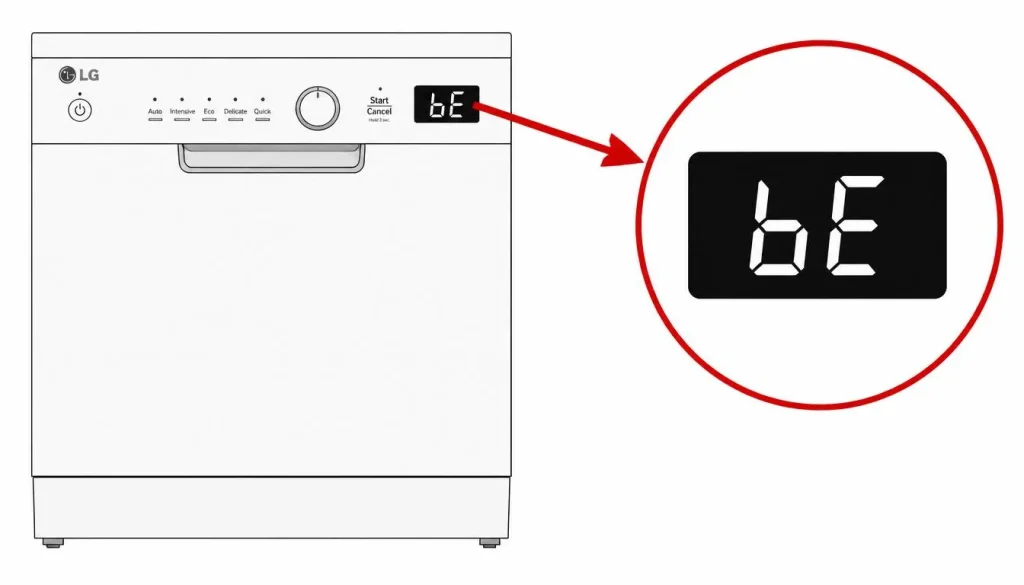
LG Dishwasher bE Error: Foam Fix and Detergent Rules
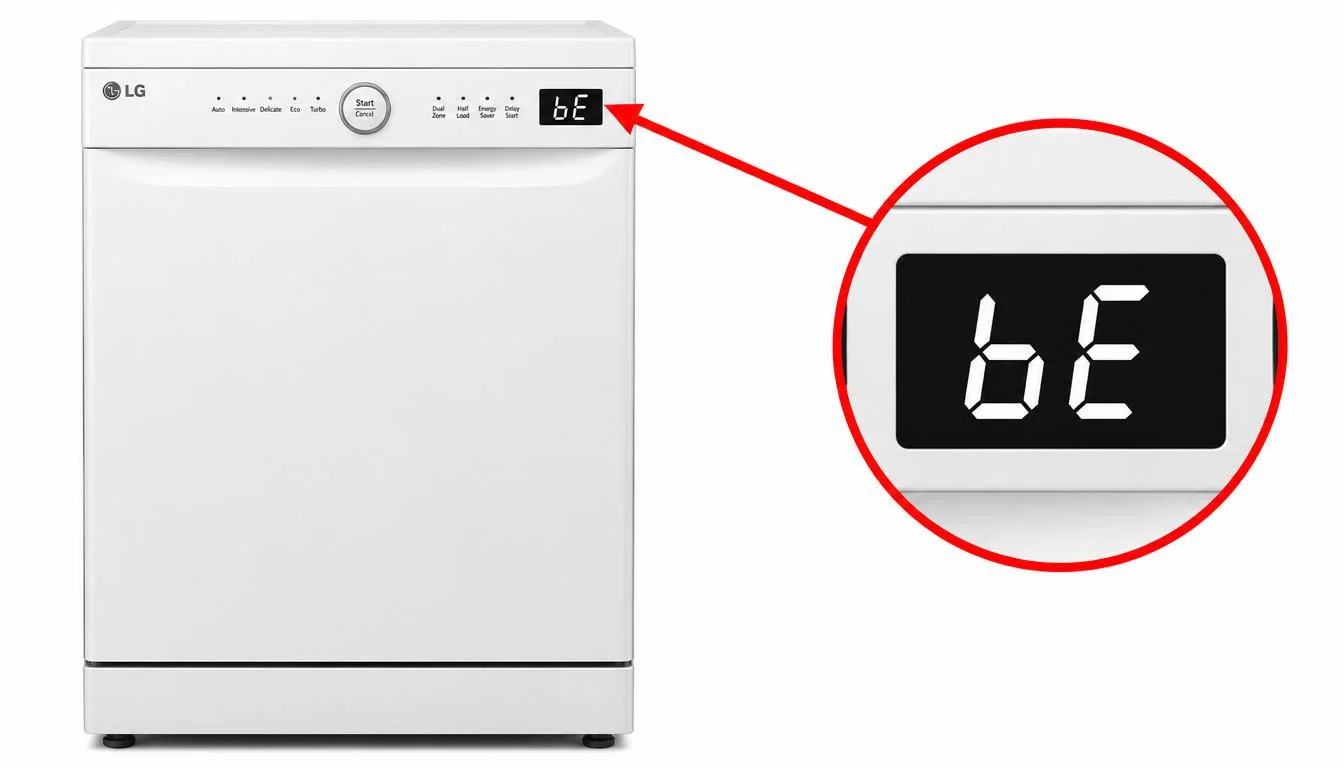
When “bE” appears on the display of an LG dishwasher, the machine is not reporting a drainage failure, a heating fault, or a motor problem. The LG dishwasher bE error stands for bubble error. LG’s official documentation states that error code bE stands for bubble error, and that if a regular handwash or liquid dishwashing detergent is used, excessive bubbles may be generated, causing leakage to the outside. To avoid leakage, the dishwasher has a function that displays the bE error .
The LG dishwasher bE error is therefore a protective foam-detection code. The dishwasher has detected more suds than it can safely manage, and it stops the cycle to prevent water and foam from escaping the machine. LG describes the code as appearing when excessive suds build up inside the dishwasher, and states that the dishwasher displays this code to prevent water from leaking .
This definition matters because the response to the LG dishwasher bE error is entirely about detergent and foam control, not about mechanical repair. The machine is working as designed. The foam is the problem, and the solution is to remove the foam and correct the detergent practice that created it. This article explains what the bE code means, why foam forms in a dishwasher, the two conditions that trigger the code, the official LG procedure using milk and specific cycle settings, the detergent rules that prevent recurrence, the questions users most often ask, and the circumstances in which service may be required.
?What Does the LG Dishwasher bE Error Mean
The LG dishwasher bE error means that excessive suds have built up inside the dishwasher. LG’s troubleshooting page describes the code as a bubble error, and explains that the machine displays it to prevent water from leaking outside the unit . The newer LG guidance states the same condition in slightly different words: the bE error code appears when excessive suds build up inside your dishwasher, and the dishwasher displays this code to prevent water from leaking .
The code is therefore a foam-volume alert. A dishwasher uses a relatively small amount of water, and the spray arms circulate that water under pressure. When detergent that foams heavily enters the system, the foam expands far beyond the water volume. The foam can push past the door seal and the internal seals, which is the leakage risk LG describes. The LG dishwasher bE error is the machine’s response to that risk: it stops the cycle before the foam escapes.
This is not a code that indicates a failed component. LG’s documentation does not describe bE as a pump failure, a sensor failure, or a control board failure. It describes it as a bubble condition caused by the type or amount of detergent used. The distinction is important because it tells the user where to look: at the detergent, not at the machine’s mechanical parts.
Why Foam Forms in a Dishwasher
Foam forms in a dishwasher when the detergent used is not designed for the machine’s low-water, high-pressure washing environment. LG’s documentation identifies two specific detergent mistakes that produce the LG dishwasher bE error.
The first is using regular handwash detergent. LG states directly that a regular handwash or liquid dishwashing detergent will generate excessive bubbles . The newer page repeats the point: using regular dish soap or too much liquid dishwasher detergent can create excessive suds . Hand dish soap is formulated to produce a thick, lasting foam in a sink full of water. In a dishwasher, that same formulation produces far more foam than the machine can handle.
The second is using too much liquid dishwasher detergent. Even a detergent designed for dishwashers can create excess suds if it is overdosed. LG notes that if you use liquid dishwasher detergent, it should be measured carefully, because it is easy to accidentally pour more than the recommended amount . The newer page’s FAQ confirms that using too much liquid dishwasher detergent can create excessive suds .
A third contributing condition is residue from previous cycles. LG explains that if the bE error code appears when you run the dishwasher empty without detergent, suds from previously used detergent may still be inside the dishwasher . This means the foam does not always originate in the current cycle. Detergent residue from an earlier wash can remain in the tub, the filter area, or the sump, and it can re-foam when the machine runs again.
The Two Conditions That Trigger the Code
LG’s troubleshooting documentation distinguishes two scenarios for the LG dishwasher bE error, and the distinction determines which corrective step applies.
The first scenario is a bE code that appears during a normal wash with detergent. In this case, the detergent used in that cycle is the likely source. LG’s guidance for this scenario is to check the detergent type: do not use a regular kitchen detergent or liquid dishwashing detergent, and use a powder detergent or a solid-type dedicated detergent for dishwashers instead . The correction is to switch the detergent and, if foam remains, to run the milk procedure described below.
The second scenario is a bE code that appears when the dishwasher is run empty with no detergent. LG states that if excessive foam remains after operating the machine without adding any detergent, and bE is displayed, it indicates that the error was caused by using the wrong type of detergent . In this case, the foam is residual. The detergent that caused it is no longer being added, but its residue is still in the machine. The correction is the foam-removal procedure, because changing the detergent alone will not clear foam that is already present.
A related pattern is sporadic bE occurrence. LG notes that if you use a detergent that generates a lot of bubbles, bE may occur sporadically depending on how dirty the dishes are. If you use an eco-friendly type 1 detergent or a large amount of detergent, excessive bubbles may be generated and bE may be displayed. The guidance is to change the detergent to the recommended one or reduce the amount of detergent .
The Official Milk Procedure for Removing Foam
When foam is already present and the LG dishwasher bE error persists, LG provides a specific procedure for removing it. The procedure uses milk, which LG states helps to reduce foam when the dishwasher is operated with milk inside .
The first step is to remove all dishes and ensure the detergent dispenser is empty. LG’s instruction is to empty the dishwasher and operate it without adding any detergent . The newer page adds the same preparation: remove all dishes, ensure the detergent dispenser is empty, and set the rinse aid level to L0 .
The second step is to set the rinse aid level to L0. LG specifies this setting in both the original troubleshooting page and the newer page . The purpose is to eliminate the rinse aid as a foam source during the foam-removal cycle.
The third step is to place a bowl containing 200 to 300 mL of milk in the center of the upper rack. LG’s original page states that instead of putting detergent in the detergent dispenser, a bowl with 200ml to 300ml of milk should be placed in the middle of the upper rack, and that operating the dishwasher with milk inside helps to reduce foam . The newer page repeats the same measurement: place a bowl containing 200 to 300 mL of milk in the center of the upper rack .
The fourth step is to run the dishwasher on the Normal cycle. LG’s original page specifies running the dishwasher on the Normal cycle . The newer page adds two options: select the Normal cycle, add the High Temp and Extra Rinse options, and start the dishwasher . The additional options increase the rinse volume and the water temperature, which helps carry the foam and milk residue out of the system.
The fifth step is to check whether foam remains and repeat if necessary. LG notes that bubbles may still remain after following these steps because the composition of detergents and rinse aids varies by brand, and that if foam still remains, the steps should be repeated . The original page also states that once the cycle is finished, the rinse aid level can be set back to how it was .
What to Do If the Error Persists
LG’s newer guidance provides an escalation path if the milk procedure and cycle adjustments do not resolve the LG dishwasher bE error. The instruction is that if the issue persists after following the steps above, further support can be obtained through the LG Chatbot on the website or by requesting a technician visit. LG also notes that a service fee may apply if the product is out of warranty .
This is the point at which the condition moves beyond the detergent and foam causes that LG’s user-level procedure addresses. A persistent bE code after the milk treatment and a correct detergent change may indicate that foam is trapped in a part of the system that the normal cycle cannot flush, or that a sensing or drainage condition is preventing the foam from clearing. These conditions require diagnosis rather than further user steps.
It is important not to continue running normal wash cycles repeatedly while the LG dishwasher bE error persists. If foam is still present, each cycle adds more detergent and more foam, and the risk of leakage that the code exists to prevent remains. The milk procedure and the empty-cycle run are the appropriate response, not repeated normal washes.
Detergent Rules That Prevent the bE Error
LG’s documentation points to a clear set of detergent rules that prevent the LG dishwasher bE error from recurring. These rules appear in the troubleshooting steps and in the FAQ section of the newer page.
The first rule is to use powder or tablet detergent rather than liquid. LG’s FAQ states that powder or tablet detergents should be used to easily control the exact amount and prevent excessive suds . The original page states the same preference: use a powder detergent or solid-type dedicated detergent for dishwashers .
The second rule is to never use regular handwash detergent. LG states directly that a regular kitchen detergent or liquid dishwashing detergent should not be used . The newer page explains why in the FAQ: loading dishes with leftover regular dish soap can create excessive suds and trigger the bE error code .
The third rule is to prewash with water only, or to rinse off any regular dish soap completely. LG’s FAQ states that only water should be used when prewashing dishes, and that if regular dish soap is used to prewash, the soap should be rinsed off completely before loading the dishes into the dishwasher . This rule addresses a source of foam that many users overlook: the soap applied before the dishes go into the machine.
The fourth rule is to measure liquid detergent carefully if it is used at all. LG acknowledges that liquid dishwasher detergent can be used, but states that it should be measured carefully because it is easy to accidentally pour more than the recommended amount .
Quick Reference Table
| Situation | What It Means | What To Do |
|---|---|---|
| bE appears during a wash with detergent | Excessive suds from the detergent used | Switch to powder or tablet dishwasher detergent |
| bE appears when running empty without detergent | Residual suds from a previous wash | Run the milk procedure to remove the foam |
| Regular handwash soap was used | Hand soap foams heavily in a dishwasher | Stop using it; rinse dishes before loading |
| Liquid dishwasher detergent was overdosed | Too much liquid detergent creates suds | Measure carefully or switch to powder or tablets |
| bE occurs sporadically with eco detergent | Some detergents foam more depending on soil level | Change to the recommended detergent or reduce the amount |
| Milk procedure completed but foam remains | Foam may be trapped or the detergent brand differs | Repeat the milk procedure |
| bE persists after repeated milk procedures | Condition is beyond detergent and foam removal | Contact LG support or request a technician visit |
| Dishes were prewashed with regular dish soap | Soap residue triggers foam inside the machine | Rinse the soap off completely before loading |
Frequently Asked Questions
?What does the LG dishwasher bE error mean
The bE error stands for bubble error. LG states that if a regular handwash or liquid dishwashing detergent is used, excessive bubbles may be generated, causing leakage to the outside, and the dishwasher displays the bE error to prevent that leakage .
?Is the bE error a mechanical failure
No. LG’s documentation describes bE as a foam condition caused by detergent type or amount, not as a failed component. The machine stops the cycle to prevent water from leaking .
Can I use regular dish soap in my LG dishwasher
No. LG states directly that a regular kitchen detergent or liquid dishwashing detergent should not be used, and that a powder detergent or solid-type dedicated detergent for dishwashers should be used instead .
?What should I do if the bE error appears
LG’s first recommendation is to check the detergent: stop using regular handwash or liquid dishwashing detergent, and switch to a powder or solid dishwasher detergent . If foam remains, run the milk procedure.
?How does the milk procedure work
LG’s procedure is to empty the dishwasher, set the rinse aid level to L0, place a bowl with 200 to 300 mL of milk in the center of the upper rack, and run the Normal cycle . The newer page adds the High Temp and Extra Rinse options . Milk helps reduce foam when the dishwasher is operated with it inside .
?What if the bE error appears even when I run the dishwasher empty
LG states that if excessive foam remains after operating the machine without detergent and bE is displayed, the error was caused by using the wrong type of detergent . The residual suds from the previous detergent are still inside the machine, and the milk procedure is needed to remove them.
?Why does bE occur only sometimes
LG explains that if you use a detergent that generates a lot of bubbles, bE may occur sporadically depending on how dirty the dishes are, and that eco-friendly type 1 detergent or a large amount of detergent can generate excessive bubbles . Changing the detergent or reducing the amount addresses this pattern.
?Should I use powder or liquid detergent
LG’s FAQ recommends powder or tablet detergents to easily control the exact amount and prevent excessive suds. If liquid dishwasher detergent is used, it should be measured carefully .
?Can prewashing dishes with regular dish soap cause bE
Yes. LG states that loading dishes with leftover regular dish soap can create excessive suds and trigger the bE error code, and that only water should be used for prewashing, or the soap should be rinsed off completely .
?What if the bE error persists after the milk procedure
LG advises contacting LG support through the Chatbot or requesting a technician visit. A service fee may apply if the product is out of warranty .
When the LG Dishwasher bE Error Requires Service
The LG dishwasher bE error requires service under the condition LG states clearly: the issue persists after the documented steps have been completed. LG’s newer page directs users to the LG Chatbot or a technician visit if the problem continues after the milk procedure and the empty-cycle run .
Service is the appropriate next step because the remaining possibilities are not addressed by detergent changes or foam-removal cycles. Foam that will not clear after repeated milk treatments may be trapped in a part of the circulation system that the Normal cycle cannot flush, or a drainage or sensing condition may be preventing the foam from leaving the machine. These conditions require a technician’s diagnosis rather than further user-level attempts.
LG also notes that a service fee may apply if the product is out of warranty , which is a practical consideration for users deciding how long to continue the at-home procedure before requesting service.
Preventing the LG Dishwasher bE Error
Prevention for the LG dishwasher bE error follows directly from its causes, and LG’s documentation provides a complete set of preventive rules.
Use powder or tablet dishwasher detergent. This is LG’s explicit preference because the dose can be controlled precisely and the formulation is designed for the dishwasher’s low-water environment . If liquid dishwasher detergent is used, measure it carefully to avoid overdosing .
Never use regular handwash or liquid dishwashing detergent in the dishwasher. This is the single most direct cause of the bE code, and LG states the prohibition explicitly .
Prewash with water only, or rinse off regular dish soap completely before loading. This prevents soap residue from entering the wash cycle and generating foam .
If bE occurs sporadically with a particular detergent, change to the recommended detergent or reduce the amount. LG notes that eco-friendly type 1 detergent or a large amount of detergent can generate excessive bubbles, and that adjusting the detergent addresses the pattern .
