


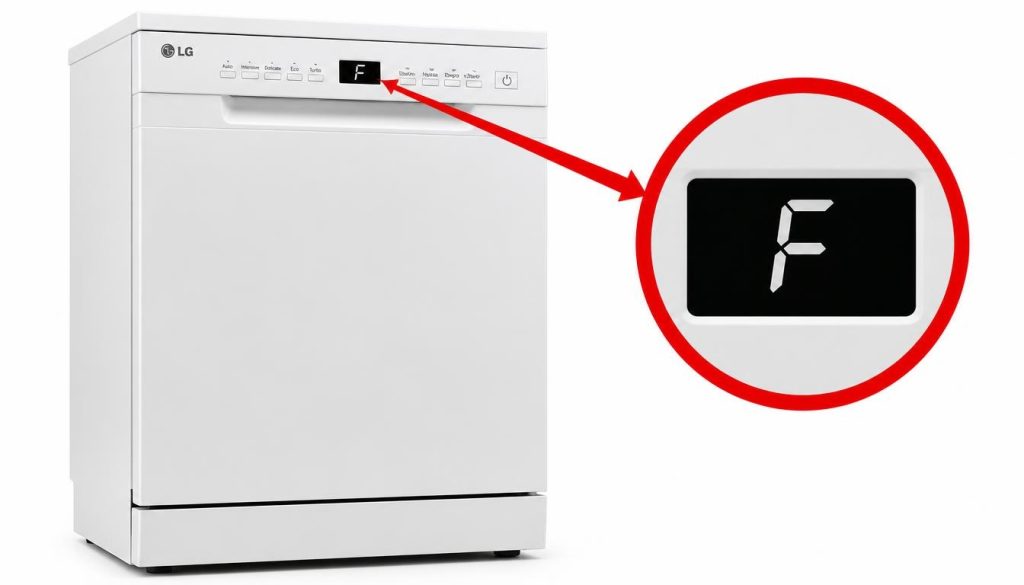
LG Dishwasher F Error: F31, F35, F37 Explained
The LG dishwasher F error is not a single code. LG’s official dishwasher error guide presents the F-series as a family of codes that apply to models featuring the Dynamic Heat Dry system, and each code points to a different component within that system. LG’s guide lists three F codes: F31, F35, and F37.
This structure matters because a user who sees an “F” code cannot treat it as one generic fault. The specific number after the F identifies which part of the Dynamic Heat Dry system has reported a problem. F31 concerns the heat dry fan motor, F35 concerns the temperature measurement of the heat dry components, and F37 concerns the Auto Open Door feature. LG’s instruction for all three is the same: a detailed inspection is necessary, and the user should request service.
This article explains what the LG dishwasher F error family means, the Dynamic Heat Dry context that connects the codes, each code’s definition, why LG directs the user to service rather than to a user-level fix, what the user can reasonably observe before calling, how the F-series differs from other LG dishwasher codes, and what the guide’s model-variation note means for interpreting the display.
?What Does the LG Dishwasher F Error Mean
The LG dishwasher F error means that a component within the Dynamic Heat Dry system has reported a condition that requires inspection. LG’s guide introduces the F-series with a shared qualifier: “This error code is applicable to models featuring Dynamic Heat Dry”. The F codes are therefore specific to dishwashers equipped with that drying system, and they do not apply to models without it.
The Dynamic Heat Dry system combines a fan motor, a heater, temperature sensing, and in some configurations an Auto Open Door feature. The F codes map onto these components. F31 is displayed when the heat dry fan motor does not operate. F35 is displayed when the temperatures of Heat Dry components cannot be measured. F37 is displayed when the Auto Open Door feature does not function.
The LG dishwasher F error is therefore a drying-system alert, not a wash-system alert. It does not point to the water inlet, the drainage path, the wash pump, or the detergent. It points to the components that dry the dishes after the wash cycle, and its resolution follows the drying system’s service path.
The Dynamic Heat Dry Context
The F-series codes share a single technological context: the Dynamic Heat Dry system. LG’s guide does not describe the system’s internal operation in detail, but the code definitions identify its key parts. The fan motor moves air through the drying circuit. The heater raises the air temperature. Temperature sensors monitor the heat dry components. The Auto Open Door feature opens the door at the end of the cycle to release moisture.
When one of these parts fails or reports an abnormal condition, the corresponding F code appears. The LG dishwasher F error family is the machine’s way of telling the user which part of the drying system needs attention. Because these components are internal and involve both electrical and mechanical elements, LG’s guide does not provide a user-level repair procedure. It provides the code definition and the instruction to request service.
F31: Heat Dry Fan Motor Does Not Operate
F31 is displayed when the heat dry fan motor does not operate. LG’s definition is direct: the fan motor that circulates air during the drying cycle is not running. LG states that the issue may lie with a component of the fan motor or the fan motor itself, and directs the user to request service because a detailed inspection is necessary.
The fan motor is central to the drying function. Without airflow, the heat dry system cannot move warm air through the tub, and the drying performance declines. The LG dishwasher F error in this case points to the airflow side of the drying system. LG’s guide does not describe a user-level check for the fan motor, and it does not suggest a reset or a cleaning procedure. The instruction is service.
F35: Heat Dry Temperature Cannot Be Measured
F35 is displayed when the temperatures of the Heat Dry components cannot be measured. LG states that the issue may lie with the heat dry heater or the temperature sensor, and directs the user to request service because a detailed inspection is necessary.
This code points to the temperature-sensing side of the drying system. The machine cannot confirm the temperature of the heat dry components, which means it cannot safely regulate the drying cycle. The LG dishwasher F error in this case involves either the heater that produces the heat or the sensor that measures it. LG’s guide does not separate the two possibilities into user-level steps; it identifies both as candidates for the service inspection.
F37: Auto Open Door Does Not Function
F37 is displayed when the Auto Open Door feature does not function. LG provides one user-level check for this code: ensure that there are no interferences near the door. If an object is blocking the door’s movement, removing it may restore the feature. If no interference is present, LG states that the issue may lie with the components functioning auto door open, and directs the user to request service.
The Auto Open Door feature is part of the drying system on models that support it. The door opens slightly at the end of the cycle to release humid air. The LG dishwasher F error in this case points to the mechanism that performs that opening. LG’s guide is the only one in the F-series that includes a user-level check, and that check is limited to confirming that nothing is blocking the door.
Why LG Directs the User to Service
The LG dishwasher F error family is consistently routed to service in LG’s guide. For F31 and F35, the instruction is identical: the issue may lie with a component, and a detailed inspection is necessary, so the user should request service. For F37, the service instruction applies after the interference check.
This routing reflects the nature of the components involved. The heat dry fan motor, the heater, the temperature sensor, and the Auto Open Door mechanism are internal assemblies. Diagnosing which specific component has failed requires access to the drying system and testing of electrical and mechanical parts. LG’s guide does not describe a user procedure for these checks, and it does not suggest a reset or a maintenance step that would resolve the code without service.
The LG dishwasher F error is therefore not a code that the user is expected to clear through a cleaning routine or a detergent change. The guide provides the definition and the service instruction, and the repair path runs through a technician’s inspection.
What the User Can Observe Before Calling
LG’s guide does not provide user-level troubleshooting steps for F31, F35, or F37 beyond the door-interference check for F37. However, a few observations can help the user prepare for the service call without attempting repairs.
Note whether the dishes are coming out wet at the end of the cycle. A wet load is consistent with a drying-system fault, and it confirms that the LG dishwasher F error is affecting the drying function rather than the wash function.
Note whether the code appears on every cycle or intermittently. A consistent code points to a persistent component condition. An intermittent code may involve a connection or a sensor that the technician can test.
For F37 specifically, check the area around the door for objects that could block its movement before concluding that the mechanism has failed. LG’s guide identifies interference as the first thing to check for this code.
These observations are not repairs, and they do not replace LG’s instruction to request service. They are simply the kind of information that makes the service visit more efficient.
F-Series vs. Other LG Dishwasher Codes
The LG dishwasher F error family is distinct from the other codes in LG’s dishwasher guide, and the distinction helps confirm the diagnosis.
The FE/AE(RE) codes relate to water supply, overfill, oversudsing, leveling, and leak detection. The IE code relates to the water inlet. The OE code relates to drainage. The tE code relates to the temperature sensor. The HE code relates to the heater that heats wash water. The LE code relates to the cleaning motor. The PE code relates to the water level sensor. The bE code relates to oversudsing. The nE code relates to the impeller. The CL code is the Control Lock indicator.
The LG dishwasher F error is the only family in the guide that is explicitly tied to the Dynamic Heat Dry system. Its codes are drying-system codes, not wash-system or water-system codes. A user who sees F31, F35, or F37 should not clean the drain filter, check the water supply, or adjust the detergent. Those actions belong to other codes. The F-series directs the user to the drying components and to service.
The Model-Variation Note
LG’s guide includes a note that applies to the entire error code list: “This guide was created for all models, so the images or content may be different from your product”. For the LG dishwasher F error, this note has practical significance. Not every LG dishwasher has the Dynamic Heat Dry system, and not every model that has it will display all three F codes. The codes apply only to models featuring Dynamic Heat Dry, and the specific code that appears depends on which component has reported the condition.
The note also means that the user should treat the guide’s definitions as general and confirm the code’s meaning against the manual for their specific model if the display shows an F code that the guide does not list. The LG dishwasher F error family in LG’s guide consists of F31, F35, and F37, but model-specific documentation remains the authoritative source for any particular machine.
Quick Reference Table
| Code | What It Means | LG’s Recommended Action |
|---|---|---|
| F31 | Heat dry fan motor does not operate | Request service; detailed inspection is necessary |
| F35 | Temperatures of Heat Dry components cannot be measured | Request service; heater or temperature sensor may be at fault |
| F37 | Auto Open Door feature does not function | Check for interference near the door; request service if none |
| Dynamic Heat Dry qualifier | The F codes apply only to models with this system | Confirm your model’s features before interpreting the code |
| Dishes are wet at cycle end | Drying function is affected | Report this observation to the technician |
| Code appears on every cycle | Persistent component condition | Request service |
| Code appears intermittently | Possible connection or sensor issue | Request service and describe the pattern |
Frequently Asked Questions
?What does the LG dishwasher F error mean
The F error is a family of codes specific to models featuring Dynamic Heat Dry. LG’s guide lists F31, F35, and F37, each pointing to a different component in the drying system.
?Is there a single “F” error code
LG’s guide does not list a standalone “F” code. It lists F31, F35, and F37 as the F-series codes for Dynamic Heat Dry models.
?What is F31
F31 is displayed when the heat dry fan motor does not operate. LG states that the issue may lie with a component of the fan motor or the fan motor itself, and directs the user to request service.
?What is F35
F35 is displayed when the temperatures of the Heat Dry components cannot be measured. LG states that the issue may lie with the heat dry heater or the temperature sensor, and directs the user to request service.
?What is F37
F37 is displayed when the Auto Open Door feature does not function. LG advises ensuring that there are no interferences near the door, and requesting service if the issue lies with the auto door open components.
?Can I fix an LG dishwasher F error myself
LG’s guide does not provide user-level repair procedures for F31, F35, or F37 beyond the door-interference check for F37. The instruction for all three is to request service because a detailed inspection is necessary.
?Why does LG say the F error requires service
Because the components involved—the fan motor, the heater, the temperature sensor, and the Auto Open Door mechanism—are internal assemblies that require access and testing to diagnose. LG’s guide routes these codes to service rather than to a user procedure.
?Do all LG dishwashers display F errors
No. The F codes apply only to models featuring Dynamic Heat Dry. Models without that system do not use these codes.
What should I check before calling for service on F37?
Check for objects or obstructions near the door that could prevent it from opening. LG’s guide identifies interference as the first thing to check for this code.
?What should I tell the technician when I call
Describe which F code appears, whether it is consistent or intermittent, and whether the dishes are wet at the end of the cycle. For F37, mention whether any obstruction was found near the door.
?Does the F error affect the wash cycle
The F codes relate to the drying system, not the wash system. The wash portion of the cycle may run normally, but the drying performance is affected because a drying component has reported a condition.
?Where can I confirm the code for my specific model
LG’s guide notes that it was created for all models and that the content may differ from your product. The manual for your specific model is the authoritative source.
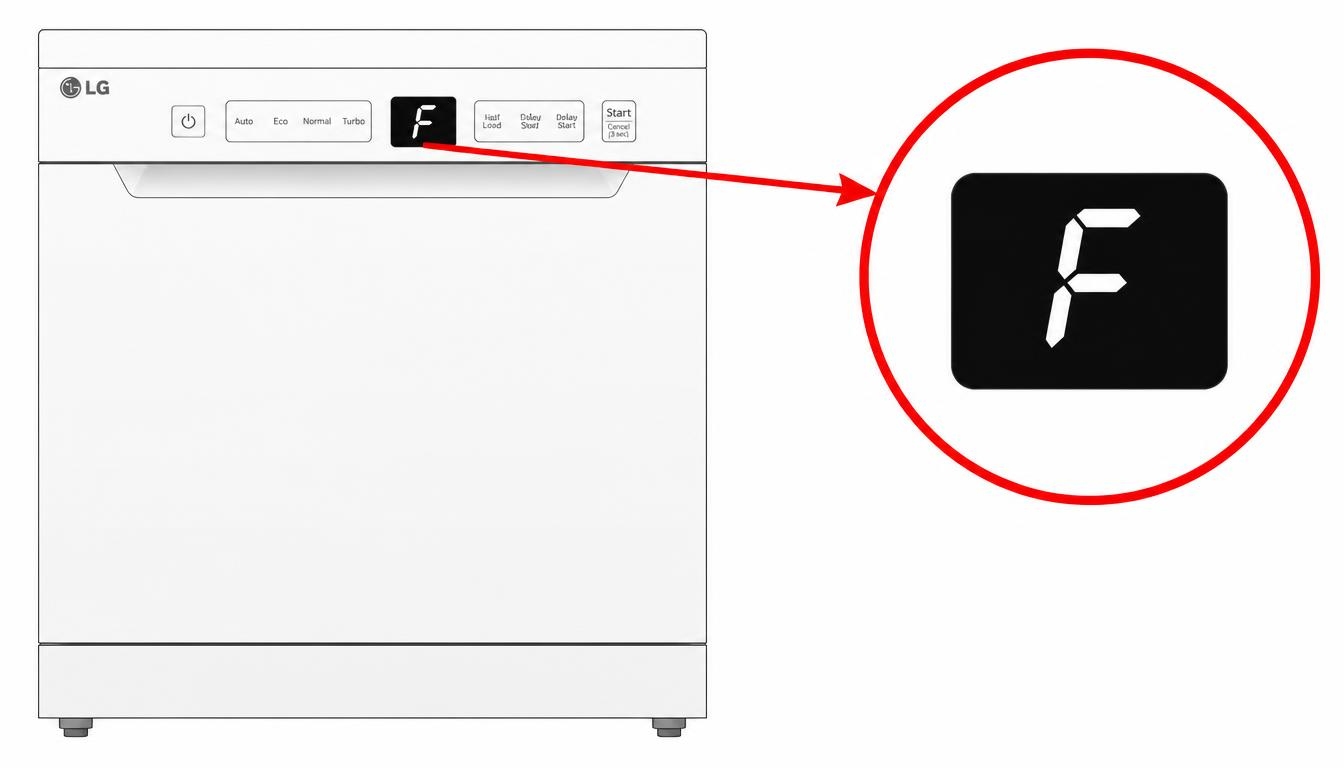
When the LG Dishwasher F Error Requires Service
The LG dishwasher F error requires service under the condition LG’s guide states for each code. For F31 and F35, the instruction is unconditional: request service because a detailed inspection is necessary. For F37, the instruction is to check for interference near the door first, and to request service if the issue lies with the auto door open components.
Service is the appropriate next step because the remaining causes are component-level conditions in the Dynamic Heat Dry system. The fan motor, the heater, the temperature sensor, and the Auto Open Door mechanism are not user-serviceable parts in LG’s guide. Diagnosing which component has failed requires access to the drying system and testing that falls outside the scope of the guide’s user instructions.
It is also worth noting that the LG dishwasher F error is not a water or drainage code. The troubleshooting for FE, IE, OE, and bE does not apply to the F-series. A user who sees F31, F35, or F37 should not attempt the filter cleaning, hose straightening, or detergent adjustments that belong to other codes. The F-series directs the user to the drying components and to service.
Preventing F-Series Codes
LG’s guide does not include a prevention section for the LG dishwasher F error family. The codes report component conditions in the Dynamic Heat Dry system, and the guide’s guidance is limited to the code definitions and the service instruction.
What the guide does support is a correct response pattern when an F code appears: identify the specific code, note whether the dishes are wet, check for door interference in the case of F37, and request service according to the guide’s instruction. This pattern avoids the two common errors that can delay a proper repair: treating the F code as a water-system problem and attempting unrelated troubleshooting, or ignoring the code and continuing to run cycles with a drying system that is not functioning as designed.
