


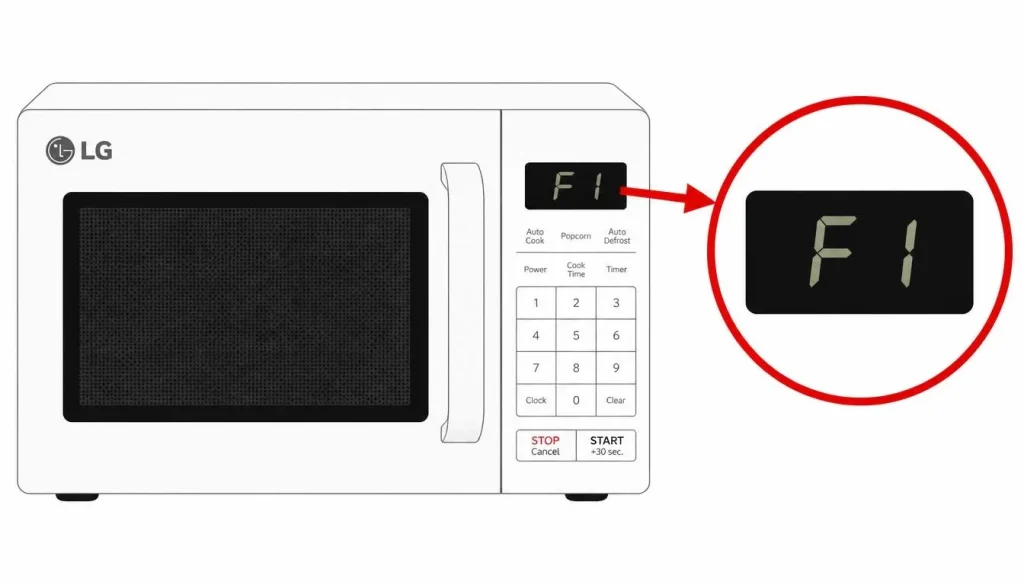
LG Microwave F-1 Error: Thermistor Fault and Fix
When F-1 appears on an LG microwave display, the appliance is reporting that its cavity temperature sensor—the thermistor—has an open circuit and is no longer sending a reading to the control board. The LG microwave F-1 error is therefore a sensor-level fault rather than a magnetron failure, a door-switch problem, or a high-voltage breakdown. The control board has lost its temperature feedback from inside the cooking cavity, and it refuses to run rather than operating without any way to detect an overheating condition.
This distinction matters because the safety stakes in a microwave are higher than in most appliances. The magnetron and the high-voltage capacitor can hold a lethal charge even after the appliance is unplugged, and the cabinet is not a user-serviceable area. The LG microwave F-1 error is one of the codes that can be diagnosed from the outside and repaired by a technician, but it is not a code that invites the owner to open the case.
A note on sourcing is necessary before proceeding. The two links supplied for this article do not cover the microwave F-1 code. The first link is an LG Canada page for the refrigerator IF/F1 code, which describes an ice-maker fan fault, and the second is an LG USA range error code list for cooking appliances. Neither page contains microwave-specific F-1 troubleshooting. The microwave-specific information in this article is therefore drawn from dedicated LG microwave repair guides, which are identified as repair guidance rather than LG’s consumer support pages.
This article explains what the LG microwave F-1 error means, how F-1 differs from F-2, the causes repair guidance identifies, the reset procedure that should be attempted first, the diagnostic steps a technician follows, the safety rules that apply to microwave repairs, the circumstances in which the microwave should be taken out of service, and the practical prevention measures that reduce the chance of a recurrence.
?What Does the LG Microwave F-1 Error Mean
The LG microwave F-1 error means that the cavity thermistor has an open circuit. The thermistor is the component that monitors the temperature inside the cooking cavity. When it is working, it reports a resistance that changes with temperature, and the control board uses that reading to regulate cooking and to trigger over-temperature protection if the cavity gets too hot. When the thermistor’s circuit is open, the sensor reports nothing at all, and the control board treats the absence of a reading as a reason to stop rather than a detail to work around.
LG’s microwave manual confirms the same definition. The manual lists F1 with the cause “High Temperature Sensor Open,” and lists F2 with the cause “High Temperature Sensor Short”. The manual’s framing is useful because it places F-1 and F-2 side by side: they are the same sensor failing in opposite directions. F-1 is the open circuit, which reads as impossibly cold, and F-2 is the short circuit, which reads as impossibly hot.
The LG microwave F-1 error is therefore not a general control board fault in its primary definition, although some repair sources describe F1 more broadly as a control board or keypad fault. The weight of the LG-specific documentation and the dedicated microwave repair guidance points to the thermistor as the primary meaning, and the article follows that interpretation while noting the alternative reading where it appears.
F-1 vs. F-2: The Same Sensor, Opposite Failures
The LG microwave F-1 error is best understood alongside F-2, because the two codes describe the same sensor failing in opposite directions. LG’s manual states that F1 is the “High Temperature Sensor Open” and F2 is the “High Temperature Sensor Short”. Repair guidance explains the practical consequence: an open circuit reads as impossibly cold, and a short circuit reads as impossibly hot.
This distinction matters for diagnosis. A thermistor that is open has a broken internal element or a disconnected lead, and the resistance measurement reads infinite or out of range. A thermistor that is shorted has an internal short or crossed wires, and the resistance measurement reads zero or near zero. Both conditions produce a fault code, but the F-1 code is the open-circuit case, and the technician’s resistance test is what confirms which failure mode is present.
The two codes also share the same safety classification in repair guidance. Both are described as “safe to keep using” in the sense that the microwave is not presenting a hazard while the sensor fault is pending repair, although the appliance will not cook until the fault is resolved. This is different from F-7 (a stuck relay) and F-9 (over-temperature protection), which repair guidance describes as codes that mean the appliance should be switched off at the outlet or breaker.
Causes of the LG Microwave F-1 Error
Repair guidance identifies four causes for the LG microwave F-1 error, and each affects the thermistor circuit at a different point.
Cavity Thermistor Failure
The first cause is the cavity thermistor itself. The sensor can fail from steam and food-splash exposure, which degrade the thermistor element over time and eventually break the internal circuit. This is the most direct cause of the open-circuit condition that F-1 reports.
Corroded Harness Connector
The second cause is a corroded wire-harness connector. Moisture and cooking vapors can reach the connector that joins the thermistor to the control board, and corrosion on the pins can interrupt the signal path. The thermistor may be healthy, but the board receives no reading because the connection has degraded.
Control Board ADC Input Failure
The third cause is a failure in the control board’s analog-to-digital converter input. The board’s ADC circuit is what reads the thermistor’s resistance and converts it into a temperature value. If that input circuit has failed, the board may interpret a healthy sensor as open, and the F-1 code appears even though the thermistor and harness are intact.
Dislodged Thermistor Mounting
The fourth cause is a thermistor that has come loose from its mounting on the cavity wall. If the sensor is dislodged, it may no longer make contact with the cavity surface, and its reading can fall outside the expected range or become open. This cause is mechanical rather than electrical, but it produces the same fault code.
The Reset Procedure: What to Try First
The first response to the LG microwave F-1 error is a power reset. Repair guidance describes a standard procedure: press the Stop/Clear button to dismiss the error, unplug the microwave (or flip the breaker for over-the-range and built-in models) for 60 seconds, plug it back in, and attempt a one-minute cook cycle with a microwave-safe cup of water inside.
The purpose of the reset is to allow the control board to discharge and re-initialize. If the F-1 code was caused by a transient glitch rather than a permanent open circuit, the reset may clear the code and the microwave may resume normal operation. Repair guidance notes that if the error returns after the reset, the specific code troubleshooting applies, and the thermistor, harness, or control board becomes the diagnostic target.
The reset is diagnostic as well as corrective. If the LG microwave F-1 error clears and does not return, the cause was likely transient. If the code returns immediately or during the first cook cycle, a persistent sensor, connector, or board condition is present, and the service path applies. The reset should not be repeated indefinitely; one reset is the documented step, and a returning code requires diagnosis rather than another reset.
What the Technician Tests
The LG microwave F-1 error is diagnosed by measuring the thermistor’s resistance against the model’s specification and checking the harness connector for corrosion. Repair guidance describes the sequence: the technician measures the thermistor’s resistance against the value on the model’s tech sheet, checks the harness connector for corrosion from cooking vapors, and if the thermistor reads within specification, tests the main control board’s ADC circuit.
This sequence matters because it separates the three possible fault points. If the thermistor reads open or far out of range, the sensor has failed and requires replacement. If the thermistor reads within specification but the connector shows corrosion, the harness or connector requires repair. If both the thermistor and the connector test good, the control board’s input circuit is the remaining suspect, and the board requires replacement.
The resistance test is not a user procedure. The thermistor and its connector sit behind the outer casing, next to the high-voltage capacitor, and repair guidance states explicitly that owners never open a microwave cabinet because the capacitor can hold a lethal charge even when the appliance is unplugged. The diagnostic work belongs to a technician with the correct tools and the knowledge to discharge the capacitor safely.
Safety Rules for the LG Microwave F-1 Error
The LG microwave F-1 error involves a sensor circuit inside the microwave cabinet, and the safety rules for microwave repairs are stricter than for most appliances. Repair guidance is direct: never open a microwave cabinet, because the high-voltage capacitor holds a dangerous charge long after the appliance is unplugged. The same guidance states that repairs beyond basic door, turntable, and control-panel issues should not be attempted without professional training, because the magnetron operates at extremely high voltage.
These warnings are not boilerplate. A microwave’s high-voltage circuit includes the capacitor, the diode, and the magnetron, and the capacitor can retain a charge that is lethal even when the unit is disconnected from the wall. The thermistor itself operates at low voltage, but reaching it requires removing the outer casing and working in the same compartment as the high-voltage components. The LG microwave F-1 error is a low-voltage fault in a high-voltage environment, and that combination is exactly why the repair is a technician’s job.
Repair guidance also distinguishes the codes that are safe to wait on from the codes that are not. F-1 and F-2 are described as sensor codes that are safe to keep using in the sense that the appliance is not presenting an immediate hazard, and the repair can be booked as an appointment. F-7 and F-9 are different: F-7 is a relay that has welded closed and is passing power when the control has told it to stop, and F-9 is an over-temperature protection trip. Both of those codes mean the appliance should be switched off at the outlet or breaker, not booked for a later visit.
When the F-1 Error Means the Microwave Should Be Taken Out of Service
The LG microwave F-1 error normally means the microwave will not cook, but it does not normally mean the microwave is dangerous. Repair guidance describes F-1 as a sensor fault that is safe to keep using while a repair is arranged, in the sense that the appliance is not presenting the kind of hazard that F-7 or F-9 present.
There are, however, circumstances in which the microwave should be taken out of service rather than used while waiting for the repair. If the microwave displays F-1 together with sparking, buzzing, or arcing, the fault is no longer a simple sensor issue, and the appliance should be switched off at the outlet or breaker. If the microwave displays F-1 together with F-7 or F-9, the safety-critical code takes precedence, and the appliance should be taken out of service immediately. If the microwave has been running with the door open, or if there is any sign of smoke or burning, the appliance should be disconnected and not used until a technician has inspected it.
The general rule from repair guidance is that the F numbers group by what kind of thing failed, and the question owners actually have is not what the code means but whether the appliance is safe to keep using while they arrange something. For F-1, the answer is that the appliance is safe to keep in the kitchen but will not cook, and the repair can be scheduled. For F-7 and F-9, the answer is that the appliance should be switched off.
Preventing the F-1 Error
The LG microwave F-1 error cannot always be prevented, because thermistor failures can be age-related and the sensor is exposed to steam and food splash during normal use. However, a few practical measures reduce the conditions that lead to the fault.
Keeping the microwave cavity clean and free of food residue reduces the moisture and vapor exposure that degrade the thermistor and corrode the harness connector. Wiping the cavity after each use and avoiding overheating of liquids and foods that produce heavy steam support the sensor’s longevity. For over-the-range models, running the vent fan while the cooktop is on reduces the steam, heat, and grease-laden air that reach the microwave’s underside, which repair guidance identifies as a key preventive measure for the sensor and keypad codes that appear disproportionately on over-the-range units.
Quick Reference Table
| Situation or Check | What It Means | What To Do |
|---|---|---|
| F-1 appears on the display | Cavity thermistor has an open circuit | Press Stop/Clear, unplug for 60 seconds, and retest |
| F-1 clears after the reset | Possible transient glitch | Monitor for recurrence |
| F-1 returns during a cook cycle | Persistent sensor, connector, or board fault | Book a repair; do not open the cabinet |
| F-2 appears instead of F-1 | Thermistor is shorted, not open | Follow the same repair path |
| F-1 appears with sparking or arcing | Not a simple sensor fault | Switch off at the outlet or breaker and call a technician |
| F-7 or F-9 appears alongside F-1 | Safety-critical code is present | Take the microwave out of service immediately |
| Food is not heating but no code shows | A different fault may be present | Do not assume the thermistor is the cause; request diagnosis |
| Microwave is over-the-range | Steam and grease exposure is higher | Run the vent fan during cooktop use |
Frequently Asked Questions
?What does the LG microwave F-1 error mean
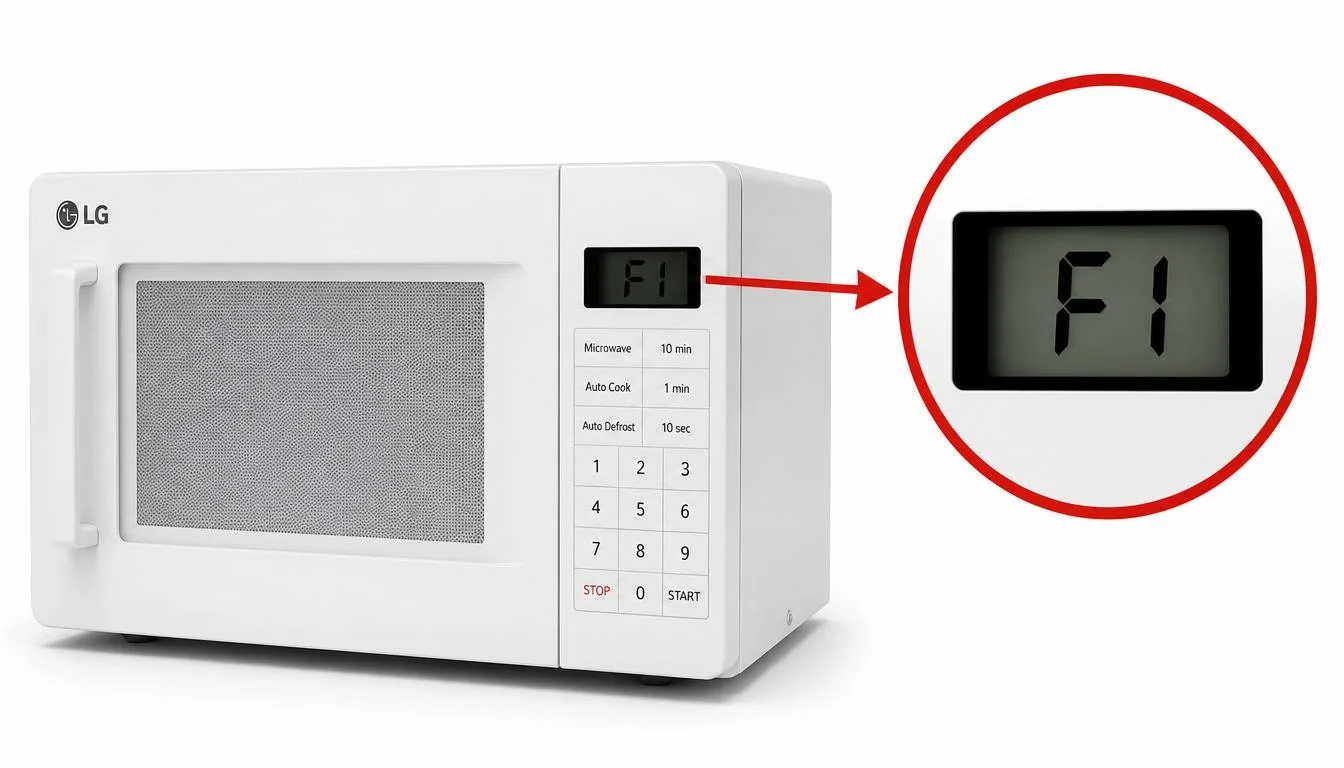
F-1 means the cavity thermistor—the temperature sensor inside the cooking cavity—has an open circuit and is no longer reporting a reading. LG’s manual lists F1 as “High Temperature Sensor Open”.
?Is F-1 the same as F-2
No. F-1 is the open-circuit failure of the thermistor, and F-2 is the short-circuit failure of the same sensor. Both require repair, but the electrical condition is opposite.
?Can I fix the LG microwave F-1 error myself
The only user-level step is the power reset: press Stop/Clear, unplug the microwave for 60 seconds, plug it back in, and test with a cup of water. If the code returns, the thermistor, harness, and control board require testing, and that work belongs to a technician because the cabinet contains a lethal high-voltage charge.
?How do I reset the LG microwave after an F-1 error
Press the Stop/Clear button to dismiss the error, unplug the microwave (or flip the breaker for over-the-range and built-in models) for 60 seconds, plug it back in, and attempt a one-minute cook cycle with a microwave-safe cup of water inside.
?What causes the LG microwave F-1 error
The causes are cavity thermistor failure from steam and food splash, a corroded harness connector, a control board ADC input failure, and a thermistor that has come loose from its mounting.
?Is it safe to keep using the microwave with F-1 showing
Repair guidance describes F-1 as a sensor code that is safe to keep in the kitchen while a repair is arranged, but the microwave will not cook until the fault is resolved. If F-1 appears with sparking, arcing, F-7, or F-9, the appliance should be switched off and taken out of service.
?Can I open the microwave to check the thermistor myself
No. Repair guidance is explicit: never open a microwave cabinet, because the high-voltage capacitor holds a dangerous charge long after the appliance is unplugged. The thermistor sits next to the high-voltage capacitor, and the repair requires professional tools and training.
?What does a technician test for F-1
The technician measures the thermistor’s resistance against the model’s specification, checks the harness connector for corrosion, and if the thermistor reads within specification, tests the control board’s ADC circuit.
?Is F-1 worth repairing
Repair guidance describes F-1 as one of the least expensive faults on the microwave to fix, because the thermistor is a small, inexpensive part, and it favors repair over replacement in most cases, especially for built-in and over-the-range models.
?Does F-1 affect the magnetron
F-1 is a sensor fault, not a magnetron fault. Repair guidance notes that F-1 is far cheaper to fix than a magnetron or high-voltage circuit fault, and that the sensor fault is caught before it can damage the magnetron or the cavity liner.
?Where can I confirm the F-1 meaning for my model
The model’s owner’s manual and tech sheet are the authoritative sources. LG’s manual lists F1 as “High Temperature Sensor Open,” and the model-specific documentation confirms the resistance specification the technician uses.
