


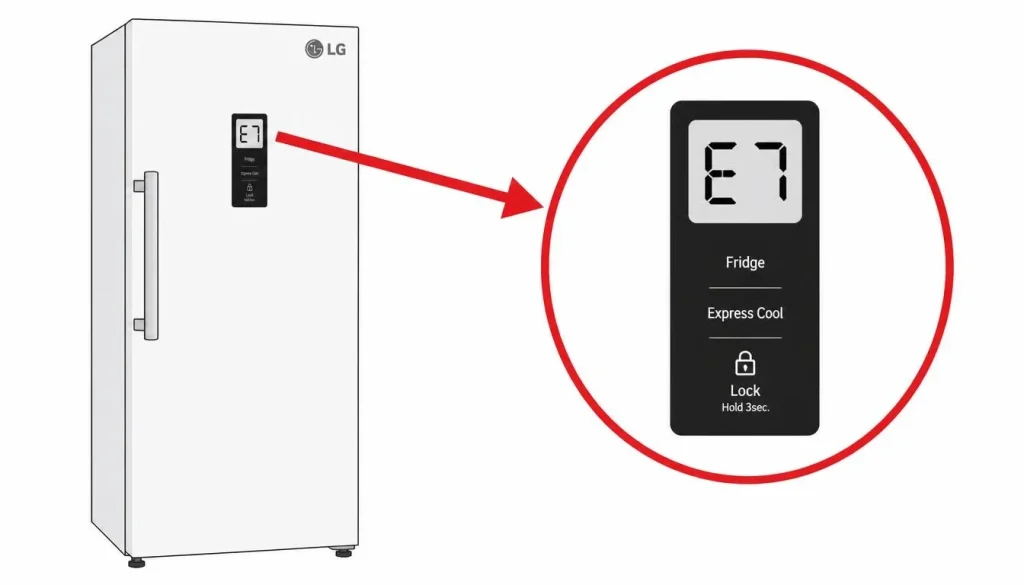
LG Refrigerator E7 Error: Communication or Sensor Fault
The LG refrigerator E7 error is a code without a single, authoritative definition in LG’s consumer-facing documentation. The two sources supplied for this article demonstrate the gap directly. The first source is an LG support page for the LG washer E7 error, which describes a stacking switch problem on the Sidekick pedestal washer and states that the error occurs when the Mini Washer is used without the top washing machine or when the top washing machine detection device is damaged . That page is categorized under Laundry Accessories and Washers, not refrigerators . The second source is an LG Parts refrigerator error code list that covers EFS, ErS, ESS, EIS, FdS, Ert, EHS, EId, EIO, EIt, EIU, EIC, and EgF, but it does not include an E7 entry .
The LG refrigerator E7 error therefore cannot be defined from a single LG page or a single parts list. Its meaning must be assembled from repair literature and regional LG documentation, and those sources describe the code differently. Some sources describe E7 as a communication failure between the refrigerator’s control modules. Others describe it as an ambient temperature sensor error, a thermostat problem, or an operational cycle fault. Each description is a documented interpretation for some LG refrigerator, and none of them can be presented as the universal meaning of the code.
This article explains why the E7 code is ambiguous, what each source says about it, the difference between the codes that LG documents clearly and the E7 code that it does not, the reset procedure that applies regardless of the specific interpretation, the safety warnings that accompany any internal refrigerator fault, and the practical approach a user should take when the code appears. The article is deliberately transparent about the limits of the available documentation, because inventing a single definition for E7 would misrepresent what the sources actually say.
Why the E7 Code Is Ambiguous
The LG refrigerator E7 error is ambiguous for the same structural reasons that affect several of LG’s numeric codes, and understanding them explains why the sources conflict.
The first reason is that LG’s error code assignments are model-dependent. LG produces refrigerators across many platforms, generations, and regions, and the same numeric code can be assigned to different conditions on different platforms. A code that means “communication failure” on one model family can mean “ambient sensor error” on another, because the control board’s diagnostic logic is written for the specific hardware configuration of that model.
The second reason is that LG’s consumer-facing documentation does not cover every code. LG publishes detailed support pages for the codes that generate the most service calls—FF, CF, CO, dH, FS, rS, and the other high-frequency codes—but it does not publish a dedicated page for every numeric code in its library. The E7 code falls into the gap between the fully documented codes and the codes that appear only in service manuals or regional error tables.
The third reason is that repair literature fills the gap inconsistently. Independent repair sources and regional LG pages each describe E7 according to the models they have encountered, and their descriptions do not align. A user who searches for the code will find several different answers, and the sources do not cite a common authority that resolves the conflict.
The practical consequence is that a user who sees E7 cannot assume a single cause. The code must be interpreted in the context of the specific model, the symptoms that accompany it, and the model’s own manual.
What the Supplied Sources Actually Say
The two sources supplied for this article are worth examining closely, because they demonstrate why the E7 code cannot be defined from a single reference.
The First Source: An LG Washer Page
The first source is an LG USA support page titled “LG washing machine – Why is an E7 error code displayed?” The page states that the error occurs when the Mini Washer is used only without the top washing machine, and that it also occurs when the top washing machine detection device is damaged . The page’s instruction is that the Mini Washer can operate only when there is a front load washing machine accepted by the Mini Washer at the top, that the Mini Washer cannot be used alone, and that if the error is displayed even though a compatible washing machine has been installed normally, the user should contact an LG Electronics service center .
This page is an LG source, and its information is accurate—for LG washers. It does not describe a refrigerator code. The page’s category listing confirms that it belongs to Laundry Accessories and Washers, not refrigerators . A user who applies the washer stacking-switch procedure to a refrigerator will not resolve the LG refrigerator E7 error, because the component described does not exist in a refrigerator.
The page is included here because it was supplied as a source, and it is cited to make the point that the E7 code on an LG washer and the E7 code on an LG refrigerator are different codes with different meanings. The washer page does not contribute to the refrigerator definition.
The Second Source: A General Error Code List
The second source is an LG Parts refrigerator error code list. The page covers freezer sensor defects (EFS), refrigerator sensor defects (ErS), pantry sensor defects (ESS), ice-room sensor defects (EIS), freezer defrosting sensor defects (FdS), room temperature sensor defects (Ert), humidity sensor defects (EHS), and several ice-maker sensor and motor defects (EId, EIO, EIt, EIU, EIC, EgF) . Each entry describes a short-circuit, disconnection, or malfunction, with causes and solutions such as checking wiring, replacing the sensor, and resetting the appliance by unplugging it .
The page does not include an E7 entry. It lists the conditions by name rather than by code number in most of its sections, and the codes that do appear do not include E7 . The page is therefore useful as a general reference for refrigerator sensor faults, but it does not define the LG refrigerator E7 error.
The gap in the second source is significant. If LG’s own parts documentation does not list E7 among the refrigerator error codes, then the code’s meaning must come from elsewhere, and the elsewhere is the repair literature and the model-specific manuals.
The Documented Interpretations of E7
Repair literature and regional LG error tables offer several interpretations of the LG refrigerator E7 error. Each is presented below as the source states it, without resolving the conflict, because the sources do not agree.
E7 as a Communication Failure
A Chinese LG refrigerator error code list describes E7 as “通讯不合格,” which translates to a communication failure or communication non-conformance . The same list groups E6 as an over-temperature alarm and E8 as a zero-crossing non-conformance, placing E7 in the communication family rather than the sensor or defrost families .
A second Chinese LG error code list describes E7 as a “通讯故障” (communication fault) and explains that the refrigerator’s control system may have a communication problem, possibly caused by a poor wiring connection or a control board fault .
An English-language repair source, Alex Appliances, lists LG refrigerator error codes and describes E7 as an “Ambient temperature sensor error” . That source does not describe E7 as a communication fault, which illustrates the divergence between the sources.
E7 as an Ambient Temperature Sensor Error
Alex Appliances’ LG refrigerator code list states that E7 indicates an ambient temperature sensor error . The ambient sensor measures the room temperature around the refrigerator rather than the temperature inside the food compartments, and it is a distinct component from the freezer and fresh-food thermistors.
A Turkish refrigerator error code page also associates E7 with an ambient sensor fault on some brands, describing it as a room-temperature sensor issue . That page is a cross-brand reference rather than an LG-specific source, but it shows that the ambient-sensor interpretation is one of the documented readings of E7 in the broader repair literature.
E7 as a Thermostat Problem
A Persian LG refrigerator error list describes E7 as “مشکل در ترموستات,” which translates to a thermostat problem . The same list assigns E4 to the evaporator fan, E5 to the condenser fan, E6 to the defrost heater, and E8 to the solenoid valve, placing E7 in the thermostat position within that model family’s code table .
E7 as an Operational Cycle Fault
Codeserreur, an English-language appliance error code database, describes LG E7 as an “Operational cycle fault detected during Refrigerator / Freezer program execution” . The same source lists component fatigue, sensor feedback out of tolerance, and wiring harness issues among the underlying causes . This interpretation treats E7 as a system-level fault rather than a specific sensor or communication code.
A German repair page describes E07 on LG refrigerators as a defrost fault, with ice accumulation blocking the air passages, the evaporator frosting over, or the defrost heater or its circuit not working correctly . The E07 versus E7 distinction is a display variation, and the defrost interpretation is another documented reading in the repair literature.
What the Interpretations Have in Common
The interpretations do not share a single component, but they share a structural feature: E7 is consistently treated as a fault code rather than a notification or a mode setting. None of the sources describes E7 as a Child Lock indicator, a demo-mode display, or a Cool Dry notification. The code appears when the refrigerator’s self-diagnosis has detected a condition that requires attention, and the specific condition depends on the model and the source.
The Reset Procedure That Applies to All Interpretations
Regardless of which interpretation applies to a specific refrigerator, the first response to the LG refrigerator E7 error is a power reset. LG’s general refrigerator error code guidance uses a standard procedure: unplug the refrigerator from the wall outlet, wait about 60 seconds, and plug it back into a direct outlet without extension cords or power strips .
The purpose of the reset is the same in every interpretation. The control board and the connected components discharge and re-initialize, and if the code was caused by a transient power or communication glitch, the reset may clear it. If the LG refrigerator E7 error clears and does not return, the cause was likely transient. If the code returns immediately or after a short period, a persistent condition is present, and the service path applies.
The reset should not be repeated indefinitely. One reset is the documented step. A code that returns after one reset is a code that requires diagnosis, not a code that requires another reset.
What to Do When the E7 Code Returns
If the LG refrigerator E7 error returns after the reset, the next step depends on the interpretation that matches the model and the symptoms.
If the refrigerator is not cooling in one or both compartments and the display shows E7, the temperature-related interpretations are relevant. The user should check the door seals, confirm that the vents are not blocked by food, and verify that the condenser coils at the back of the refrigerator are not covered in dust. If those checks do not resolve the code, the refrigerator requires service, because the cooling failure may involve the sealed system or a temperature sensor.
If the refrigerator is cooling but the display shows E7 and the controls or display behave erratically, the communication interpretation is relevant. The code may indicate a fault between the main board and another control module, and the service diagnosis focuses on the boards and the harness between them .
If the refrigerator is cooling but frost is visible on the evaporator and the display shows E7, the defrost interpretation is relevant. The user-level response is the natural thaw procedure that LG documents for defrost codes: move the food, unplug the refrigerator, open the doors wide, and wait for the ice to melt. If the code returns after a full thaw, the defrost heater, fuse, sensor, or board requires service.
If the ambient temperature in the room is unusually high or low and the display shows E7, the ambient sensor interpretation is relevant . The refrigerator may be struggling to regulate its temperature because the room conditions are outside the expected range, and the code may clear once the environment returns to normal.
In every case, the model’s own manual is the authority. LG’s error code assignments vary by model, and the manual for the specific refrigerator states which meaning applies to that machine.
Safety Warnings for the E7 Code
The LG refrigerator E7 error involves the refrigerator’s internal electronics, sensor circuit, or cooling system, and the safety warnings that apply to refrigerator repairs apply here. LG’s general error code guidance states that users should not disassemble the refrigerator or replace internal parts themselves, because doing so may cause fire, electric shock, serious injury, or death. The same guidance states that if the error code persists, the user should stop using the refrigerator and contact LG Support for service.
These warnings are not boilerplate. The E7 interpretations that involve the control board, the sensor wiring, or the defrost circuit all require access to internal components that carry line voltage or are connected to the sealed system. The interpretations that involve the compressor or the sealed system are not user-serviceable at all. A user who opens the panels or attempts a component replacement without the correct procedure is exposed to real hazards.
When the E7 Code Requires Service
The LG refrigerator E7 error requires service when the reset does not clear it and the symptoms point to a component that the user cannot replace. The specific conditions depend on the interpretation that applies, but the general threshold is the same: a persistent code after a single reset is a service matter.
Service is the appropriate next step under the following conditions. If the refrigerator is not cooling and the door seal, vent, and coil checks do not resolve the problem, the sealed system or a temperature sensor may be involved, and that requires a technician. If the communication fault persists after the reset, the boards and the harness require diagnosis. If the defrost system is not completing its cycle and the natural thaw does not resolve the code, the heater, fuse, sensor, or board requires service. If the ambient sensor is suspected and the room conditions are within the normal range, the sensor or its wiring requires testing.
It is also important not to continue using the refrigerator indefinitely when the LG refrigerator E7 error persists. A refrigerator that is not cooling correctly can put the food at risk, and a defrost fault can lead to frost accumulation that reduces cooling performance over time. LG’s guidance is to request service, and the appliance’s own symptoms—warming compartments, frost buildup, or erratic display behavior—support that instruction.
Preventing E7 and Similar Codes
The LG refrigerator E7 error cannot always be prevented, because its causes range from sensor failures to communication glitches to cooling-system faults. However, a few practical measures support the reliability of the systems that produce the code.
Keeping the condenser coils clean and the area around the back of the refrigerator clear supports heat rejection and reduces the load on the compressor. Checking the door seals periodically and ensuring that the doors close fully prevents the warm-air intrusion that can trigger temperature-related conditions. Keeping the refrigerator on a stable power supply reduces the voltage fluctuations that can stress the control board and the communication link. Addressing a defrost-related code promptly prevents a sensor fault from interfering with the defrost cycle and producing a secondary code.
For users who have recently moved the refrigerator or had it serviced, the connector observation is worth noting. A connector disturbed during a repair or a move can produce a sensor or communication code. This is not a user repair step; it is information that helps the service diagnosis.
Quick Reference Table
| Interpretation | What It Suggests | What To Do |
|---|---|---|
| Communication failure | Fault between control modules or the board and display | Unplug for 60 seconds, plug back in, and check if the code cleared |
| Ambient temperature sensor error | Room-temperature sensor fault | Check the room conditions; request service if the code persists |
| Thermostat problem | Thermostat fault in the temperature control circuit | Request service for thermostat diagnosis |
| Operational cycle fault | System-level fault during program execution | Request service for component diagnosis |
| Defrost fault (E07 variant) | Ice buildup or defrost heater circuit issue | Perform the natural thaw; request service if it returns |
| Code persists after reset | Persistent component or system fault | Stop using the refrigerator and contact LG Support |
| Washer E7 code | Stacking switch error on an LG washer, not a refrigerator | Do not apply the washer procedure to a refrigerator |
Frequently Asked Questions
?What does the LG refrigerator E7 error mean
There is no single, authoritative LG definition for the refrigerator E7 code. Repair literature and regional error tables describe it variously as a communication failure, an ambient temperature sensor error, a thermostat problem, an operational cycle fault, and a defrost fault. The meaning depends on the specific model.
?Is the LG refrigerator E7 error the same as the LG washer E7 error
No. The LG washer E7 code indicates a stacking switch or Mini Washer detection problem and is resolved by ensuring the Mini Washer is installed under a compatible front-load washer. That procedure does not apply to a refrigerator, which does not have a stacking switch or a Mini Washer connection .
?Why do the sources disagree about E7
Because LG’s error code assignments are model-dependent, and LG does not publish a dedicated consumer support page for every numeric code. The E7 meaning is assembled from regional error tables and repair literature, and those sources describe different models with different diagnostic logic.
?Can I fix the LG refrigerator E7 error myself
The only user-level step is the power reset: unplug the refrigerator, wait about 60 seconds, and plug it back into a direct outlet. If the code returns, the remaining causes are internal component or system faults that require service.
?How do I reset the LG refrigerator E7 error
Unplug the refrigerator from the wall outlet, wait about 60 seconds, plug it back into a direct outlet without extension cords or power strips, and check whether the code has cleared.
?What should I do if E7 returns after the reset
If the code returns after the reset, LG’s general guidance is to stop using the refrigerator and contact LG Support for service. The specific diagnostic path depends on which interpretation matches the model and the symptoms.
?Does E7 affect both the freezer and the refrigerator compartment
It depends on the interpretation. The communication and operational-cycle interpretations can affect the whole appliance’s regulation. The ambient sensor interpretation relates to the room temperature rather than either compartment. The model’s manual and the observed symptoms determine the scope.
?Is it safe to keep using the refrigerator with E7 showing
LG’s general guidance is to minimize use and contact service if the code persists, because the refrigerator may not be able to control its internal systems correctly.
?Can I disassemble the refrigerator to check the E7 fault myself
No. LG warns that users should not disassemble the refrigerator or replace internal parts, because doing so may cause fire, electric shock, serious injury, or death.
?When should I call a technician for the E7 error
Call for service if the E7 code persists after the reset, if the refrigerator is not cooling, if frost is visible on the evaporator, or if the display or controls are not working correctly.
?Where can I confirm the E7 meaning for my model
The manual for the specific refrigerator model is the authoritative source. LG’s regional error code pages and the model’s service documentation state which meaning applies to that machine.
