


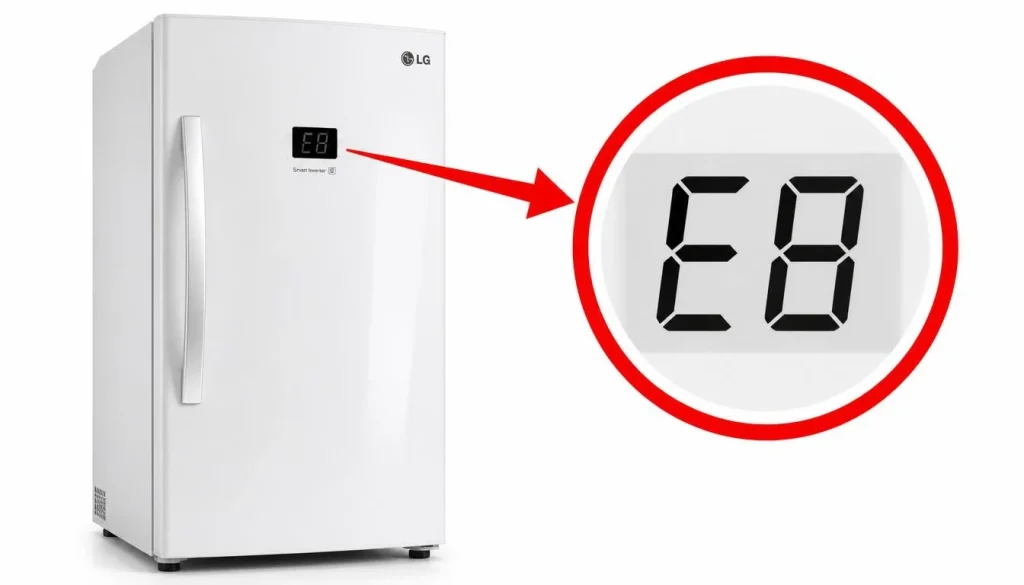
LG Refrigerator E8 Error: Conflicting Codes Explained
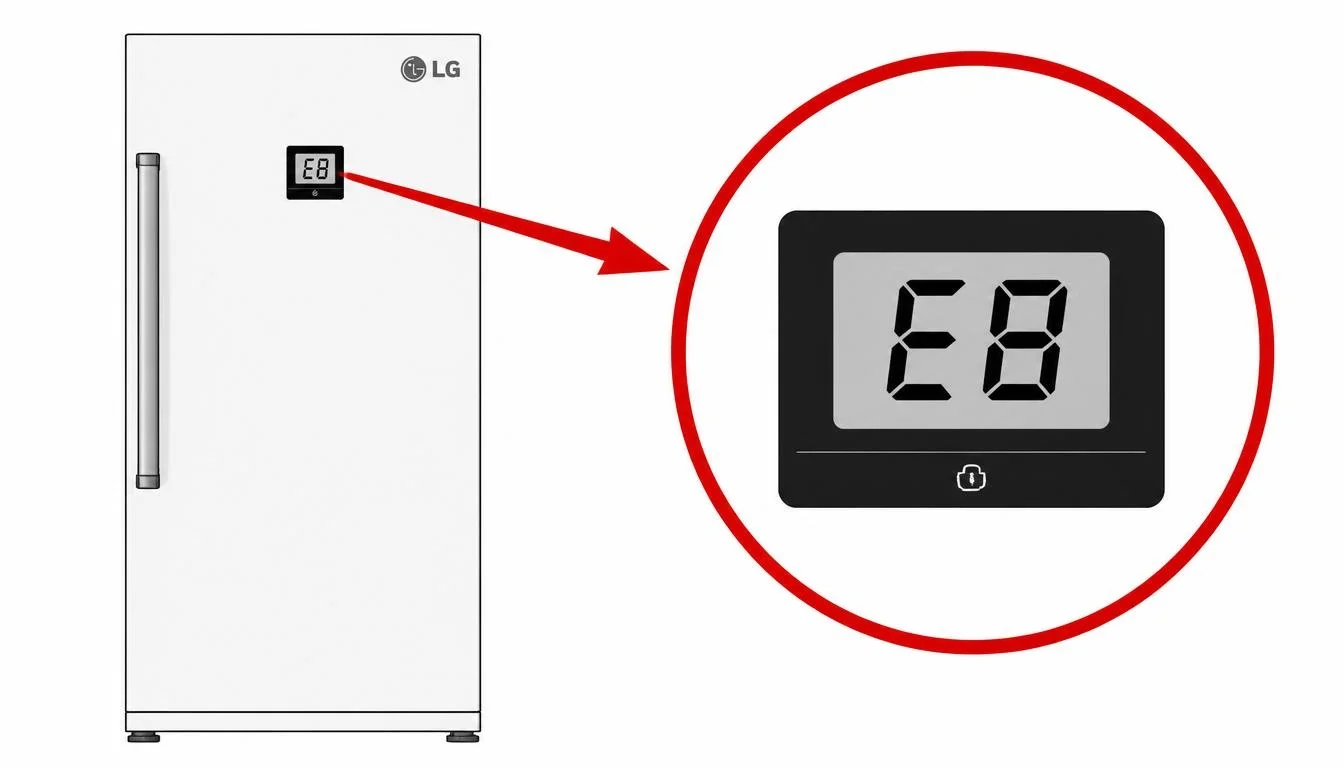
The LG refrigerator E8 error is a code without a single, authoritative definition in LG’s consumer-facing documentation. The two sources supplied for this article demonstrate the gap directly. The first source is LG’s official “Digital and Analog Error Codes” page, which lists codes such as CF, CO, FF, FS, FU, and the full range of sensor and communication faults, but does not include an E8 entry in its rendered content. The second source is an LG Parts refrigerator error code list, which covers EFS, ErS, ESS, EIS, FdS, Ert, EHS, EId, and other sensor and ice-maker codes, but also does not include an E8 entry.
The LG refrigerator E8 error therefore cannot be defined from a single LG page or a single parts list. Its meaning must be assembled from repair literature and regional error tables, and those sources do not agree. Some describe E8 as a defrost system fault. Others describe it as a zero-crossing detection failure. A Persian repair source lists E8 as a solenoid valve problem. A Turkish source associates it with the ice-maker motor or sensor. A French page describes it as a freezer defrost fault. An English repair database describes it as a freezer door contact fault. Each description is a documented interpretation for some LG refrigerator, and none of them can be presented as the universal meaning of the code.
This article explains why the E8 code is ambiguous, what each source says about it, the difference between the codes that LG documents clearly and the E8 code that it does not, the reset procedure that applies regardless of the specific interpretation, the safety warnings that accompany any internal refrigerator fault, and the practical approach a user should take when the code appears. The article is deliberately transparent about the limits of the available documentation, because inventing a single definition for E8 would misrepresent what the sources actually say.
Why the E8 Code Is Ambiguous
The LG refrigerator E8 error is ambiguous for three structural reasons, and understanding them explains why the sources conflict.
The first reason is that LG’s error code assignments are model-dependent. LG produces refrigerators across many platforms, generations, and regions, and the same numeric code can be assigned to different conditions on different platforms. A code that means “defrost fault” on one model family can mean “solenoid valve issue” on another, because the control board’s diagnostic logic is written for the specific hardware configuration of that model.
The second reason is that LG’s consumer-facing documentation does not cover every code. LG publishes detailed support pages for the codes that generate the most service calls—CF, CO, FF, FS, and the other high-frequency codes—but it does not publish a dedicated page for every numeric code in its library. The E8 code falls into the gap between the fully documented codes and the codes that appear only in regional error tables or service manuals.
The third reason is that repair literature fills the gap inconsistently. Independent repair sources, regional LG pages, and model-specific manuals each describe E8 according to the models they have encountered, and their descriptions do not align. A user who searches for the code will find several different answers, and the sources do not cite a common authority that resolves the conflict.
What the Supplied Sources Actually Say
The two sources supplied for this article are worth examining closely, because they demonstrate why the E8 code cannot be defined from a single reference.
The First Source: LG’s Digital and Analog Error Code Page
The first source is LG’s official “Digital and Analog Error Codes” page. The page provides a comprehensive list of the codes that the refrigerator’s self-diagnosis can display. It covers the condenser fan error (CF), the communication error (CO), the freezer fan error (FF), the freezer sensor error (FS), the cycle error (FU), and a range of other sensor and component faults. It also includes the codes that do not indicate a fault, such as the demo mode display, the low ambient temperature warning (Lo), and the high ambient temperature warning (HI).
The page does not include an E8 entry. The codes that appear in its malfunction section are alphanumeric combinations that LG has chosen to document for the consumer, and E8 is not among them. The page’s general guidance for the codes it does list is to request service if the issue continues, and to perform a power reset by unplugging the refrigerator and waiting 60 seconds before reconnecting it to a direct outlet.
The absence of E8 from this page is significant. It means that LG’s own consumer documentation does not assign the code a fixed meaning, and the code’s interpretation must come from elsewhere.
The Second Source: The LG Parts Error Code List
The second source is an LG Parts refrigerator error code list. The page covers a wide range of sensor and component faults, including the freezer sensor defect (EFS), the refrigerator sensor defect (ErS), the pantry sensor defect (ESS), the ice-room sensor defect (EIS), the freezer defrosting sensor defect (FdS), the room temperature sensor defect (Ert), the humidity sensor defect (EHS), and several ice-maker sensor and motor defects (EId, EIO, EIt, EIU, EIC, EgF). Each entry describes a short circuit, disconnection, or malfunction, with causes and solutions such as checking the wiring, replacing the sensor, and resetting the appliance by unplugging it.
The page does not include an E8 entry. It lists the conditions by name rather than by code number in most of its sections, and the codes that do appear do not include E8. The page is therefore useful as a general reference for refrigerator sensor faults, but it does not define the LG refrigerator E8 error.
The gap in the second source reinforces the point. If LG’s own parts documentation does not list E8 among the refrigerator error codes, then the code’s meaning must come from the repair literature and the regional error tables, and those sources do not agree.
The Documented Interpretations of E8
Repair literature and regional error tables offer several interpretations of the LG refrigerator E8 error. Each is presented below as the source states it, without resolving the conflict, because the sources do not agree.
E8 as a Defrost Fault
A Chinese LG refrigerator error code list describes E8 as “除霜故障,” which translates to a defrost fault, and states that the defrost system may have a problem that requires checking the defrost heater, the defrost sensor, or the related control components. The same list assigns E7 to a communication fault and E9 to a door fault, placing E8 in the defrost family within that model’s code table.
A French repair page uses the same interpretation. It states that E8 indicates a defrost problem in the freezer compartment and instructs the technician to check the defrost sensor and replace it if it is defective. The page groups E8 with the other defrost-related codes, such as rdH, ErdH, and FdH, and treats it as a sensor-level fault within the defrost system.
E8 as a Zero-Crossing Failure
A different Chinese LG error code list describes E8 as “过零不合格,” which translates to a zero-crossing non-conformance or zero-crossing failure. The same list assigns E6 to an over-temperature alarm and E7 to a communication fault, and it does not describe E8 as a defrost or sensor fault. The zero-crossing interpretation points to the control board’s power supply circuit rather than to a sensor or a heater.
E8 as a Solenoid Valve Fault
A Persian LG refrigerator error list describes E8 as “مشکل در شیر برقی,” which translates to a solenoid valve problem. The same list assigns E5 to the condenser fan, E6 to the defrost heater, and E7 to the thermostat, and it places E8 in the valve position within that model family’s code table. The solenoid valve interpretation points to the refrigerant flow control rather than to the defrost or power supply circuits.
E8 as a Condenser Fan Motor Fault
The LG Poshtiban error table, a Persian-language LG reference, lists E8 as “condensor fan motor” in its side-by-side code table. The same table lists Er CF as the condenser fan error and E8 as the condenser fan motor, which creates an overlap between the two codes in that model’s documentation. Tehran Service also states that E8 relates to the condenser fan in some LG refrigerator models.
E8 as a Freezer Door Contact Fault
Codeserreur, an English-language appliance error code database, describes LG E8 as a “Freezer door contact fault” and lists component fatigue, sensor feedback out of tolerance, wiring harness connector discontinuity, and electronic control board glitch among the underlying causes. The same database provides a diagnostic sequence that includes disconnecting the mains power, inspecting the wire harness and edge connectors, and resetting the board.
E8 as an Ice-Maker Motor or Sensor Fault
A Turkish repair page describes E8 on LG refrigerators with the Linear Cooling system as a communication error involving the ice-maker motor or the ice sensor, and it advises checking for an obstruction in front of the ice-maker arm. This interpretation is model-specific and appears in a regional repair source rather than in LG’s official documentation.
E8 as a Low Gas Pressure or Power Supply Issue
An Arabic appliance Q&A page lists E8 as a “gas pressure low” fault, and a German repair page describes the E08 variant as a power supply issue in which the refrigerator detects a mains voltage that is too low or unstable. These interpretations are the least common in the sources reviewed, and they appear in general troubleshooting pages rather than in model-specific LG documentation.
What the Interpretations Have in Common
The interpretations do not share a single component, but they share a structural feature: E8 is consistently treated as a fault code rather than a notification or a mode setting. None of the sources describes E8 as a Child Lock indicator, a demo-mode display, or a Cool Dry notification. The code appears when the refrigerator’s self-diagnosis has detected a condition that requires attention, and the specific condition depends on the model and the source.
The Reset Procedure That Applies to All Interpretations
Regardless of which interpretation applies to a specific refrigerator, the first response to the LG refrigerator E8 error is a power reset. LG’s general refrigerator error code guidance uses a standard procedure: unplug the refrigerator from the wall outlet, wait about 60 seconds, and plug it back into a direct outlet without extension cords or power strips.
Repair guidance for the E-series codes sometimes extends the wait. Codeserreur recommends disconnecting the 230V mains power for 3 minutes, then pressing Power to turn the unit off, unplugging the mains cable for 5 minutes, holding the Start/Pause button for 10 seconds to discharge the board capacitors, and restarting.
The purpose of the reset is the same in every interpretation. The control board and the connected components discharge and re-initialize, and if the code was caused by a transient power or communication glitch, the reset may clear it. If the LG refrigerator E8 error clears and does not return, the cause was likely transient. If the code returns immediately or after a short period, a persistent condition is present, and the service path applies.
The reset should not be repeated indefinitely. One reset is the documented step. A code that returns after one reset is a code that requires diagnosis, not a code that requires another reset.
What to Do When the E8 Code Returns
If the LG refrigerator E8 error returns after the reset, the next step depends on the interpretation that matches the model and the symptoms.
If the refrigerator is not cooling in the freezer compartment and frost is visible on the evaporator, the defrost interpretation is relevant. The user-level response is the natural thaw procedure that LG documents for defrost codes: move the food, unplug the refrigerator, open the doors wide, and wait for the ice to melt. If the code returns after a full thaw, the defrost heater, defrost sensor, or main board requires service.
If the refrigerator is cooling normally but the display shows E8 and the controls behave erratically, the zero-crossing or communication interpretation is relevant. The code may indicate a fault in the control board’s power supply circuit, and the service diagnosis focuses on the board and its power components.
If the refrigerator is cooling unevenly or the condenser area is unusually hot, the condenser fan interpretation is relevant. The user should check that the area around the back and bottom of the refrigerator is clear and that the condenser coils are not covered in dust. If the code persists, the condenser fan motor requires service.
If the ice maker is not working and the display shows E8, the ice-maker interpretation is relevant. The user should check the ice-maker arm for obstructions and confirm that the ice bucket is properly seated. If the code persists, the ice-maker motor or sensor requires service.
If the freezer door does not seal properly or the door contact is suspected, the door contact interpretation is relevant. The user should check the door gasket for tears or debris and confirm that the door closes fully. If the code persists, the door switch or its wiring requires service.
In every case, the model’s own manual is the authority. LG’s error code assignments vary by model, and the manual for the specific refrigerator states which meaning applies to that machine.
Safety Warnings for the E8 Code
The LG refrigerator E8 error involves the refrigerator’s internal electronics, sensor circuit, or cooling system, and the safety warnings that apply to refrigerator repairs apply here. LG’s general error code guidance states that users should not disassemble the refrigerator or replace internal parts themselves, because doing so may cause fire, electric shock, serious injury, or death. The same guidance states that if the error code persists, the user should stop using the refrigerator and contact LG Support for service.
Codeserreur reinforces the same safety protocol: always disconnect the appliance from the mains power before opening panels, use a CAT III multimeter for circuit testing, verify zero voltage at the test points, and allow hot water or heating elements to cool below 30°C before handling.
These warnings are not boilerplate. The E8 interpretations that involve the control board, the sensor wiring, the defrost circuit, or the solenoid valve all require access to internal components that carry line voltage or are connected to the sealed system. A user who opens the panels or attempts a component replacement without the correct procedure is exposed to real hazards.
When the E8 Code Requires Service
The LG refrigerator E8 error requires service when the reset does not clear it and the symptoms point to a component that the user cannot replace. The specific conditions depend on the interpretation that applies, but the general threshold is the same: a persistent code after a single reset is a service matter.
Service is the appropriate next step under the following conditions. If the refrigerator is not cooling and the defrost-related checks do not resolve the problem, the defrost heater, sensor, or board may be involved, and that requires a technician. If the zero-crossing or communication fault persists after the reset, the control board requires diagnosis. If the condenser fan is suspected and the coil-cleaning and clearance checks do not resolve the code, the fan motor requires service. If the ice maker is not working and the obstruction check does not resolve the code, the ice-maker motor or sensor requires service. If the solenoid valve is suspected, the refrigerant circuit requires a technician.
It is also important not to continue using the refrigerator indefinitely when the LG refrigerator E8 error persists. A refrigerator that is not cooling correctly can put the food at risk, and a defrost fault can lead to frost accumulation that reduces cooling performance over time. LG’s guidance is to request service, and the appliance’s own symptoms—warming compartments, frost buildup, or erratic display behavior—support that instruction.
Preventing E8 and Similar Codes
The LG refrigerator E8 error cannot always be prevented, because its causes range from sensor failures to control board faults to refrigerant circuit issues. However, a few practical measures support the reliability of the systems that produce the code.
Keeping the condenser coils clean and the area around the back of the refrigerator clear supports heat rejection and reduces the load on the condenser fan and the compressor. Checking the door seals periodically and ensuring that the doors close fully prevents the warm-air intrusion that can trigger temperature-related conditions and door-contact faults. Keeping the refrigerator on a stable power supply reduces the voltage fluctuations that can stress the control board and the zero-crossing detection circuit. Addressing a defrost-related code promptly prevents a sensor fault from interfering with the defrost cycle and producing a secondary code.
For users who have recently moved the refrigerator or had it serviced, the connector observation is worth noting. A connector disturbed during a repair or a move can produce a sensor or communication code. This is not a user repair step; it is information that helps the service diagnosis.
Quick Reference Table
| Interpretation | What It Suggests | What To Do |
|---|---|---|
| Defrost fault | The defrost system is not completing its cycle | Perform the natural thaw; request service if it returns |
| Zero-crossing failure | Control board power supply circuit fault | Request service for board diagnosis |
| Solenoid valve fault | Refrigerant flow control issue | Request service for valve diagnosis |
| Condenser fan motor fault | Heat rejection problem | Clean the coils and clear the area; request service if it persists |
| Freezer door contact fault | Door switch or wiring issue | Check the door seal and closure; request service if it persists |
| Ice-maker motor or sensor fault | Ice-maker communication or mechanical issue | Check the ice-maker arm and bucket; request service if it persists |
| Code persists after reset | Persistent component or system fault | Stop using the refrigerator and contact LG Support |
Frequently Asked Questions
?What does the LG refrigerator E8 error mean
There is no single, authoritative LG definition for the refrigerator E8 code. Repair literature and regional error tables describe it variously as a defrost fault, a zero-crossing failure, a solenoid valve problem, a condenser fan motor fault, a freezer door contact fault, and an ice-maker fault. The meaning depends on the specific model.
?Why do the sources disagree about E8
Because LG’s error code assignments are model-dependent, and LG does not publish a dedicated consumer support page for every numeric code. The E8 meaning is assembled from regional error tables and repair literature, and those sources describe different models with different diagnostic logic.
?Can I fix the LG refrigerator E8 error myself
The only user-level step is the power reset: unplug the refrigerator, wait about 60 seconds, and plug it back into a direct outlet. If the code returns, the remaining causes are internal component or system faults that require service.
?How do I reset the LG refrigerator E8 error
Unplug the refrigerator from the wall outlet, wait about 60 seconds, plug it back into a direct outlet without extension cords or power strips, and check whether the code has cleared.
?What should I do if E8 returns after the reset
If the code returns after the reset, LG’s general guidance is to stop using the refrigerator and contact LG Support for service. The specific diagnostic path depends on which interpretation matches the model and the symptoms.
?Does E8 affect both the freezer and the refrigerator compartment
It depends on the interpretation. The defrost interpretation relates to the freezer compartment. The condenser fan and solenoid valve interpretations can affect the whole appliance’s cooling. The door contact and ice-maker interpretations relate to specific components. The model’s manual and the observed symptoms determine the scope.
?Is it safe to keep using the refrigerator with E8 showing
LG’s general guidance is to minimize use and contact service if the code persists, because the refrigerator may not be able to control its internal systems correctly.
?Can I disassemble the refrigerator to check the E8 fault myself
No. LG warns that users should not disassemble the refrigerator or replace internal parts, because doing so may cause fire, electric shock, serious injury, or death.
?When should I call a technician for the E8 error
Call for service if the E8 code persists after the reset, if the refrigerator is not cooling, if frost is visible on the evaporator, or if the display or controls are not working correctly.
?Where can I confirm the E8 meaning for my model
The manual for the specific refrigerator model is the authoritative source. LG’s regional error code pages and the model’s service documentation state which meaning applies to that machine.
