


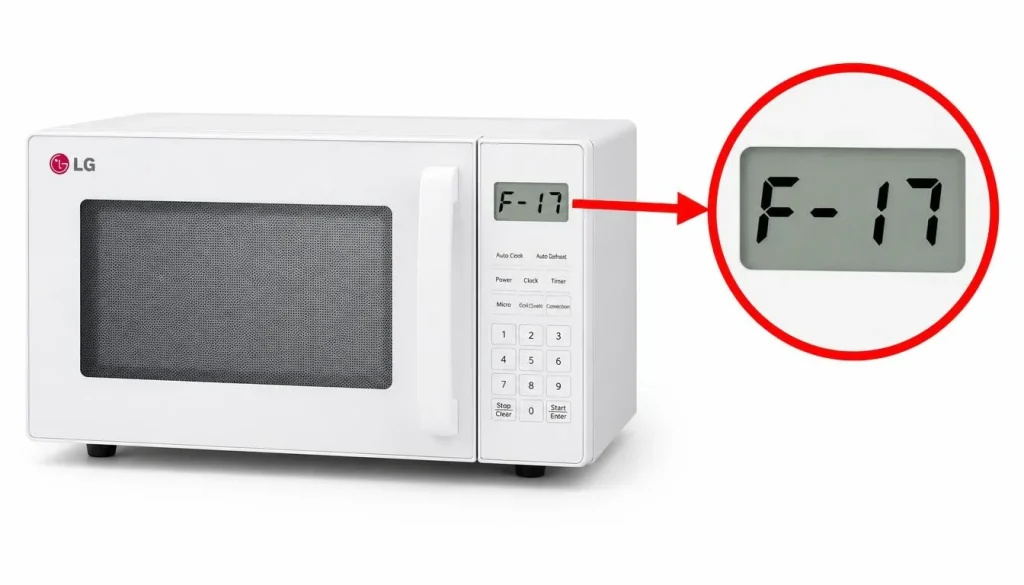
LG Microwave F-17 Error: Inverter Sensor Fix Guide
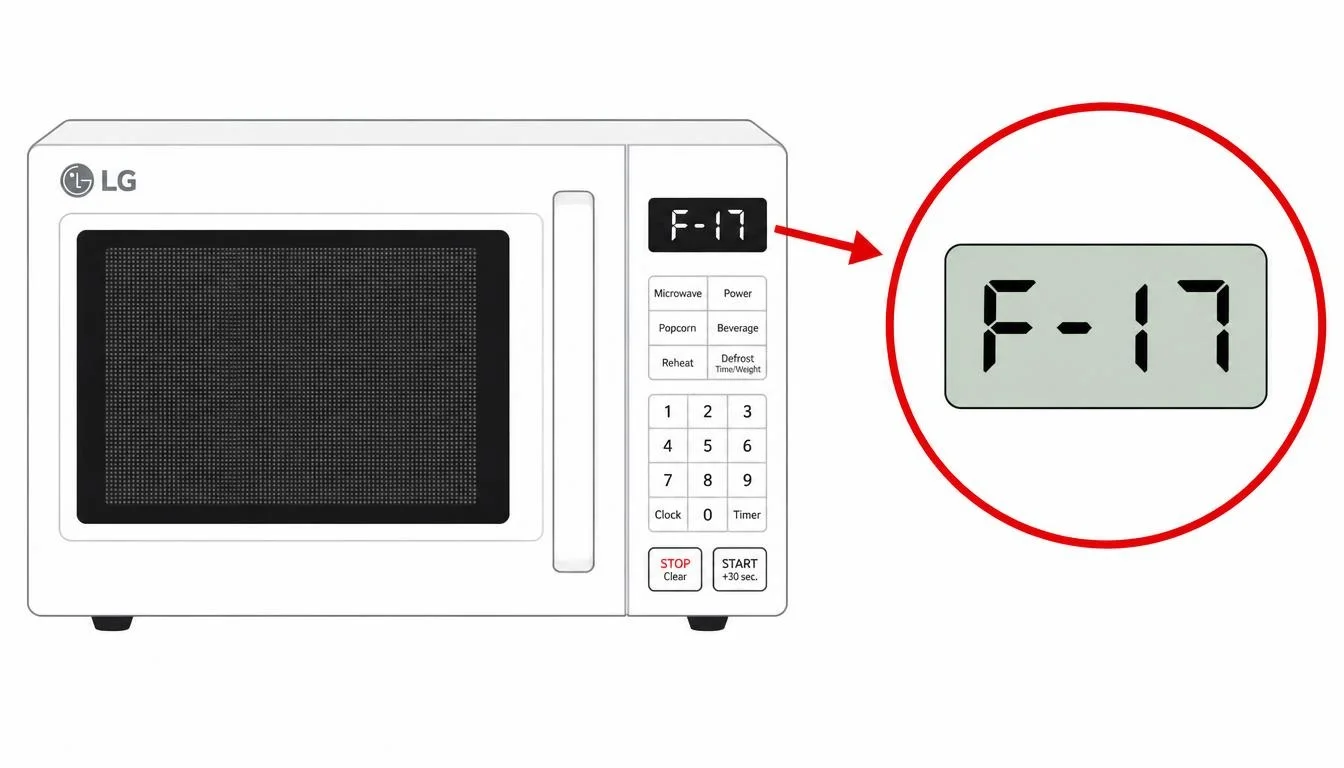
When F-17 appears on an LG microwave display, the appliance is reporting a fault in the temperature sensor that monitors the inverter board—the component that drives the magnetron in an inverter microwave. The LG microwave F-17 error is therefore a sensor-level fault in the inverter circuit, not a magnetron failure, a door-switch problem, or a general control-board breakdown. LG’s regional error documentation describes the code as a temperature sensor problem, and dedicated repair guidance identifies it specifically as an inverter temperature sensor error.
The inverter is the board that converts the incoming power into the high-frequency drive that the magnetron needs, and it generates heat during operation. The inverter temperature sensor monitors that heat so the control board can regulate cooling and protect the inverter from overheating. When the sensor fails—whether it drifts out of calibration, loses thermal contact, or develops an intermittent connection—the control board cannot confirm that the inverter is operating within safe temperature limits, and it posts F-17 rather than continuing to run the magnetron without thermal supervision.
A note on sourcing is necessary before proceeding. The two links supplied for this article do not contain usable F-17 troubleshooting content. The first link is an LG Egypt support page for the F-17 code, but its rendered content displayed only a login and OTP prompt, with no troubleshooting text. The second link is an LG USA range error code list for cooking appliances, and it does not cover microwave-specific F-17 codes or definitions. The microwave-specific F-17 information in this article is therefore drawn from LG’s regional error documentation and from dedicated microwave repair guides, which are identified as repair guidance rather than LG’s consumer support pages.
This article explains what the LG microwave F-17 error means, how it differs from the related F-16 code, the causes repair guidance identifies, the reset procedure that should be attempted first, the diagnostic steps a technician follows, the safety rules that apply to microwave repairs, the circumstances in which the microwave requires professional service, and the practical measures that reduce the chance of a recurrence.
?What Does the LG Microwave F-17 Error Mean
The LG microwave F-17 error means that the inverter temperature sensor has failed or is reporting an unreliable reading. The sensor is a thermistor mounted on or near the inverter board, and its job is to report the inverter’s operating temperature to the main control board. When the sensor is healthy, the board can regulate the cooling fan and the cooking cycle to keep the inverter within its safe temperature range. When the sensor fails, the board loses that thermal feedback, and it stops the microwave rather than allowing the inverter to run without supervision.
LG’s regional documentation describes the code in the same terms. The Persian LG Isfahan error table lists F-17 as a “defect in the inverter motor temperature sensor,” and states that the temperature sensor or the inverter board requires replacement. The Russian LG error guide groups F-16 and F-17 together as inverter temperature codes: F-16 is an inverter board overheat or temperature sensor fault, while F-17 is an open circuit, short circuit, or incorrect reading from the sensor.
The LG microwave F-17 error is therefore not a general “inverter failure” code in the way F-11 is. F-11 indicates a communication failure between the main board and the inverter board. F-17 indicates that the inverter’s thermal sensing has failed. The distinction matters for diagnosis: F-11 points to the data link between the boards, while F-17 points to the sensor that monitors the inverter’s temperature.
F-17 vs. F-16 and F-11: What the Difference Tells You
The LG microwave F-17 error belongs to a family of inverter-related codes, and distinguishing it from the related codes helps confirm the diagnosis.
F-16 is the inverter heat-sink error. Repair guidance describes F-16 as an “Inverter Heat Sink Error,” with the inverter, the inverter fan, and the wiring as the possible causes. The Russian guide explains that F-16 indicates an overheat condition or a fault in the inverter board’s temperature sensor, while F-17 indicates an open, short, or incorrect reading from that sensor. The two codes share the same sensor, but F-16 leans toward an overheat condition and F-17 leans toward a sensor signal fault.
F-11 is the inverter communication error. Repair guidance describes F-11 as an “Inverter Communication Error,” with the inverter, the main control PCB, and the wiring between them as the possible causes. F-17 is not a communication code; it is a sensor code. A user who sees F-17 should not assume the communication link between the boards has failed, and a user who sees F-11 should not assume the inverter sensor has failed.
The practical implication is that F-17 directs the technician to the inverter’s temperature-sensing circuit—the sensor itself, its thermal contact with the inverter, and its wiring to the control board—rather than to the data link between the boards.
Causes of the LG Microwave F-17 Error
Repair guidance identifies four causes for the LG microwave F-17 error, and the list follows the order in which a technician would check them.
Sensor Drifted Out of Calibration
The first and most common cause is a sensor that has drifted out of calibration. Years of heat cycling shift a thermistor’s resistance curve, so the sensor still reports plausible numbers that no longer match reality. The reading looks normal to the control board’s range check, but the sensor’s consistency check fails because the temperature does not move the way the firmware expects during cooking.
Sensor Lost Thermal Contact
The second cause is a sensor that has lost thermal contact with the inverter board. A clip that has relaxed or a probe that has been pushed off its seat measures the air near the surface rather than the surface itself. The sensor reports a temperature, but it is not the inverter’s temperature, and the board rejects the reading as implausible.
Intermittent Connection
The third cause is an intermittent connection. A joint that makes and breaks with vibration produces a reading that jumps around, and the board rejects the signal as unreliable rather than as out of range. This cause can be difficult to diagnose because the sensor may test normal when the microwave is stationary and fail only during operation.
Incorrect Sensor Fitted in an Earlier Repair
The fourth cause is a sensor of the wrong type fitted during an earlier repair. Thermistors of the same shape can have different resistance curves, and one substituted for another reads consistently but wrongly. This cause is rare, but it becomes relevant when a previously repaired microwave develops F-17 shortly after the repair.
A secondary interpretation appears in some repair sources: F-17 as a ventilation or fan fault. A Persian repair page describes F-17 as indicating a problem in the ventilation system or the internal fan, and advises checking the fan and cleaning the air filters and ventilation paths. This interpretation is less consistent with the inverter-sensor reading that LG’s regional documentation and the dedicated repair guides describe, but it is a documented meaning for some LG microwave models and is worth noting when the sensor checks do not reveal a fault.
The Reset Procedure: What to Try First
The first response to the LG microwave F-17 error is a power reset. Repair guidance describes the procedure: unplug the microwave from the wall outlet, wait about 60 seconds, plug it back in, and check whether the code has cleared. LG’s regional error tables use the same reset interval: disconnect the appliance from the power source for 60 seconds and reconnect it, because many of these codes are caused by momentary power fluctuations.
The purpose of the reset is to allow the control board and the inverter circuit to discharge and re-initialize. If the F-17 code was caused by a transient glitch rather than a permanent sensor fault, the reset may clear it and the microwave may resume normal operation. Repair guidance notes that if the fault comes back after one reset, the user should stop resetting it and arrange for a qualified appliance engineer to look at the microwave properly.
The reset is diagnostic as well as corrective. If the LG microwave F-17 error clears and does not return, the cause was likely transient. If the code returns immediately or part-way through a cooking cycle, a persistent sensor, thermal-contact, wiring, or board condition is present, and the service path applies. The reset should not be repeated indefinitely; one reset is the documented step, and a returning code requires diagnosis rather than another reset.
What the Technician Tests
The LG microwave F-17 error is diagnosed by checking the sensor’s resistance, its thermal contact with the inverter, and its wiring to the control board. Repair guidance describes the sequence that isolates the fault before any part is replaced.
The technician first inspects the sensor’s mounting on the inverter board. If the clip has relaxed or the probe has shifted, the sensor is measuring the air rather than the board, and reseating it may resolve the code. If the mounting is intact, the technician measures the sensor’s resistance against the model’s specification. A reading that is open, shorted, or far outside the expected range points to a failed sensor. If the sensor reads within specification but the code persists, the technician checks the wiring between the sensor and the control board for an intermittent connection, and then tests the inverter board’s sensor input circuit.
This diagnostic work is not a user procedure. The inverter board and its sensor sit inside the microwave cabinet, next to the high-voltage capacitor and the magnetron circuit, and repair guidance states explicitly that the outer casing should not be removed because the capacitor can hold a lethal charge even after the appliance is unplugged.
Safety Rules for the LG Microwave F-17 Error
The LG microwave F-17 error involves the inverter circuit and the high-voltage section of the microwave, and the safety rules for microwave repairs are strict. Repair guidance is direct: the repair itself is not a user task, and the outer casing should be left alone. A microwave holds a high-voltage capacitor that stays charged after the plug is out, so unplugging the appliance does not make the inside of it safe.
These warnings are not boilerplate. The inverter board operates at high voltage and drives the magnetron, and the capacitor in the high-voltage circuit can retain a lethal charge long after the microwave is disconnected from the wall. The temperature sensor itself operates at low voltage, but reaching it requires removing the outer casing and working in the same compartment as the high-voltage components. The F-17 code is a low-voltage sensor fault in a high-voltage environment, and that combination is why the repair is a technician’s job.
The power reset is the only user-level action that the repair guidance describes for F-17. The guidance states that there is nothing safe to try yourself beyond the reset, and that the microwave should be turned off and a qualified appliance engineer called if the code returns.
When the F-17 Error Requires Service
The LG microwave F-17 error requires service when the power reset does not clear it. LG’s documentation states that F-17 “will require service to resolve,” and the repair guidance is equally direct: if the fault comes back after one reset, stop resetting it and get a qualified appliance engineer to look at the microwave.
Service is the appropriate next step under the following conditions. If the F-17 code returns after a power reset, the inverter temperature sensor or its wiring has a persistent fault. If the microwave powers on but stops part-way through a cooking cycle with F-17, the sensor’s consistency check is failing during operation, which points to a drifted sensor or a thermal-contact problem. If the microwave displays F-17 together with F-16, the inverter is overheating as well as reporting a sensor fault, and the cooling fan and the inverter board require diagnosis. If the microwave displays F-17 together with F-11, the communication link and the sensor circuit are both suspect, and the technician should diagnose the inverter board as a whole.
It is also important not to continue using the microwave indefinitely when the F-17 code persists. The microwave may start a cooking cycle and then stop when the sensor check fails, which means the food is partially cooked and the appliance is not performing its function reliably. Addressing the code promptly restores the microwave’s cooking capability and prevents further strain on the inverter board.
Preventing the F-17 Error
The LG microwave F-17 error cannot always be prevented, because sensor drift is age-related and the inverter sensor is exposed to heat cycling during normal use. However, a few practical measures support the reliability of the inverter cooling system.
Keeping the microwave’s ventilation openings clear allows air to flow through the cabinet and cool the inverter board. Dust and debris that accumulate around the vents and the cooling fan reduce the airflow that the inverter needs, and a hotter inverter accelerates sensor drift. For over-the-range models, running the vent fan while the cooktop is on reduces the heat and grease-laden air that reach the microwave’s underside, where the inverter and the control boards are often mounted. Keeping the microwave on a stable power supply reduces the voltage fluctuations that can stress the inverter circuit and its sensor.
Quick Reference Table
| Situation or Check | What It Means | What To Do |
|---|---|---|
| F-17 appears on the display | Inverter temperature sensor fault | Unplug for 60 seconds and retest |
| Code clears after the reset | Possible transient glitch | Monitor for recurrence |
| Code returns after the reset | Persistent sensor, thermal-contact, or wiring fault | Book a repair; do not open the cabinet |
| Code appears part-way through cooking | Sensor consistency check is failing | Service diagnosis required |
| F-16 appears alongside F-17 | Inverter overheat plus sensor fault | Service diagnosis of the cooling fan and inverter |
| F-11 appears alongside F-17 | Communication fault plus sensor fault | Service diagnosis of the inverter board |
| Ventilation openings are blocked | Inverter cooling is reduced | Clear the vents and the cooling fan area |
| Microwave is over-the-range | Heat and grease exposure is higher | Run the vent fan during cooktop use |
Frequently Asked Questions
?What does the LG microwave F-17 error mean
F-17 means the inverter temperature sensor has failed or is reporting an unreliable reading. LG’s regional documentation describes it as a defect in the inverter motor temperature sensor, and the Russian LG guide groups it with F-16 as an inverter temperature code.
?Is F-17 the same as F-16
No. F-16 indicates an inverter heat-sink error or an overheat condition, while F-17 indicates an open, short, or incorrect reading from the inverter temperature sensor. The two codes share the same sensor, but F-16 leans toward an overheat condition and F-17 leans toward a sensor signal fault.
?Is F-17 the same as F-11
No. F-11 is an inverter communication error, while F-17 is an inverter temperature sensor error. F-11 points to the data link between the boards, and F-17 points to the sensor that monitors the inverter’s temperature.
?Can I fix the LG microwave F-17 error myself
The only user-level step is the power reset: unplug the microwave for about 60 seconds and plug it back in. Repair guidance states that there is nothing safe to try yourself beyond the reset, and that the microwave should be turned off and a qualified appliance engineer called if the code returns.
?How do I reset the LG microwave after an F-17 error
Unplug the microwave from the wall outlet, wait about 60 seconds, plug it back in, and check whether the code has cleared.
?What causes the LG microwave F-17 error
The causes are a sensor drifted out of calibration, a sensor that has lost thermal contact with the inverter board, an intermittent connection, and an incorrect sensor fitted during an earlier repair.
?Why does F-17 appear part-way through cooking
Because the sensor’s consistency check fails during operation. The board knows how fast the temperature should move when the fan runs and the magnetron cycles, and a sensor that fails to move when it should, or moves in a way the firmware cannot reconcile, gets rejected.
?Is F-17 worth repairing
Repair guidance describes F-17 as a sensor or inverter-board fault that requires service. The repair cost depends on whether the sensor alone has failed or the inverter board requires replacement, and a precise diagnosis is required before any part is replaced.
?Can I open the microwave to check the sensor myself
No. Repair guidance is explicit: the outer casing should be left alone, because the high-voltage capacitor holds a dangerous charge even after the plug is out. The sensor and the inverter board are internal components that require professional tools and training.
?When should I call a technician for the F-17 error
Call for service if the F-17 code persists after the power reset, or if the microwave stops part-way through a cooking cycle with F-17. LG’s documentation states that F-17 will require service to resolve.
?Does F-17 affect the magnetron
F-17 is an inverter temperature sensor fault, not a magnetron fault. The code is specific to the sensor circuit that monitors the inverter, and the magnetron and high-voltage components are not directly implicated by the F-17 definition.
?Where can I confirm the F-17 meaning for my model
The model’s owner’s manual or service manual is the authoritative source. The provided LG links did not contain usable F-17 troubleshooting content, so the definitions in this article are drawn from LG regional documentation and dedicated microwave repair guides.
