


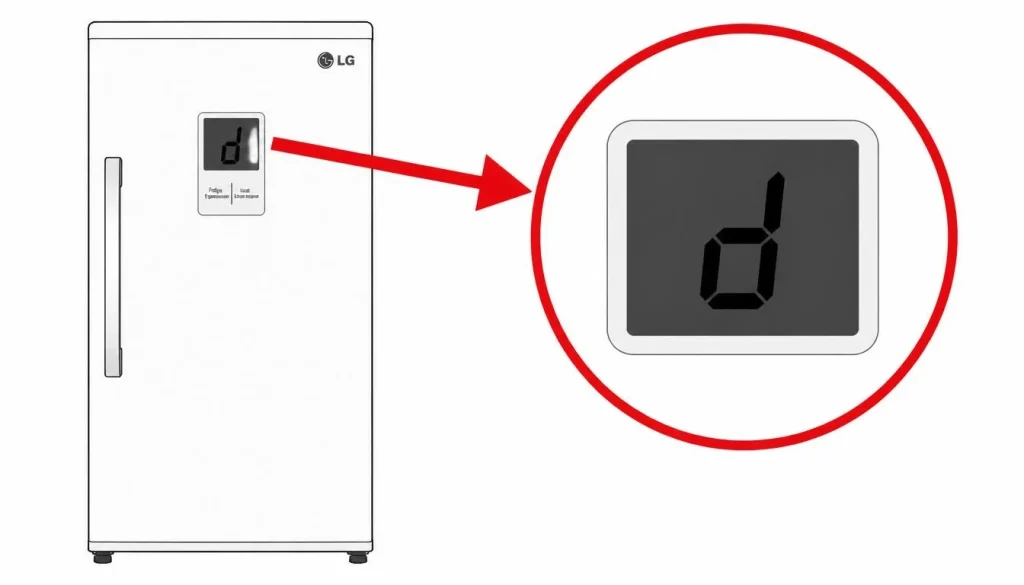
LG Refrigerator d Error: Defrost Fault Fix Guide
When a d appears on an LG refrigerator display, it belongs to the family of defrost-related codes that LG groups together under its self-diagnosis system. LG’s official error code list includes d alongside dH, d1, and d2, and describes these codes as signals that the refrigerator has detected an issue with its internal system, such as a faulty component, a control circuit problem, or a disconnected wire. The LG refrigerator d error is therefore a defrost-system alert rather than a general cooling complaint, a compressor fault, or a fan blockage.
The code points to the system that melts frost from the evaporator coils during the defrost cycle. When that system does not complete its cycle as expected, the control board posts a d code to indicate that the defrost function requires attention. The practical consequence is that frost can accumulate on the evaporator, restricting airflow and reducing the refrigerator’s cooling performance over time.
This article explains what the LG refrigerator d error means within LG’s defrost code family, how it relates to the dH, d1, and d2 codes, the causes LG identifies for defrost faults, the user-level natural thawing procedure that addresses ice-blockage cases, the safety warnings that apply, the circumstances in which professional service is required, and the observations that help a service call. All information is drawn from LG’s official support documentation.
?What Does the LG Refrigerator d Error Mean
The LG refrigerator d error means that the refrigerator has detected a problem in its defrost system. LG’s error code list includes d among the codes that appear when the refrigerator detects an issue with its internal system, and the list groups it with dH, d1, and d2—codes that all relate to the defrost function. LG describes the general cause of this code group as a faulty component, a control circuit issue, or a disconnected wire.
The d code is not a code that identifies a single, specific part the way some other LG codes do. It belongs to the defrost-family alert group, and its meaning is that the defrost cycle is not operating as designed. The specific component involved—the heater, the sensor, the fuse, the drainage path, or the main board—must be identified through the diagnostic procedure that follows the code.
LG’s service documentation distinguishes the defrost codes by the part of the system they monitor. The dH code is a defrosting (frost removal) failure code that appears when the normal temperature of the freezer or refrigerator compartment is not detected even after a certain period of time has elapsed since defrosting started. The d1 and d2 codes are additional defrost-related variants that LG lists alongside dH and d. The single d is the shortest form of this family, and it carries the same general meaning: the defrost system has not completed its cycle as expected.
d vs. dH, d1, and d2: What the Family Tells You
The LG refrigerator d error is one member of a defrost-code family, and distinguishing it from the related codes helps confirm the diagnosis.
The dH code is the most fully documented defrost code in LG’s public support pages. LG states that an [F(r) dH] appearing on the display is a defrosting failure error code that requires a product inspection. The code is a freezer defrosting or refrigerator defrosting failure caused by ice accumulation, a blocked drainage hole, a temperature fuse disconnection, a heater disconnection, or a main PCB failure. It is displayed when the normal temperature of the freezer or refrigerator compartment is not detected after a certain period since defrosting started.
The d1 and d2 codes are additional variants that LG lists alongside dH and d, and they relate to the same defrost system. LG’s public pages do not provide separate component-level definitions for d1 and d2 in the same way they do for dH, and the troubleshooting for the family follows the same general path.
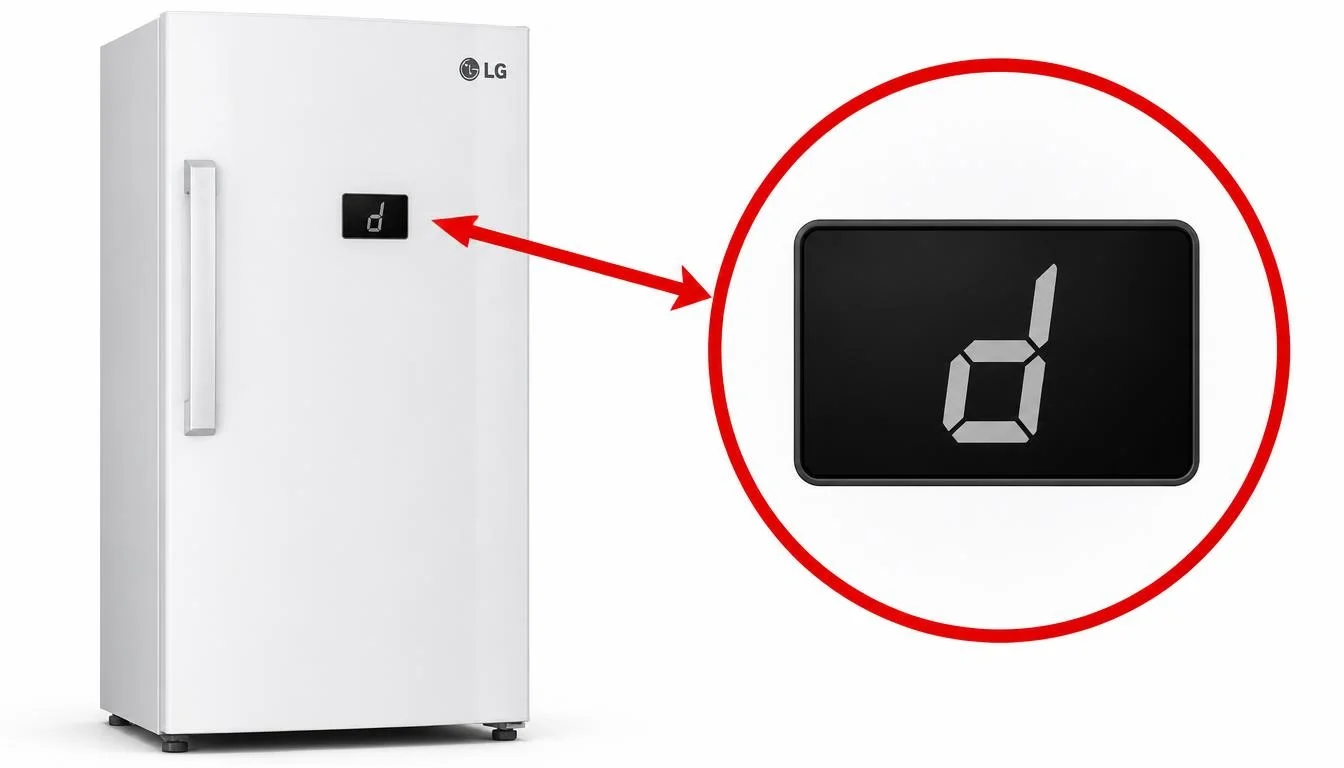
The single d is the shortest form of the family. It appears on models whose display shows only one letter, and it carries the same meaning as the longer formats: the defrost system has not completed its cycle as expected. A user who sees d should follow the same procedure as a user who sees dH, because LG does not distinguish the troubleshooting by display format.
Causes of the LG Refrigerator d Error
LG’s documentation identifies five causes for the defrost-failure family that includes the LG refrigerator d error, and each affects the defrost system at a different point.
Ice Accumulation Blocking the Drainage Hole
The first cause is ice accumulation that blocks the drainage hole. LG states that if the drainage hole in the freezer or refrigerator compartment is blocked with ice and water from the frost does not flow to the drain tray, the normal temperature will not be detected, and the error may be displayed. During defrost, melted frost must drain away through the hole. If the hole is blocked, the water refreezes around the evaporator, and the defrost sensor never reaches its target temperature.
A Blown Temperature Fuse
The second cause is a blown temperature fuse. LG lists a temperature fuse disconnection among the causes of the defrost failure. The thermal fuse is a safety component that interrupts the heater circuit if it overheats. Once it blows, the heater cannot energize, and the defrost cycle cannot raise the temperature.
A Failed Defrost Heater
The third cause is a failed defrost heater. LG lists heater disconnection among the causes. The heater may have an open element, a broken connection, or a control relay that does not energize. In any of these cases, the heater does not produce the heat needed to melt the frost.
A Main PCB Failure
The fourth cause is a main PCB failure. LG lists a main board failure among the causes of the defrost failure. The control board supplies power to the defrost heater and reads the defrost sensor. If the board’s defrost output or sensor input circuit has failed, the heater may not run even though the heater and fuse are intact.
Ice Accumulation Around the Defrost Sensor
The fifth cause is ice accumulation around the defrost sensor itself. Although LG’s US page focuses on the drainage-hole mechanism, the broader defrost-system documentation notes that ice around the sensor can insulate it from the heated air, causing it to report a low temperature even when the heater is running. This is why the natural thawing procedure addresses the entire freezer compartment rather than only the drain hole.
The Natural Thawing Procedure
LG’s primary user-level remedy for defrost-failure codes, including the LG refrigerator d error, is a natural thawing procedure. The US page states that if the drainage hole is blocked with ice and the water does not flow to the drain tray, the user should disconnect the power cord, open the freezer or refrigerator compartment door wide, and wait for one day in the summer or three days in the winter for the ice to melt.
LG provides a four-step version of this procedure. First, if a spare refrigerator is available, move the food into it. Second, disconnect the power plug of the product. Third, with the freezer or refrigeration compartment door wide open, allow the ice to melt—one day in summer and three days in winter. Fourth, once the ice has melted completely, water will normally run out to the drain tray.
The duration matters. A partial thaw that leaves ice deeper in the drain path can allow the LG refrigerator d error to return as soon as the refrigerator is restarted. LG’s instruction is to leave the door open for the full period, not until the visible ice disappears. The thawing procedure addresses the ice blockage that prevents the defrost sensor from detecting the expected temperature rise. If the blockage is the only problem, the thaw clears the drain path, the sensor reads correctly on the next cycle, and the code does not return.
Safety Warnings LG Attaches to the Thawing Procedure
The LG refrigerator d error thawing procedure involves water, electricity, and a refrigerator that will be open for days. LG attaches specific warnings to the procedure, and the most important one concerns how the ice is melted.
LG’s FAQ addresses the question directly: do not use a hair dryer to melt the ice faster. The heat could warp plastic parts inside the refrigerator or create a fire hazard, and the instruction is to leave the doors open and allow the ice to melt naturally. This warning applies to the defrost-code family, and it is relevant to the LG refrigerator d error because the natural thaw is the user-level remedy.
The other practical safety consideration is the water. The melting ice will produce a significant volume of water, and the user should place towels on the floor around the refrigerator to catch it. LG’s four-step procedure notes that once the ice has melted completely, water will normally run out to the drain tray, but the user should still be prepared for water around the base of the unit.
When the d Error Requires Service
The LG refrigerator d error requires service under the condition LG states clearly: the code persists after the thawing procedure has been completed. LG’s US page states that if the same inspection code is repeated, it is necessary to have it checked by a service technician for an accurate diagnosis.
Service is the appropriate next step because the remaining causes are component-level and the repair is not user-serviceable. The defrost heater, the temperature fuse, the defrost sensor, and the main PCB are internal components, and LG’s documentation does not describe a user procedure for replacing them. A technician can test the heater for continuity, check the thermal fuse, measure the defrost sensor’s resistance, and determine whether the main board’s defrost output is functioning.
LG also provides an alternative service trigger that applies when the user is concerned about the food. The US page states that if the user is concerned about the food stored inside, it is recommended to have the product checked by a service technician by requesting a service. This means the user does not have to complete the full thaw if the food risk is unacceptable; a service request is appropriate at that point.
It is also important not to continue using the refrigerator indefinitely when the LG refrigerator d error persists. The defrost system is not completing its cycle, and frost is accumulating on the evaporator. The cooling performance of the refrigerator will decline over time, and the condition may affect the food. LG’s guidance is to request service, and the food-safety context from the thawing procedure supports that instruction.
What the User Can Observe Before Calling
LG’s public documentation does not provide user-level troubleshooting for the LG refrigerator d error beyond the thawing procedure. However, a few observations can help the user prepare for the service call and understand the code’s practical impact.
The first observation is whether frost is visibly building up in the freezer. LG’s defrost-failure documentation identifies ice accumulation as a primary cause, and visible frost is a sign that the defrost cycle is not completing. If frost is visible, the natural thaw is the appropriate first step.
The second observation is whether both compartments are cooling. If the freezer is holding temperature and the fresh-food section is cold, the defrost fault may be affecting one evaporator rather than the entire cooling system. If both compartments are warming, the defrost failure is affecting the cooling performance more broadly, and the service call becomes more urgent.
The third observation is whether the code is continuous or intermittent. A continuous d code points to a persistent defrost-system condition. An intermittent code may involve a connection or a sensor that the technician can test.
The fourth observation is whether any other codes appear alongside d. If the display shows d together with another code, the second code may point to a separate condition, and the technician should be told about both.
These observations do not replace LG’s instruction to request service if the code persists. They are the kind of information that makes the service visit more efficient and helps the user decide how urgently to act.
Preventing Defrost-Related Codes
LG’s documentation does not include a dedicated prevention section for the LG refrigerator d error, but its causes point to practical measures. Keeping the freezer and refrigerator compartments free of excessive frost buildup reduces the ice that can block the drain hole. Ensuring that the drain hole is clear during routine cleaning allows melted frost to flow to the drain tray as designed. Addressing a defrost sensor code promptly prevents a sensor fault from interfering with the defrost cycle and producing a secondary d code.
The most important preventive measure is to complete the natural thaw fully when the code first appears. LG specifies one day in summer and three days in winter for the ice to melt. Shortening the thaw because the visible ice has melted can leave ice deeper in the drain path, and the LG refrigerator d error can return. Following the full duration is the difference between a one-time code and a recurring one.
Quick Reference Table
| Display or Situation | What It Means | LG’s Documented Action |
|---|---|---|
| d appears on the display | Defrost system alert | Unplug and perform the natural thaw |
| dH appears instead of d | Defrosting failure; temperature not detected after defrosting started | Follow the same natural thaw procedure |
| d1 or d2 appears instead of d | Additional defrost-related variants | Follow the defrost-family troubleshooting |
| Ice is visible around the drain hole | Drain blockage may be preventing the temperature rise | Unplug, open the door wide, and thaw for 1 day in summer or 3 days in winter |
| Code clears after a full thaw and does not return | The cause was an ice blockage | Monitor for recurrence |
| Code returns after a full thaw | Heater, fuse, sensor, or main board fault is likely | Request service for an accurate diagnosis |
| Food cannot be moved for the thaw | Thawing may risk the food | Request service instead of unplugging for days |
| User considers using a hair dryer | Accelerated melting method | Do not use a hair dryer; allow natural thawing |
Frequently Asked Questions
?What does the LG refrigerator d error mean
The d code is part of LG’s defrost-error family. LG lists d alongside dH, d1, and d2 as codes that appear when the refrigerator detects an issue with its internal system, such as a faulty component, a control circuit, or a disconnected wire.
?Is d the same as dH
They belong to the same defrost-error family. The dH code is the most fully documented variant, described as a defrosting failure caused by ice accumulation, a blocked drain hole, a fuse disconnection, a heater disconnection, or a main board failure. The single d is the shortest form of the same family and follows the same troubleshooting path.
?What causes the LG refrigerator d error
LG identifies ice accumulation, a blocked drainage hole, a temperature fuse disconnection, a heater disconnection, and a main PCB failure as the causes of the defrost-failure family that includes d.
?Can I fix the LG refrigerator d error myself
The user-level procedure is the natural thaw: move the food to a spare refrigerator, unplug the refrigerator, open the door wide, and wait one day in summer or three days in winter for the ice to melt. If the code returns after a full thaw, LG directs the user to service.
?How long does the natural thaw take
LG specifies one day in summer and three days in winter for the ice to melt.
?Can I use a hair dryer to melt the ice faster
No. LG’s guidance for defrost codes states that a hair dryer should not be used because the heat could warp plastic parts or create a fire hazard. The instruction is to allow the ice to melt naturally.
?What should I do with my food during the thaw
LG advises moving the food to a spare refrigerator before starting the thaw. If the food cannot be moved or spoilage is a concern, LG recommends requesting service instead of proceeding with the thaw.
?What should I do after the ice melts
Once the ice has melted completely, water will normally run out to the drain tray. Wipe the interior dry, plug the refrigerator back in, and allow time for the compartments to return to their normal temperatures.
?Why does d return after a thaw
A returning d code indicates that the defrost system itself is not working: the heater, fuse, sensor, or main board may have failed. LG states that if the same inspection code is repeated, the product should be checked by a service technician.
?Does d affect both the freezer and the refrigerator compartment
The defrost-failure family relates to the defrost system of the freezer or refrigerator compartment, depending on the model and the specific variant. LG’s documentation describes dH as a freezer or refrigerator defrosting failure.
?When should I call a technician for the d error
Call for service if the d code persists after a complete thaw of one day in summer or three days in winter, or if the food cannot be protected during the thaw. LG’s guidance is to request service for an accurate diagnosis.
?Where can I confirm the d meaning for my model
LG notes that its guide was created for all models and that images or content may differ from the product. The manual for your specific refrigerator is the authoritative source for the display format and service procedure.
