


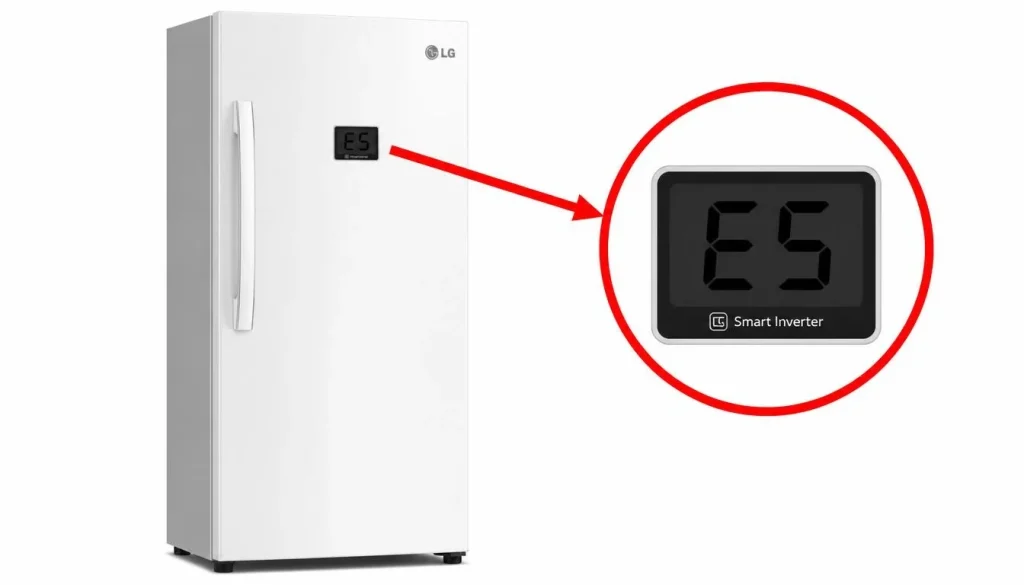
LG Refrigerator E5 Error: Defrost Sensor Fix Guide
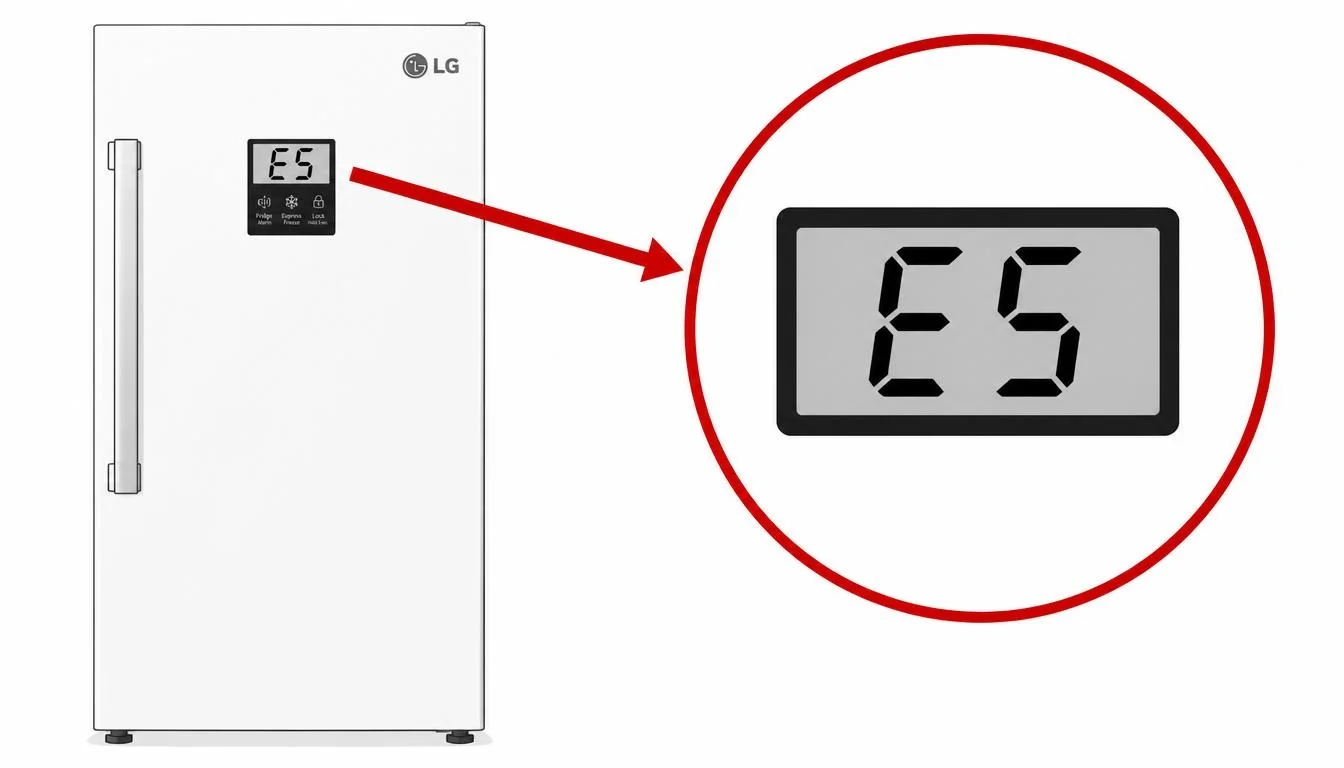
When E5 appears on an LG refrigerator display, the machine is reporting a fault in its temperature-sensing or defrost system, but the exact meaning depends on the model generation and the source consulted. The most consistent interpretation across repair documentation is that E5 indicates a defrost sensor fault—the sensor that monitors the evaporator temperature and signals the control board when the defrost heater should stop. A Persian LG repair source states directly that E5 in LG refrigerators relates to the defrost sensor, which sends the evaporator temperature to the main electronic board and initiates the defrost process. Another Persian source lists E5 as a defrost sensor fault alongside the refrigerator and freezer sensor codes.
The LG refrigerator E5 error is therefore a sensor-level fault, not a compressor failure, not a fan blockage, and not a communication error in the way CO or Od are. The defrost sensor is the component that tells the board how cold the evaporator is during the defrost cycle. When that sensor fails or sends an out-of-range signal, the board cannot regulate the defrost heater correctly, and it posts E5 rather than continuing to run a cycle on invalid data.
A note on sourcing is necessary before proceeding. The two sources supplied for this article—LG’s official page for the E FF/E rF freezer fan code and the LG Parts refrigerator error code list—do not contain a dedicated E5 entry. The E5 definition in this article is therefore drawn from repair sources and LG’s broader regional error code documentation, and each source is identified where it is used. Readers should confirm the E5 meaning against the manual for their specific refrigerator model, because LG’s error codes can vary by model and generation.
This article explains what the E5 code means, the conflicting interpretations that appear in repair literature, the causes identified for the defrost sensor fault, the reset procedure, the diagnostic steps that a technician follows, the safety warnings that apply, and the circumstances in which professional service is required.
?What Does the LG Refrigerator E5 Error Mean
The LG refrigerator E5 error most commonly means that the defrost sensor is malfunctioning. The defrost sensor is a thermistor mounted near the evaporator coils. It measures the temperature of the coils during the defrost cycle and reports that temperature to the main control board. When the sensor reads correctly, the board knows when the heater has melted the frost and can end the defrost cycle. When the sensor fails or drifts out of range, the board cannot confirm that the defrost cycle is working, and it posts E5.
Repair documentation describes the E5 code in slightly different terms depending on the source. Codeserreur describes E5 as a “Lower compartment air sensor fault” and lists component fatigue, sensor feedback out of tolerance, wiring harness connector discontinuity, and electronic control board glitch as the root causes. A Chinese LG error code list describes E5 as a “refrigerator evaporator sensor fault” and states that the sensor may be damaged and may need to be replaced. Another Chinese source lists E5 as an “E2PROM read/write fault,” which is a different interpretation entirely and points to the memory chip on the control board rather than the defrost sensor.
The practical implication is that E5 is not a single, universal definition. On most LG refrigerators, the defrost sensor interpretation is the one that repair technicians work with, and it is the interpretation that aligns with the code’s position in the E-series sensor family. But a user who sees E5 should be aware that some model families assign the code differently, and the model’s own documentation is the final authority.
The Defrost Sensor: What It Does and Why It Fails
The defrost sensor is one of several thermistors in an LG refrigerator, and its role is specific to the defrost cycle. During normal cooling, frost builds up on the evaporator coils as the refrigerant absorbs heat from the compartments. Periodically, the refrigerator runs a defrost cycle: the defrost heater warms the coils to melt the frost, and the defrost sensor measures the coil temperature to determine when the cycle should end.
When the defrost sensor fails, the control board loses its ability to confirm that the defrost cycle is working. The heater may still run, but the board does not know when to stop it, or the board may prevent the heater from running at all because it cannot verify the sensor’s signal. In either case, the frost can accumulate, and the cooling performance of the refrigerator declines over time.
Repair sources describe the failure modes in practical terms. The sensor can fail open, which breaks the circuit and leaves the board with no signal. It can fail short, which produces a fixed low resistance that the board interprets as a fault. It can drift out of tolerance, which produces plausible but incorrect readings that gradually degrade the defrost cycle. And the wiring harness or connector between the sensor and the board can develop a discontinuity, which produces the same missing signal as a failed sensor.
Conflicting Interpretations in Repair Literature
The LG refrigerator E5 error is one of the codes where repair literature is not fully consistent, and understanding the variations helps a user interpret what they find online.
The defrost sensor interpretation is the most common in Persian-language LG repair sources and in Chinese-language error code lists that describe E5 as an evaporator sensor fault. The Persian source states that E5 relates to the defrost sensor and that the sensor sends the evaporator temperature to the main board and initiates defrost. The Chinese source describes E5 as a refrigerator evaporator sensor fault and states that the sensor may need to be replaced.
The E2PROM interpretation appears in a different Chinese source, which lists E5 as an E2PROM read/write fault rather than a sensor fault. This interpretation points to the memory chip on the control board, and it is a board-level fault rather than a sensor-level fault. It is less common in the repair guidance that focuses on the E-series sensor codes, but it is a documented interpretation for some LG model families.
The communication interpretation appears in a Chinese appliance repair Q&A, which states that E5 indicates a control board communication interruption and that the code appears when the board cannot exchange data with another module. This interpretation overlaps with the CO code’s territory, and it is not the primary meaning assigned to E5 in the defrost-focused sources.
The practical takeaway is that a user who sees E5 should treat the defrost sensor interpretation as the starting point, because it is the most widely documented and the most consistent with the code’s position in the E-series family. If the defrost sensor and its wiring test good and the code persists, the E2PROM or communication interpretations become relevant, and the technician should be told about the conflicting possibilities.
Causes of the LG Refrigerator E5 Error
The causes of the LG refrigerator E5 error follow from the defrost sensor interpretation, with the secondary interpretations adding board-level and communication-level possibilities.
A Failed Defrost Sensor
The most direct cause is a failed defrost sensor. The thermistor can fail open, fail short, or drift out of tolerance, and in each case the control board receives an invalid or missing signal and posts E5. This is the cause that the defrost-focused repair sources identify first.
A Loose or Corroded Connector
The second cause is a loose or corroded connector between the defrost sensor and the main control board. Repair guidance identifies wiring harness connector discontinuity as a root cause of E5, and notes that oxidation or loose pins can interrupt the sensor signal. The connector is the first thing a technician checks, because it can be reseated or cleaned without replacing the sensor.
Wiring Harness Damage
The third cause is damage to the wiring harness itself. The wires that carry the defrost sensor signal run through the refrigerator cabinet and the evaporator area, and they can be damaged by vibration, heat, or moisture. A broken conductor or a chafed insulation produces the same missing signal as a failed sensor, and the E5 code appears.
A Control Board Glitch or E2PROM Fault
The fourth cause is a control board issue. Repair guidance identifies an electronic control board glitch as a root cause of E5, and a separate Chinese source lists E2PROM read/write fault as the E5 definition for some models. If the board’s sensor input circuit or its memory chip has failed, the board may post E5 even though the sensor and wiring are intact.
A Temporary Power or Communication Glitch
The fifth cause is a temporary glitch. A power surge, a voltage dip, or a brief interruption can disrupt the sensor signal or the board’s processing, and the E5 code can appear even though no component has permanently failed. This is why the reset procedure is the first step: it rules out the transient condition before any part is suspected.
The Reset Procedure: What to Try First
The first response to the LG refrigerator E5 error is a power reset. Repair guidance describes a procedure that discharges the control board and clears temporary memory errors: disconnect the refrigerator from the mains power for about 3 minutes, then press the power button to turn it off, unplug the mains cable for 5 minutes, press and hold the Start/Pause button for 10 seconds to discharge the board capacitors, and restart.
LG’s general refrigerator error code guidance uses a shorter interval: unplug the refrigerator, wait about 60 seconds, and plug it back into a direct outlet without power strips or multiple sockets. The same guidance states that if the error code disappears after the reset, it may have been caused by a temporary power or communication problem, and the refrigerator can continue to be used.
The reset is diagnostic as well as corrective. If the LG refrigerator E5 error clears and does not return, the cause was likely transient. If the code returns immediately or after a short period, a persistent sensor, connector, wiring, or board condition is present, and the service path applies. The reset should not be repeated indefinitely; one reset is the documented step, and a returning code requires diagnosis rather than another reset.
Diagnostic Steps for the Defrost Sensor Circuit
If the reset does not clear the LG refrigerator E5 error, the next step is to diagnose the defrost sensor circuit. The following steps describe the technician’s sequence and require a multimeter and access to the sensor and the control board.
Step 1: Inspect the Harness and Connectors
The first check is the wiring harness and the edge connectors on the control board. Repair guidance instructs the technician to inspect the wire harness and the edge connectors on the control board for loose pins or oxidation. A connector that is not fully seated or that has corrosion on its pins can interrupt the sensor signal, and reseating or cleaning the connector may resolve the code without replacing the sensor.
Step 2: Measure the Sensor Resistance
The second check is the sensor’s resistance. The defrost sensor is a thermistor, and its resistance changes with temperature. The technician disconnects the sensor connector and measures the resistance across the sensor’s terminals, then compares the reading against the temperature-to-resistance table for the model. A reading that is open (infinite resistance) indicates a failed sensor with a broken element. A reading that is zero or near zero indicates a shorted sensor. A reading that is far outside the expected range for the ambient temperature indicates a drifted sensor. In each case, the sensor requires replacement.
Step 3: Check the Wiring Continuity
The third check is the continuity of the wiring between the sensor connector and the control board. If the sensor itself tests good but the signal does not reach the board, the wiring harness has an open circuit or a short. The technician traces the harness and checks for continuity on each conductor, and repairs or replaces the harness if a fault is found.
Step 4: Inspect the Control Board
The fourth check is the control board’s sensor input circuit. If the sensor, connector, and wiring all test good, the remaining suspect is the board itself. The technician checks the board’s sensor input for the expected voltage or resistance and determines whether the board is processing the signal correctly. If the board’s input circuit or its E2PROM has failed, the board requires replacement.
Safety Warnings That Apply to the E5 Code
The LG refrigerator E5 error involves the control board, the sensor wiring, and the defrost circuit, and the safety warnings that apply to refrigerator repairs apply here. Repair guidance states that the appliance should always be disconnected from the mains power before opening panels, and that a CAT III multimeter should be used for circuit testing. The same guidance states that the technician should verify zero voltage at the test points before touching any component, and that hot water or heating elements should be allowed to cool below 30°C before handling.
LG’s general error code guidance adds a stronger warning for the internal-fault group that includes the sensor and communication codes: do not disassemble the refrigerator or replace internal parts yourself, because doing so may cause fire, electric shock, serious injury, or death. The same guidance states that if the error code persists, the user should stop using the refrigerator and contact LG Support for service.
These warnings are not boilerplate. The defrost circuit includes the defrost heater, which draws significant current and reaches high temperatures during operation. The control board and the sensor wiring are internal, and the refrigerator contains line-voltage circuits. A user who opens the panels without disconnecting power or who handles the heater before it cools is exposed to real hazards.
When the E5 Error Requires Service
The LG refrigerator E5 error requires service when the reset does not clear it and the diagnostic steps point to a component that the user cannot replace. The defrost sensor, the wiring harness, and the control board are internal components, and LG’s public documentation does not describe a user procedure for replacing them.
Service is the appropriate next step under the following conditions. If the defrost sensor tests open, shorted, or out of tolerance, it requires replacement, and the replacement requires access to the evaporator area. If the wiring harness has an open circuit or a short, it requires repair or replacement, and the harness runs through the cabinet. If the control board’s sensor input or E2PROM has failed, the board requires replacement, and that is a board-level repair. In each case, the work requires tools, access, and electrical testing that fall outside the scope of user maintenance.
It is also important not to continue using the refrigerator indefinitely when the LG refrigerator E5 error persists. The defrost system is not being regulated correctly, and frost can accumulate on the evaporator. The cooling performance of the refrigerator declines over time, and the compressor may work harder to maintain temperature. Addressing the code promptly protects the food and the sealed system.
Preventing Defrost Sensor Faults
The LG refrigerator E5 error cannot always be prevented, because sensor failures can be age-related and the thermistor is a wear component. However, a few practical measures support the defrost circuit’s reliability.
Keeping the area around the evaporator clear of excessive frost buildup reduces the thermal cycling that the sensor experiences, and it allows the defrost heater to melt the frost within the expected window. Ensuring that the refrigerator is on a stable power supply reduces the voltage fluctuations that can stress the control board and the sensor circuit. Addressing a defrost-related code promptly prevents a sensor fault from interfering with the defrost cycle and producing a secondary code.
For users who have recently moved the refrigerator or had it serviced, the connector observation is worth noting. The wiring between the defrost sensor and the main board can be disturbed during a repair or a move, and a loose connector can produce E5. This is not a user repair step; it is information that helps the service diagnosis.
Quick Reference Table
| Situation or Observation | What It Means | What To Do |
|---|---|---|
| E5 appears on the display | Defrost sensor fault on most models; other interpretations exist | Perform a power reset first |
| E5 clears after the reset | Possible transient glitch | Monitor for recurrence |
| E5 returns after the reset | Persistent sensor, connector, wiring, or board condition | Request service for diagnosis |
| Frost is visible on the evaporator | Defrost system is not completing its cycle | Request service; do not ignore the code |
| The refrigerator is still cooling | Sensor fault may be affecting defrost only | Report this observation to the technician |
| The refrigerator is warming | Defrost fault is affecting cooling performance | Request service promptly |
| A different E-code appears | A different sensor or component fault | Follow the troubleshooting for that specific code |
| Burning smell, sparks, or breaker trip | Electrical or safety condition | Switch off at the breaker and leave it off until checked |
Frequently Asked Questions
?What does the LG refrigerator E5 error mean
The most common interpretation is a defrost sensor fault. A Persian LG repair source states that E5 relates to the defrost sensor, which sends the evaporator temperature to the main board and initiates the defrost process. Other sources describe E5 as an evaporator sensor fault, an E2PROM read/write fault, or a communication interruption depending on the model.
?Is E5 the same as dS or rS
No. dS is a freezer defrost sensor error, and rS is a refrigerator sensor error. E5 is a numeric code that is most often associated with the defrost sensor, but the exact assignment varies by model and source.
?Can I fix the LG refrigerator E5 error myself
The only user-level step is the power reset: disconnect the refrigerator from the mains for about 3 minutes, then unplug it for 5 minutes, press and hold the Start/Pause button for 10 seconds, and restart. If the code returns, the remaining causes are sensor, connector, wiring, or board faults that require service.
?How do I reset the LG refrigerator E5 error
Disconnect the refrigerator from the mains power for about 3 minutes, then press the power button to turn it off, unplug the mains cable for 5 minutes, press and hold the Start/Pause button for 10 seconds to discharge the board capacitors, and restart. LG’s general guidance uses a shorter 60-second reset into a direct outlet.
?What causes the LG refrigerator E5 error
The causes are a failed defrost sensor, a loose or corroded connector, wiring harness damage, a control board glitch or E2PROM fault, and a temporary power or communication glitch.
?How does a technician test the defrost sensor
The technician inspects the harness and connectors for loose pins or oxidation, measures the sensor’s resistance against the model’s temperature-to-resistance table, checks the wiring continuity between the sensor and the board, and inspects the control board’s sensor input circuit.
?What should I do if the E5 code returns after the reset
A returning E5 code indicates a persistent condition. LG’s general guidance is to stop using the refrigerator and contact LG Support for service, and repair guidance directs the user to a technician for sensor, wiring, and board diagnosis.
?Is it safe to keep using the refrigerator with E5 showing
The defrost system is not being regulated correctly, and frost can accumulate on the evaporator. The cooling performance declines over time, and the compressor may work harder. LG’s general guidance is to minimize use and contact service if the code persists.
?Can I disassemble the refrigerator to check the E5 fault myself
No. LG’s safety warning states that users should not disassemble the refrigerator or replace internal parts, because doing so may cause fire, electric shock, serious injury, or death.
?When should I call a technician for the E5 error
Call for service if the E5 code persists after the reset, if frost is visible on the evaporator, or if the refrigerator is warming. The sensor, wiring, and board are internal components that require diagnostic tools and access.
?Does E5 affect both the freezer and the refrigerator compartment
The defrost sensor is associated with the evaporator, and the effect depends on which evaporator the sensor monitors. On dual-evaporator models, the freezer and refrigerator have separate defrost circuits, and the code’s scope depends on the model.
?Where can I confirm the E5 meaning for my model
The two sources supplied for this article do not contain a dedicated E5 entry. LG’s regional error code pages and the manual for the specific refrigerator model are the authoritative sources, because the E5 assignment varies by model and generation.
